

A wedding after-party band is a live music act that performs following the main reception, delivering a focused, high-energy atmosphere for the guests who stay on to celebrate. Unlike the formal reception band, this is a specialised role. The music shifts, the crowd shrinks, and the energy changes entirely. Knowing what to expect from wedding bands in this context helps you plan smarter and spend better. Brownsugarmusic, Sydney’s resident R&B and soul band at the Marble Bar in the Hilton Sydney since 2003, has performed this role at countless weddings across Australia and beyond.
What is a wedding after-party band and how does it differ from a reception band?
A wedding after-party band is a live act booked specifically for the post-reception phase of your celebration, not as a continuation of the main event but as a distinct entertainment experience. The industry term for this format is “after-party entertainment,” and it covers everything from solo pianists and small ensembles to full live bands and live-DJ hybrid acts.
The reception band serves a broad audience. It plays across generations, accommodates formal traditions like the first dance and speeches, and keeps the programme structured. An after-party band operates without those constraints. The crowd is smaller, closer to the couple, and ready for something more personal and high-tempo.
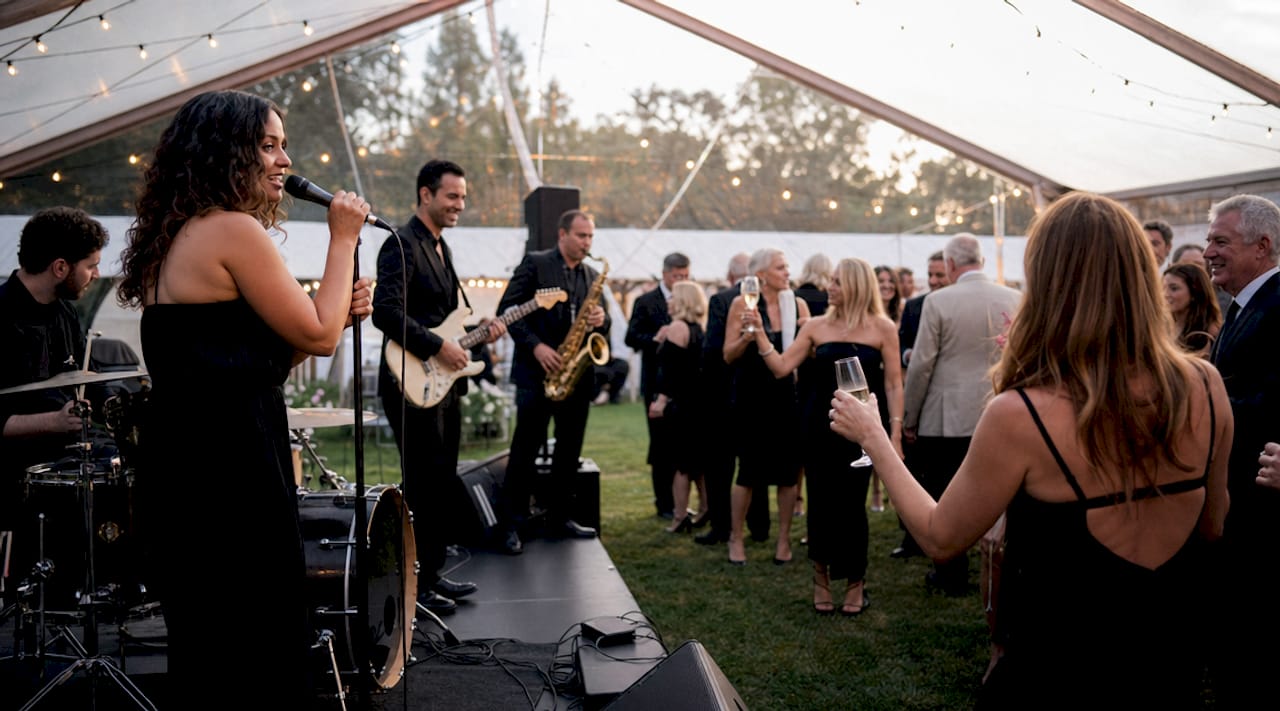
The biggest misconception couples make is treating the after-party as a smaller, identical version of the reception. It is not. The energy curve is different, the guest expectations are different, and the music freedom is far greater. A reception band might play a careful mix of Motown, pop, and ballads to keep Grandma and the teenagers both happy. An after-party band can go deep into R&B, soul, funk, or club music without compromise.
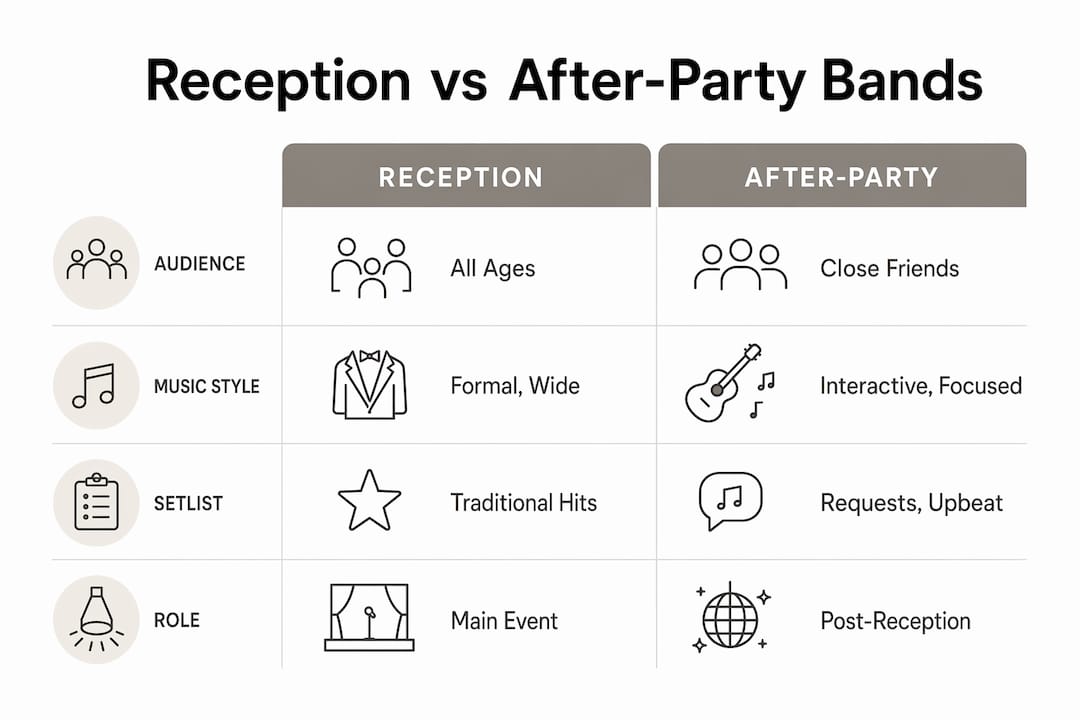
Here is how the two formats compare directly:
| Feature | Reception band | After-party band |
|---|---|---|
| Audience | All ages, all guests | Close friends and family |
| Music style | Broad, structured setlist | Focused, high-energy, flexible |
| Formality | High (speeches, first dance) | Low (freeform dancing) |
| Typical format | Full band, 3 to 5 sets | Ensemble, DJ hybrid, or solo act |
| Start time | Ceremony through dinner | Around 11 PM or midnight |
After-party live music also tends to be more interactive. Performers read the room in real time, take requests, and adapt the setlist to the crowd’s mood rather than following a preset running order. A live pianist, for example, adapts setlists dynamically to crowd energy rather than sticking to a fixed programme. That responsiveness is what makes after-party live music feel genuinely different from the main event.
Why hire a wedding band for the after-party?
Hiring a dedicated wedding band for the after-party solves a specific problem: the energy drop that happens when the formal reception ends. Guests who have been sitting through dinner and speeches are ready to dance properly. Without a clear musical signal that the party has shifted gear, many will simply leave.
The core benefits are practical and measurable:
- Momentum. After-parties starting immediately after the reception achieve better guest retention. No gap means no reason to leave.
- Personalised setlists. With a smaller, more engaged crowd, the band can play exactly what you and your closest guests love rather than compromising for a mixed audience.
- Live performance interaction. A live act creates moments that a playlist cannot. Spontaneous requests, crowd call-and-response, and real-time energy shifts are unique to live performance.
- Smooth atmosphere transition. The shift from formal to informal is handled musically. The band signals the change in mood without anyone needing to make an announcement.
- Memorable experience. Live music at weddings creates emotional anchors that guests recall long after the event. An after-party band extends that effect beyond the reception.
The after-party is also where the couple tends to relax and actually enjoy the music. The obligations of the formal reception are done. A great band in this slot becomes part of the couple’s own memory of the night, not just the guests’.
Pro Tip: Brief your after-party band on your five or ten non-negotiable songs before the event. A good band will build the rest of the setlist around those anchors and read the room for everything else.
Practical considerations when booking after-party live music
Booking party music for weddings does not stop at choosing a band you like. Several logistical factors determine whether the after-party actually works.
Timing and duration. A wedding after-party typically starts around 11 PM or midnight and runs for two to four hours. Book your band with this window in mind and confirm their finish time against the venue’s curfew.
Seamless transition. The most common planning mistake is allowing downtime between the reception and the after-party. Even a 20-minute gap kills momentum. Coordinate with your main band or DJ so music continues without interruption while the after-party band sets up.
Venue constraints. Sound limits, stage size, and curfew rules vary significantly between venues. A full six-piece band may not be practical in a smaller bar or hotel suite. Confirm volume limits and curfew with your venue before you book any act.
Budget. After-party entertainment costs vary by format. DJs start at approximately $1,875, while live bands or luxury acts range from $3,000 to $10,000 or more. A smaller ensemble or a DJ-live hybrid often delivers strong energy at a lower cost than a full band.
Coordination with other vendors. Your wedding planner, venue coordinator, and main band all need to know the after-party band’s setup requirements and schedule. Poor coordination between vendors is the second most common reason after-parties underdeliver.
Pro Tip: Ask your venue whether the after-party space has a separate sound system or whether the band needs to bring their own PA. This single question can save hours of setup delay on the night.
How to choose the best after-party bands for your wedding
Selecting the right act for your after-party comes down to fit, not just quality. A technically excellent band that plays the wrong genre for your crowd will not deliver the night you want.
Work through these criteria when assessing your options:
- Music style and energy fit. Match the band’s core genre to your guest group. If your close friends are R&B and soul fans, a soul-focused band will outperform a pop covers act every time. Genre alignment matters more at the after-party than at the reception because the crowd is more homogeneous.
- Band size and format. A four or five-piece band suits most after-party spaces. A DJ-live hybrid, where a DJ handles transitions and a vocalist or instrumentalist performs over the top, is a flexible option for venues with size or volume restrictions.
- Experience with after-parties specifically. Ask directly whether the band has performed at wedding after-parties before. Reception experience and after-party experience are different skills. Bands that understand the energy arc of warm-up, peak, and cooldown will manage the room far better than those who simply play their standard set.
- Setlist flexibility and request policies. The best after-party bands accept requests and adapt in real time. Ask how they handle song requests and whether they can learn specific tracks for your event. A clear request policy before the night avoids confusion on the evening itself.
- Reviews and recommendations. Look for reviews that specifically mention after-parties or late-night events, not just receptions. The skills required are distinct, and a band’s reputation in one context does not automatically transfer to the other.
Understanding what a wedding band does across different parts of a wedding helps you ask better questions when comparing acts. The more specific your brief, the more accurately a band can tell you whether they are the right fit.
Key takeaways
A wedding after-party band is a distinct entertainment role that requires a different act, a different setlist, and a different energy approach from the main reception band.
| Point | Details |
|---|---|
| Distinct role | An after-party band is not a reception band extension. It serves a smaller, more energetic crowd with a focused setlist. |
| Seamless timing | No gap between reception and after-party is the single most important logistical rule for guest retention. |
| Energy arc | The best acts follow a deliberate warm-up, peak, and cooldown structure adapted to the crowd in real time. |
| Budget range | Live after-party acts range from $3,000 to $10,000 or more. DJ-live hybrids offer strong value at lower cost. |
| Selection criteria | Prioritise genre fit, after-party experience, and setlist flexibility over band size or general reputation. |
Why the after-party band is the part couples forget and then regret
I have watched hundreds of weddings from the stage. The reception almost always goes well because couples spend months planning it. The after-party is where things fall apart, not because of bad music, but because of no plan at all.
The couples who get it right treat the after-party as a separate event with its own brief. They tell the band who will be in the room, what the energy should feel like at midnight versus 1 AM, and which songs are non-negotiable. The couples who get it wrong assume the band will figure it out. Sometimes they do. Often they do not.
The other thing I see consistently is the gap problem. A 30-minute silence between the reception ending and the after-party starting is enough to lose a third of your guests. People check their phones, call taxis, and decide they are tired. Once that momentum breaks, it does not come back. Continuity is not a nice-to-have. It is the foundation the whole after-party sits on.
My honest view: the after-party band slot is the best value entertainment decision you can make for your wedding. The crowd is smaller, the pressure is lower, and the music can finally be exactly what you actually love rather than a compromise for 150 people. Spend the time choosing the right act and briefing them properly. The return on that effort is significant.
— Deni
How Brownsugarmusic delivers after-party live music
Brownsugarmusic has been performing R&B and soul at Sydney’s best venues since 2003, including a residency at the Marble Bar in the Hilton Sydney that has run for over 20 years. That kind of experience translates directly to wedding after-parties. The band reads rooms, adapts setlists in real time, and delivers the energy shift that turns a good wedding into a great one.

Whether you want a full live band for a late-night dance floor or a more intimate soul and R&B set for a smaller group, Brownsugarmusic offers formats that suit different venues and guest sizes. Explore the R&B soul wedding guide to understand how genre and atmosphere work together, or check upcoming events to see the band perform before you book.
FAQ
What does a wedding after-party band actually do?
A wedding after-party band performs live music following the main reception, typically from around 11 PM, for a smaller and more energetic crowd. The focus is on high-tempo, personalised music rather than the structured, all-ages programme of the reception.
How long does a wedding after-party band typically perform?
Most after-party bands perform for two to four hours, starting around 11 PM or midnight. The exact duration depends on the venue’s curfew and the couple’s preferences.
Is a live band better than a DJ for a wedding after-party?
Both formats work well. A live band delivers unique energy and real-time interaction, while a DJ offers a broader song library and faster transitions. DJ-live hybrid acts combine both strengths and suit venues with size or volume restrictions.
How much does a wedding after-party band cost in Australia?
Live after-party bands typically range from $3,000 to $10,000 or more depending on size and experience. DJ options start lower, at approximately $1,875. The right budget depends on your venue size, guest count, and the format you choose.
What music styles work best for a wedding after-party?
R&B, soul, funk, and club-influenced music are the most popular choices because they suit a smaller, dance-focused crowd. The key is matching the genre to your specific guest group rather than trying to please everyone, as you would at the main reception.