

The single most reliable signal in any wedding band review is on-the-day performance detail. Not star ratings. Not “amazing band” praise. Specific accounts of punctuality, sound quality, and how the band handled the room. Before reading further, scan any review for these five things:
- Did the reviewer mention arrival and setup time?
- Is there a specific comment on sound quality or volume?
- Did the band learn a first-dance song or take requests?
- Are there logistical details (venue name, slot covered, band size)?
- Does the reviewer mention repeat bookings or referrals?
If a review ticks three or more of those, it carries real weight. If it ticks none, treat it as background noise.
Table of Contents
- Where UK couples find wedding band reviews and what each source is worth
- Which review signals matter most when choosing a wedding band
- How to spot fake, paid, or incentivised reviews
- How many reviews and what rating patterns give reasonable confidence
- How to evaluate photos, videos, and audio attached to reviews
- What common review phrases usually mean
- How to convert review findings into questions for bands
- UK wedding band timeline and typical price ranges
- Final shortlist checklist and a simple scorecard
- Key takeaways
- The review signals most couples overlook
- Useful sources for UK wedding verification
- Brownsugarmusic: live R&B and soul for weddings
Where UK couples find wedding band reviews and what each source is worth
UK couples typically search across several platforms before shortlisting a band. Each source has a different level of authenticity and depth.

| Platform | Strengths | Weaknesses |
|---|---|---|
| Google Maps | High volume, hard to fake at scale, photos attached | Short reviews, no wedding-specific filters |
| Hitched | Wedding-specific context, venue-linked profiles | Smaller review pool for niche bands |
| Bridebook | UK-focused, couples can message bands directly | Less review depth than Google |
| Trustpilot | Verified purchase option, detailed written reviews | Less common for individual bands |
| Photos, videos, and comments in one place | Easy to delete negative comments | |
| YouTube | Best for audio and performance footage | Reviews are comments, not structured feedback |
| Venue/agency pages | Venue endorsement adds credibility | Curated, so negative feedback rarely appears |
| Wedding forums (e.g. Mumsnet Weddings) | Candid, unmoderated opinions | Anecdotal, hard to verify |
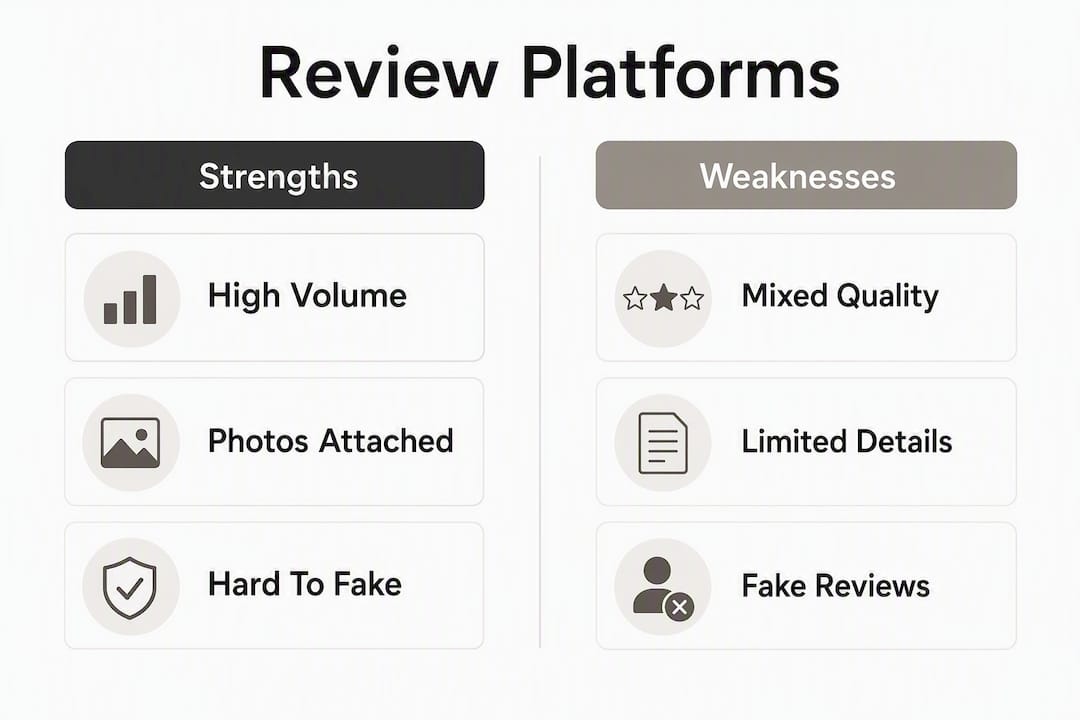
No single platform gives the full picture. The most reliable approach is to cross-reference at least two sources: a high-volume platform like Google alongside a wedding-specific one like Hitched or Bridebook. When a venue’s own event gallery shows the same band on the same date as a reviewer claims, that venue endorsement corroborates the review independently.
Which review signals matter most when choosing a wedding band
Star ratings are a starting point, not a conclusion. A band with 4.7 stars across 80 reviews tells you more than one with 5.0 stars across 6. The content of those reviews tells you even more.
Rank signals in this order:
- Punctuality and setup — “They arrived two hours before and were ready well before guests” is a specific, verifiable claim. Generic “so professional” is not.
- Sound quality — Look for mentions of volume control, clarity, and whether the band adapted to the room. “The sound was perfect for the barn” beats “sounded great.”
- Reading the room — Did the band shift tempo when the dancefloor thinned? Reviewers who mention this are describing a skill that separates good bands from excellent ones.
- Setlist flexibility — Specific song requests handled, first-dance songs learnt, or last-minute changes accommodated.
- Communication before the day — Responsiveness to emails, clarity on logistics, willingness to discuss the timeline.
- Problem resolution — How the band handled a sound limiter, a late start, or a venue restriction. These reviews are rare but highly informative.
Anecdotal praise like “everyone danced all night” is worth something, but only when it sits alongside logistical detail. A review that says “they kept the dancefloor full from 8pm to midnight, even when the sound limiter kicked in at 10pm” is the kind of specific evidence that predicts real-world performance.
Pro Tip: Search the review text for the word “limiter” or “volume.” Any band that has navigated a sound limiter successfully and earned a positive review for it is demonstrably experienced with UK venue constraints.
Reviews written after long-term experience with a product or service consistently outperform first-impression praise for reliability signals. The same principle applies to wedding band reviews: a couple writing six months after the wedding, reflecting on the whole day, gives a more considered account than one written the morning after.

How to spot fake, paid, or incentivised reviews
Fake reviews follow recognisable patterns. Once you know what to look for, they are straightforward to filter out.
Red flags to watch for:
- Generic superlatives with no event detail (“Best band ever! Highly recommend!”)
- Multiple five-star reviews posted within a 48-hour window
- Reviewers with no profile history, no photo, and no other reviews
- Identical or near-identical phrasing across multiple reviews
- Reviews that mention a discount, gift, or competition entry
Verification steps:
- Check the reviewer’s profile. A real wedding guest usually has other reviews, a profile photo, and a posting history that spans months or years.
- Cross-check the claimed event date against the band’s social media or the venue’s event gallery. Venue event galleries often show the same band on the same date, confirming or contradicting a reviewer’s claim.
- Reverse-image-search any photos attached to reviews. If the image appears on a stock site or another band’s profile, discard the review.
- Search for the reviewer’s name alongside the venue name. A genuine guest sometimes appears in tagged photos from the same event.
- Look for a cluster of reviews that coincides with a promotional campaign or a giveaway the band ran. Five-star bursts that align with “win a free booking” posts are a known manipulation pattern.
Pro Tip: Genuine reviews almost always contain at least one specific detail: a song title, a contact name at the band, a venue room, or a logistical moment. Fabricated reviews rarely include these because the writer was not there.
How many reviews and what rating patterns give reasonable confidence
Volume and recency both matter. A band with 12 reviews averaging 4.9 stars is less reliable than one with 60 reviews averaging 4.6 stars. The larger sample absorbs outliers and reflects a broader range of events and venues.
| Review count | Average rating | Confidence level |
|---|---|---|
| Fewer than 10 | Any | Low — too small a sample |
| 10–20 | 4 and above | Moderate — check recency |
| 30–50 | 4 and above | Good — read the lowest ratings |
| 60 or more | 4 and above | Strong — weight the last 12 months |
Recency matters because bands change. A lineup change, a new sound engineer, or a shift in management can alter quality significantly. Prioritise reviews from the past 18 months. If the most recent review is two years old, ask the band directly why.
Small sample sizes are not automatically disqualifying. A newer band with 15 detailed, specific reviews from named venues can be more trustworthy than an established act with 40 vague ones. The quality of review content compensates for lower volume up to a point.
Pro Tip: Convert qualitative detail into a rough trust score. Count how many reviews mention at least one specific logistical detail. If more than half do, the review pool is genuine. If fewer than a quarter do, treat the overall rating with caution.
How to evaluate photos, videos, and audio attached to reviews
Visual evidence is the most useful supplement to written reviews, but it requires its own scrutiny.
Checklist for video authenticity:
- Is the audio live? Listen for ambient crowd noise, natural room reverb, and slight imperfections. A polished studio mix over live footage is a promotional video, not attendee evidence.
- Does the crowd react in real time? Genuine footage shows people dancing, turning towards the stage, or clapping between songs.
- Do timestamps and venue details match the reviewer’s written account?
- Is the band size consistent with what the profile advertises?
For photos, look at:
- Stage setup and equipment. A well-organised stage with appropriate PA, monitors, and lighting suggests a professional operation.
- The proportion of the room that is engaged. A photo showing a full dancefloor is more useful than a posed band shot.
- Instrumentation. Does the band in the photo match the lineup described in the profile?
Professionally produced promo videos are useful for assessing musical quality and presentation, but they tell you nothing about how the band performs under real wedding conditions. Attendee-shot clips, even shaky ones filmed on a phone, are more informative for on-the-day behaviour.
Brownsugarmusic publishes guidance on why video evidence matters before booking a live band. The core point: a promo reel shows the band at its best; an attendee clip shows the band as your guests will experience it.
What common review phrases usually mean
Review language is often vague. This table maps common phrases to the concrete behaviour they suggest and the follow-up check worth making.
| Review phrase | Likely meaning | Follow-up check |
|---|---|---|
| “Kept the dancefloor full all night” | Strong crowd-reading and setlist pacing | Ask for a sample setlist and how they adapt it live |
| “Great communication” | Responsive before the day, clear on logistics | Test response time with an enquiry email |
| “Sound was brilliant” | Volume appropriate, clear mix, no feedback | Ask about their PA setup and sound engineer |
| “Saved the day” | Handled a problem (late start, tech issue, venue restriction) | Ask what the problem was and how they resolved it |
| “So professional” | Arrived on time, dressed appropriately, no drama | Ask for arrival time relative to guest arrival |
| “Learnt our first dance” | Willing to rehearse bespoke requests | Confirm this is included in the quote |
| “Guests are still talking about it” | Strong guest experience, memorable performance | Ask for a reference from that couple directly |
| “Good value” | Price felt fair relative to quality delivered | Confirm what was included (hours, equipment, travel) |
How to convert review findings into questions for bands
Reviews give you hypotheses. Direct questions to the band confirm or contradict them. Use this checklist in your first conversation or email.
Questions to ask:
- Can you provide two references from weddings in the past 12 months, with contact details?
- Do you have attendee-shot video from a recent wedding, not just your promo reel?
- What is your public liability insurance cover, and can you send the certificate?
- Have you played at venues with sound limiters? How do you manage them?
- What is your contingency plan if a band member is ill on the day?
- What time do you arrive for setup, and what is your minimum setup time?
- Is learning a first-dance song included, or is it an additional cost?
Requests to make in writing:
- Ask for a contract clause specifying arrival time and setup completion time.
- Request a written setlist or genre list, with confirmation of how many requests they will accommodate.
- Ask for an equipment list, including PA capacity and whether a sound engineer is included.
- Confirm dress code expectations in writing, particularly for themed or formal weddings.
A band that hesitates on references or insurance is a band worth removing from your shortlist.
UK wedding band timeline and typical price ranges
Understanding when bands play and what they cost helps you judge whether a “good value” comment in a review is meaningful.
Common band slots at a UK wedding:
- Ceremony: Usually acoustic duo or string quartet. Electric bands rarely play ceremonies due to volume and setup constraints.
- Drinks reception: Background or light entertainment. Often a smaller acoustic version of the main band, or a separate act.
- Wedding breakfast: Ambient background music, sometimes a solo or duo set. Full bands rarely play during the meal.
- Evening reception: The main event. Typically two 45-minute sets with a DJ or playlist in between, running from around 7:30pm to midnight.
Reviews that say “they played all day” usually mean the band covered drinks and evening, not a continuous performance. Clarify which slots are included in any quote.
Typical UK price ranges by band size:
| Band type | Typical UK price range | What affects price |
|---|---|---|
| Acoustic duo | £600–£1,000 | Travel distance, hours, equipment |
| Three-piece band | £1,000–£2,000 | Repertoire breadth, PA included |
| Four to five-piece band | £2,000–£3,000 | Full PA, sound engineer, travel |
| Six-piece and above | £3,000 and above | Brass section, lighting, extended hours |
These are indicative ranges based on market observation. Prices vary by region, season, and demand. A review calling a £4,000 five-piece “great value” is a different claim to the same phrase applied to a £1,500 three-piece. Context matters. For a fuller picture of how entertainment timing affects the day, the slot-by-slot breakdown is worth reviewing before you finalise a brief.
Final shortlist checklist and a simple scorecard
Use this scorecard to compare shortlisted bands. Score each criterion out of 2 (0 = absent, 1 = partial, 2 = confirmed).
| Criterion | Weight | What to look for |
|---|---|---|
| Review volume and recency | High | 30+ reviews, majority within 18 months |
| Specific review detail | High | Logistical mentions, named songs, event context |
| Video evidence (attendee-shot) | High | Live audio, crowd reaction, venue match |
| References provided | High | Two recent contacts willing to speak |
| Insurance confirmed | High | Public liability certificate available |
| Contract clarity | Medium | Arrival time, setlist, equipment in writing |
| Price transparency | Medium | Quote itemised, no hidden extras |
| Communication speed | Medium | Responded within 48 hours |
| Setlist fit | Medium | Repertoire matches your guests’ age range |
| Cultural/theme adaptability | Low | Evidence of diverse event experience |
A band scoring 16 or above out of 20 is a strong candidate. Below 12, keep looking. Use the scorecard during a final call: run through the low-scoring criteria and ask directly. A good band will answer without hesitation.
Shortlist checklist:
- At least 30 reviews across two platforms
- One attendee-shot video from a wedding in the past 18 months
- Two references with contact details
- Public liability insurance certificate
- Written contract covering arrival time, setlist scope, and equipment
- Itemised quote with no ambiguous extras
Key takeaways
Specific review detail, not star ratings, is the most reliable signal when choosing a wedding band.
| Point | Details |
|---|---|
| Prioritise specific detail | Reviews mentioning punctuality, sound, and song requests outweigh generic five-star praise. |
| Cross-reference platforms | Combine Google with a wedding-specific site like Hitched to build a fuller, more reliable picture. |
| Verify before you book | Ask for references, an insurance certificate, and attendee-shot video before signing a contract. |
| Weight recency | Prioritise reviews from the past 18 months; band quality can change with lineup or management shifts. |
| Brownsugarmusic | Over two decades of live performance experience, with practical guides on video review, stage requirements, and wedding logistics. |
The review signals most couples overlook
Most couples spend too long comparing star ratings and not long enough reading the text beneath them. A 4.6-star band with 80 detailed reviews describing specific songs, named contacts, and sound limiter workarounds is a safer hire than a 5.0-star act with 9 reviews that all say “amazing night.”
The other thing couples consistently underweight is the absence of negative reviews. A band with zero critical feedback across 60 reviews is either exceptional or managing its reputation actively. Neither is a reason to dismiss them, but it is a reason to ask for references and test the claim directly.
Reviews about cultural adaptability deserve particular attention. A band that has played South Asian weddings, Jewish receptions, and secular civil ceremonies and earned specific praise in each context has demonstrated genuine flexibility. That is harder to fake than a generic five-star rating.
The practical step most couples skip: email the band before booking and note how long they take to reply, how specific their answer is, and whether they ask questions about your day. A band that responds within 24 hours with tailored questions about your venue and timeline is already demonstrating the communication standard their reviews describe.
Useful sources for UK wedding verification
A short list of authoritative resources for verifying claims and understanding UK wedding context.
- Church of England: reading of banns — official guidance on banns requirements for Church of England ceremonies.
- Trustpilot UK — verified review platform; search for entertainment agencies and band booking services.
- A Star Diamonds: how to buy a wedding ring — practical UK jewellery guidance including resizing limitations for alternative metals.
- Brownsugarmusic: why review wedding band videos before booking — practical guidance on assessing video evidence from live performances.
- Brownsugarmusic: questions before hiring a wedding band — a structured list of verification questions to ask any band before signing a contract.
Brownsugarmusic: live R&B and soul for weddings
Couples who have worked through this guide and know what they want from a live band will find Brownsugarmusic a straightforward fit. The band has performed at weddings, corporate events, and private parties for over two decades, with a resident slot at the Marble Bar in the Hilton Sydney running for more than 20 years. That kind of sustained, high-frequency performance record is exactly what the review signals in this guide point towards: consistent delivery across hundreds of events, not a handful of showcase gigs.
Brownsugarmusic covers classic and contemporary R&B, soul, funk, and pop, with a repertoire built for mixed-age wedding crowds. For couples planning a reception with genuine atmosphere, the live band reception benefits guide explains what a live act delivers that a playlist cannot. To check availability or discuss your event, visit the events and bookings page.