

Choose the band that fits your venue first. Stage dimensions, power supply, and sound-limiter policy matter more than style or price at this stage. A band that cannot physically set up, or that trips a limiter mid-set, creates problems no amount of talent can fix.
Non-negotiables to confirm with your venue before contacting any band:
- Stage dimensions and whether a riser is provided
- Load-in route from parking to stage (note stairs, gravel, or narrow corridors)
- Dedicated power circuits and total amperage available
- Sound limiter: exact decibel threshold and whether it cuts power or caps volume
- Music curfew time
First-contact checklist — what to ask and what to request:
- Ask the venue for a technical specification sheet and sound-limiter details in writing
- Ask each band for their stage plot and input list, Public Liability Insurance (PLI) certificate, and Portable Appliance Testing (PAT) records
- Confirm the band provides its own PA, basic lighting, and a DJ service between sets — this reduces coordination risk considerably
- Red flags: no PLI, no PAT, no written rider, and no live video samples
UK venues require PLI and PAT documentation before permitting live performances. Request both before signing anything.
Table of Contents
- When should you book and confirm technical details?
- What does a live wedding band cost in the UK?
- What belongs in the contract and tech rider?
- How do you match band style to your venue atmosphere?
- How do you fit the band into the venue schedule?
- How do you handle venue restrictions on volume or genre?
- What happens if equipment fails or guests request songs on the day?
- What hospitality do bands need on the day?
- Soundcheck: how much time do you need to allow?
- Key takeaways
- The detail most couples miss until it is too late
- Useful UK resources for venue and band planning
- Brownsugarmusic: R&B and soul for your wedding reception
When should you book and confirm technical details?
Book well in advance for peak summer Saturdays. Many popular bands are taken well before that window closes. For off-peak dates, booking several months ahead is usually sufficient.
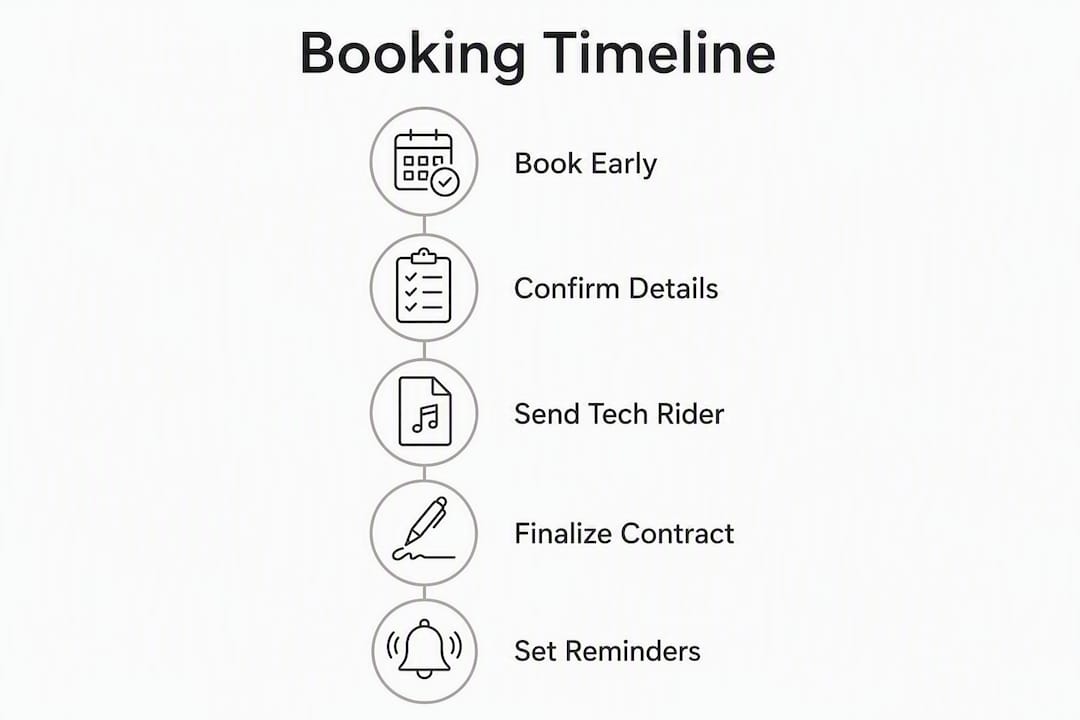
Finalise technical details 4–8 weeks before the wedding. That window gives the venue coordinator and band enough time to resolve any conflicts — power upgrades, stage repositioning, or limiter-friendly equipment swaps — without last-minute pressure.
Set a calendar reminder at the 8-week mark to send the band’s tech rider and stage plot to your venue contact directly.
What does a live wedding band cost in the UK?
UK price ranges vary by size and demand: 3-piece bands from roughly £1,700; 4–5 piece bands around £2,200–£3,200; premium acts can exceed £2,500–£4,000 depending on VAT registration and demand.
Deposits typically run at 20–30% on signing, with the balance due 2–4 weeks before the event. Confirm whether the quoted price includes VAT, travel, and equipment.
What belongs in the contract and tech rider?
The contract must cover: performance duration and set times, cancellation terms for both parties, noise-limiter clauses, and overtime rates. A band with no cancellation clause is a risk.
The tech rider should specify: stage dimensions (a four-piece typically needs around 16ft x 12ft), dedicated power circuits, parking access, setup area, and hospitality provisions. Share it with your venue coordinator the moment you sign.
How do you match band style to your venue atmosphere?
A grand country house calls for something different from a converted warehouse or a coastal barn. Match the band’s core genre to the room’s character, not just your personal taste.
Watch live video footage from real weddings, not studio recordings. Crowd response tells you more than a polished showreel. Ask for references from venues similar to yours.
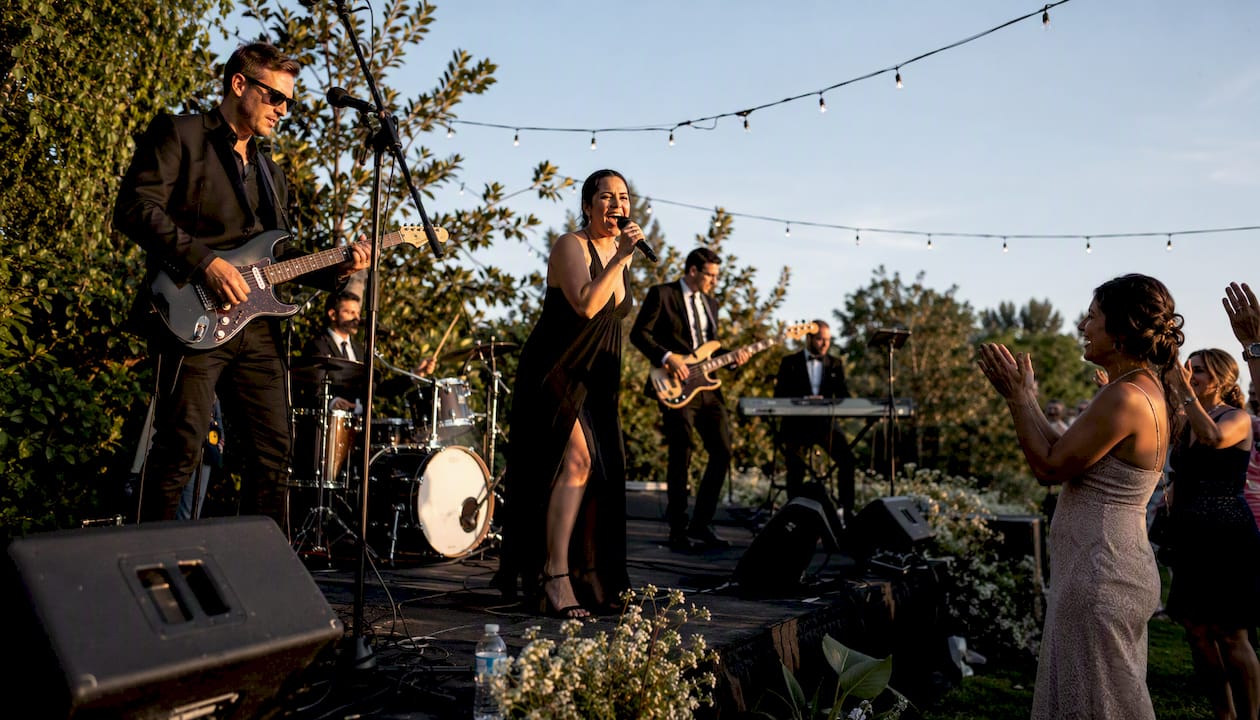
R&B and soul repertoire tends to work across a wide range of room types — the groove is adaptable without losing energy. A soul band at a wedding reception can shift from background dinner music to a full dance-floor set without a change of gear.
How do you fit the band into the venue schedule?
Map the full day first: ceremony, drinks reception, dinner, first dance, and evening set. Then place the band’s sets around fixed venue events — kitchen service windows, speeches, and curfew.
A standard evening structure: one 45–60 minute set, a break with DJ music, then a second 45–60 minute set closing before curfew. Build a 15-minute buffer before curfew for the final song and any overtime negotiation.
Share the full running order with the band, venue coordinator, and toastmaster at least two weeks out.
How do you handle venue restrictions on volume or genre?
Sound limiters do not automatically rule out live bands. Many bands offer limiter-friendly setups: electronic drum kits, silent backline, and in-ear monitoring. Ask any band you shortlist whether they carry this equipment.
On genre restrictions: some venues, particularly listed buildings or those in residential areas, restrict amplified music entirely after a set hour. Confirm this in writing. If a genre restriction applies, ask the band for an acoustic or semi-acoustic alternative set.
What happens if equipment fails or guests request songs on the day?
Ask the band what backup equipment they carry. A professional act brings spare cables, a backup DI box, and a contingency plan for a failed PA channel.
For last-minute song requests, agree a process in advance. Most bands accept requests submitted 2–4 weeks before the event. On the day, requests go through the band leader — not individual musicians mid-set. Build a short “if possible” list alongside your must-play and do-not-play lists.
What hospitality do bands need on the day?
Standard requirements: a private changing or green room, hot meals (one per musician, timed around the kitchen service), soft drinks and water on stage, and secure parking for equipment vehicles.
Confirm these with the venue when you book. Some venues charge for staff meals; factor this into your catering budget. A band arriving to no food and no parking space starts the evening at a disadvantage.
Soundcheck: how much time do you need to allow?
A four-piece band needs 2–4 hours for load-in and soundcheck. Schedule soundcheck to finish at least 90 minutes before guests arrive — this gives time to resolve any limiter or feedback issues without pressure.
Soundcheck checklist:
- Confirm load-in start time with venue and band at least 4 weeks out
- Check the limiter does not trigger at the band’s working volume during soundcheck
- Test the DJ playlist source (laptop or phone) through the PA
- Walk the room during soundcheck to identify dead spots or feedback zones
- Confirm curfew time with the venue manager on the day
Key takeaways
Venue compatibility is the single most important filter when pairing a live band to a UK wedding: confirm stage, power, and sound-limiter details before style or price.
| Point | Details |
|---|---|
| Venue constraints first | Confirm stage size, load-in path, and power capacity before shortlisting bands. |
| Sound-limiter details | Ask for the exact dB threshold and limiter type; share both with any band before booking. |
| Paperwork before signing | Request PLI and PAT certificates from every band before committing. |
| Integrated production | Prefer bands providing PA, lighting, and DJ between sets to reduce coordination risk. |
| Brownsugarmusic | An experienced R&B/soul band with a broad repertoire suited to varied venue types and reception formats. |
The detail most couples miss until it is too late
The conversation about sound limiters almost always happens too late. Couples confirm the band, sign the contract, and only discover the venue runs a power-cut limiter — not a volume-cap system — during the final site visit. By then, the band has no time to source electronic drums or reconfigure monitoring.
The fix is simple: ask the venue for the limiter type and sensor location on your first site visit, before you approach a single band. A power-cut limiter (one that kills the stage circuit for a fixed period when breached) demands a completely different technical solution from a volume-cap system. Knowing which you are dealing with narrows your band shortlist immediately.
Difficult load-in routes are the other overlooked problem. A band can fit the stage perfectly and still spend two hours navigating a spiral staircase or a long gravel drive. Quantify the path from vehicle to stage in metres. If equipment cannot be wheeled, arrange porters or budget for extra setup time.
The bands that handle these situations well — Alive Network and Greenlight Bands both surface acts with documented limiter-friendly setups — are the ones worth shortlisting. Function Central provides a useful list of questions to put to any band before booking. WedMagazine covers the venue conversation in practical terms for couples who are earlier in the process.
Useful UK resources for venue and band planning
Resources for couples working through the venue-band pairing process:
- Alive Network — PLI/PAT guidance, sound-limiter primer, and a full booking checklist
- Function Central — 20 questions to ask any band before signing, including limiter and contract clauses
- WedMagazine — venue conversation guide and practical checklist for early-stage planning
- Brownsugarmusic — R&B/soul band with broad wedding and event experience; contact for availability and rider details
| Resource | Best for |
|---|---|
| Alive Network | PLI/PAT checks, limiter types, booking guide |
| Greenlight Bands | Stage plots, power specs, load-in logistics |
| Function Central | Pre-booking questions, contract and limiter clauses |
| WedMagazine | Venue conversation, early planning checklist |
| Brownsugarmusic | R&B/soul band booking, rider and availability |
Brownsugarmusic: R&B and soul for your wedding reception
Brownsugarmusic has performed at weddings, corporate events, and private parties for over two decades, with a resident slot at Marble Bar in the Hilton Sydney running every Friday night since 2003. The repertoire covers classic and contemporary R&B, soul, funk, and pop — adaptable across room sizes and venue formats.
For couples who have confirmed their venue constraints and want a band with documented event experience, Brownsugarmusic is a direct option. The band provides a live band wedding reception package suited to varied production environments. Check availability and request rider details at the Brownsugarmusic events page.