

A live band and a DJ represent two distinct approaches to wedding reception music, each delivering a different atmosphere, cost structure, and logistical footprint. The live band vs DJ wedding decision shapes the entire mood of your reception. A band brings a visual spectacle and raw energy that fills a room differently from any playlist. A DJ offers continuous music, a vast song library, and a smaller physical presence. Neither is universally better. The right choice depends on your budget, venue, guest profile, and the atmosphere you want to create. Hybrid models combining both are also growing fast.
How do cost and budget affect the live band vs DJ choice?
Budget is the first filter most couples apply, and the gap between options is significant. Professional wedding DJs typically cost between €500 and €1,500, while live wedding bands range from €2,500 to €6,000, with premium acts exceeding €12,000. That difference reflects the number of performers, rehearsal time, and equipment each option requires.
A DJ’s quote usually covers one person, a sound system, and a music library. A band quote covers multiple musicians, transport for instruments, a PA system, and often a sound engineer. Both can carry hidden costs. Travel fees, overtime charges, and equipment hire can add meaningfully to either bill.
Budget also determines scale. A smaller budget favours a DJ, who can deliver a polished performance at a fraction of the cost. A larger budget unlocks a full band with brass, backing vocalists, and a setlist tailored to your taste.
| Option | Typical cost range | Setup needs | Best for |
|---|---|---|---|
| DJ only | €500 – €1,500 | Minimal | Tight budgets, small venues |
| Live band (small) | €2,500 – €4,000 | Moderate stage space | Mid-range budgets |
| Live band (premium) | €6,000 – €12,000+ | Full stage, sound engineer | Large receptions |
| Hybrid (band + DJ) | €3,500 – €7,500 | Combined setup | Couples wanting both |
Pro Tip: Ask your band or DJ whether their quote includes sound equipment, travel, and overtime. A lower headline price can climb quickly once extras are added.
What logistical and venue factors affect your choice?
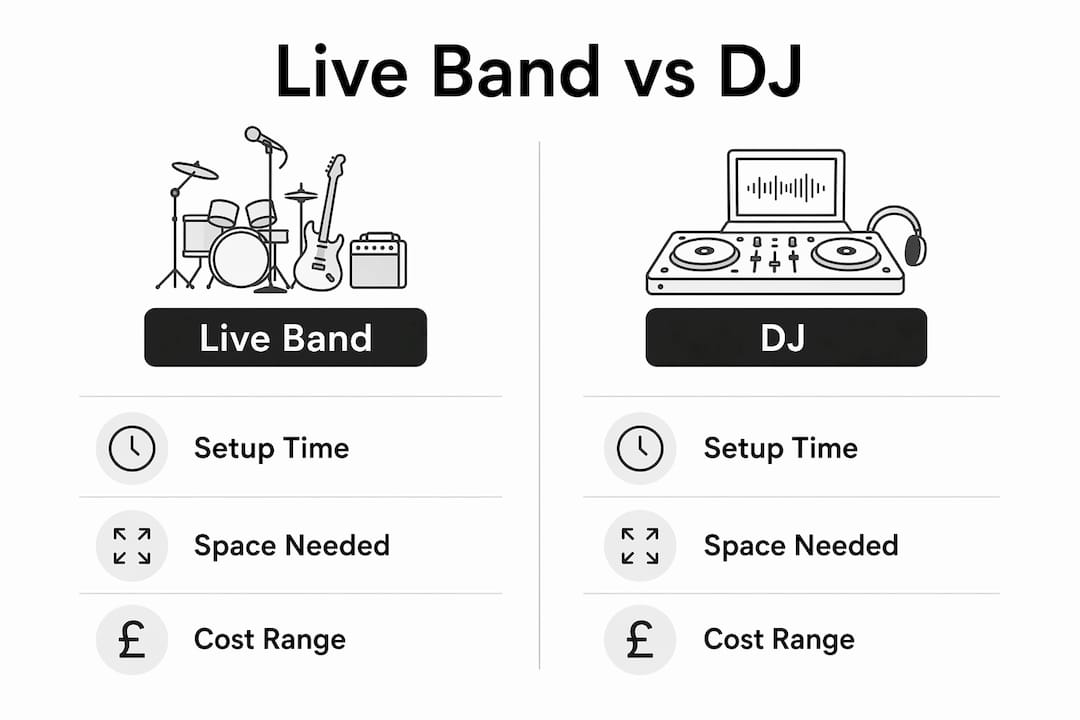
Venue constraints often decide the question before budget does. Live bands require 90–120 minutes for setup and soundcheck. DJs typically need 45–60 minutes. That difference matters when venues have strict access windows or back-to-back event schedules.
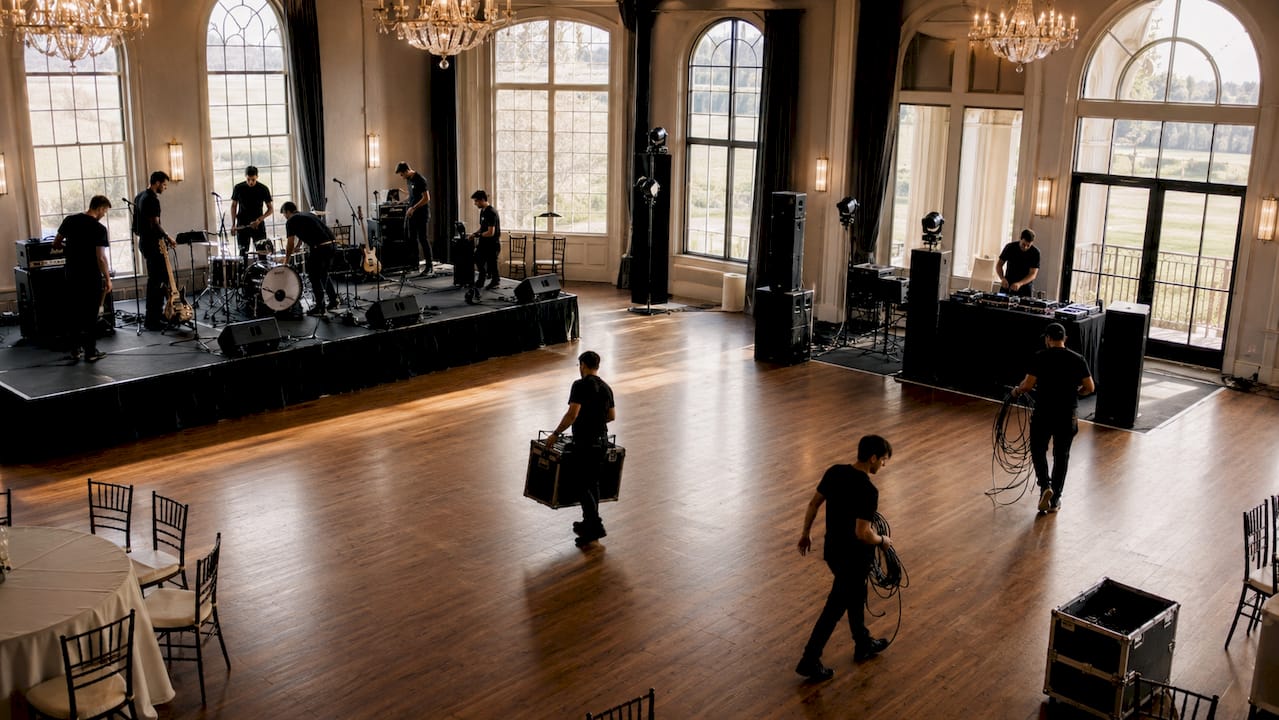
Space is the other critical factor. Bands need significantly more floor area, typically 9–12 square metres of flat stage space. A DJ requires just 2–3 square metres and a single standard power outlet. Bands need multiple dedicated power circuits, which older or historic venues may not provide.
Venue noise ordinances heavily affect live band volumes. A DJ can adjust levels instantly to comply with sound limits. A full band playing at performance volume may breach restrictions at boutique, garden, or heritage venues. Historic or intimate venues may restrict band size or volume, making a DJ the only practical option.
| Factor | Live band | DJ |
|---|---|---|
| Setup time | 90–120 minutes | 45–60 minutes |
| Stage space required | 9–12 m² | 2–3 m² |
| Power requirements | Multiple circuits | One standard outlet |
| Noise limit flexibility | Low | High |
| Venue type suitability | Large, purpose-built | Most venue types |
Pro Tip: Read your venue contract before booking entertainment. Confirm noise curfews, load-in times, and power availability. Discovering restrictions after you have paid a deposit is costly.
Check the wedding band performance checklist for a full list of logistical questions to ask your venue before signing anything.
How do atmosphere and guest experience compare?
Live bands create a visual and sonic experience that a DJ cannot replicate. Live bands bring unique technical arrangements and multi-instrumentalism that guests perceive as more engaging. Watching musicians perform in real time adds a layer of theatre to the reception. Guests often gravitate towards the stage, and the energy in the room builds differently.
DJs excel in a different way. Professional DJs provide continuous music with no breaks, sustaining dancefloor momentum from the first song to the last. A skilled DJ reads the room and shifts genre, tempo, and energy in seconds. That flexibility is hard to match when your guest list spans three generations with different musical tastes.
Bands typically perform 45–60 minute sets with 15–20 minute breaks. Those breaks require a plan. Unmanaged silence during band breaks can kill dancefloor energy. Most professional bands provide a playlist or a DJ to cover the gaps, but this needs confirming before you book.
Key atmosphere differences at a glance:
- Live band: High-energy peak moments, visual spectacle, bespoke arrangements, natural crowd focus
- DJ: Continuous music flow, vast song library, instant genre shifts, consistent volume control
- Guest engagement: Bands draw guests to the stage; DJs sustain the dancefloor across longer periods
- Multi-generational appeal: DJs handle wider genre ranges more easily; bands specialise in a defined style
- 80% of guests cited poor sound quality or dead air as the biggest reception mood-killer in a 2024 survey
The decision comes down to your desired night pulse. Bands provide high-energy peak moments; DJs sustain momentum without breaks. Both are valid. They just deliver different experiences.
What are the most common hybrid approaches?
Hybrid entertainment combining DJs and live musicians is growing in popularity, particularly for larger receptions where couples want both live energy and DJ versatility. Hybrid packages generally cost between €3,500 and €7,500, sitting between DJ-only and full-band pricing.
The most common hybrid formats include:
- Band for peak hours, DJ for late night: The band performs during dinner and the first part of the evening. A DJ takes over after midnight when energy shifts and the crowd thins.
- DJ with live saxophonist or vocalist: A DJ provides the continuous music foundation while a live musician adds a performance layer on top. This works well in smaller venues with limited stage space.
- Live band with DJ support during breaks: The band plays their sets; a DJ covers the gaps. This removes the dead-air risk entirely.
- Full hybrid production: A live band and DJ share the stage, alternating or performing together. This suits large-scale receptions with a dedicated production budget.
Hybrid solutions resolve many trade-offs by combining live visual presence with DJ flexibility. They are increasingly the norm for weddings with 150 or more guests. The scheduling and sound integration require more planning, but the result is a reception that covers every phase of the evening well.
Brownsugarmusic performs regularly alongside DJ Trey in exactly this format, blending R&B and soul live performance with DJ continuity. You can see how that combination works at live events in Sydney.
How to decide which is right for your wedding
The right choice becomes clear once you work through a few specific questions. Start with your budget, then check your venue’s physical and acoustic constraints, and then consider your guests.
- Set your entertainment budget first. Know your ceiling before you start enquiring. A DJ is the practical choice below €2,000. A band becomes viable from €3,000 upwards.
- Check your venue’s stage space and power supply. Ask the venue coordinator directly. If the space cannot accommodate 9–12 square metres of stage, a full band is not feasible.
- Confirm noise limits and curfews. Get these in writing. A venue with a strict 10pm noise curfew may not suit a live band at full volume.
- Map your guest profile. A crowd with diverse musical tastes across age groups often responds better to a DJ’s flexibility. A younger crowd with a shared music preference is ideal for a specialist live band.
- Decide on your atmosphere priority. If you want a visual centrepiece and peak-energy moments, a live band delivers that. If you want consistent dancefloor energy from start to finish, a DJ is the stronger choice.
- Book early. Booking entertainment 12–18 months in advance is recommended, especially for peak wedding season between may and september. Popular bands and DJs fill their calendars fast.
- Review videos and testimonials. Watching a band or DJ perform at a real wedding tells you more than any brochure. Brownsugarmusic publishes performance footage so couples can assess the live experience directly. See why reviewing band videos before booking matters.
- Clarify contract details. Confirm what happens during band breaks, whether the DJ also acts as MC, and what overtime costs look like. These details affect the flow of your entire evening.
For couples planning a Sydney wedding, venue access times and noise restrictions in inner-city locations make the logistical checklist above especially relevant.
Key takeaways
The most effective approach to choosing wedding reception music is to match your entertainment format to your venue constraints, guest profile, and budget before considering anything else.
| Point | Details |
|---|---|
| Cost gap is significant | DJs cost €500–€1,500; live bands range from €2,500 to over €12,000. |
| Venue constraints often decide | Bands need 9–12 m² of stage space and multiple power circuits; many venues cannot accommodate this. |
| Music continuity matters | Bands take 15–20 minute breaks; unplanned silence kills dancefloor energy. |
| Hybrid options fill the gap | Packages combining a band and DJ cost €3,500–€7,500 and cover every phase of the evening. |
| Book 12–18 months ahead | Peak-season dates fill fast for both quality bands and experienced DJs. |
What I have learned from watching both options work
The debate between a live band and a DJ is rarely about which is objectively better. It is about which fits the specific wedding in front of you.
I have watched live bands transform a reception into something guests talk about for years. The moment a brass section kicks in during a first dance, or a vocalist improvises a line that references the couple by name, the room changes. No playlist does that. A live band’s ability to create a bespoke atmosphere is real, and it is most powerful during peak energy hours when the dancefloor is full.
But I have also watched DJs outperform bands on the nights that mattered most. A skilled DJ reading a mixed crowd of 60-year-olds and 25-year-olds, shifting from Motown to current R&B without losing anyone, is genuinely impressive. Bands specialise. DJs adapt. That distinction matters more than most couples realise when they are planning the evening.
The honest truth is that venue and budget constraints make the decision for most couples before they even start comparing options. A beautiful heritage ballroom with a 9pm noise curfew is not the right room for a six-piece band. A large outdoor marquee with 200 guests and no sound restrictions is exactly where a live band earns its cost.
My recommendation for couples who can stretch the budget: consider a hybrid. A live band for the peak two hours, with a DJ covering the rest, gives you the best of both without the compromises of either.
— Deni
Brownsugarmusic: live band and DJ hybrid for Sydney weddings
Brownsugarmusic has been performing at Sydney weddings since 2003. The band specialises in R&B and soul, a genre that works across generations and keeps dancefloors moving from the first song. As the resident band at Marble Bar in the Hilton Sydney every Friday night for over 20 years, Brownsugarmusic brings a level of live performance experience that translates directly to weddings.
For couples who want both live energy and DJ continuity, Brownsugarmusic offers hybrid packages with DJ Trey, combining live R&B performance with seamless DJ coverage across the full evening. Explore the R&B soul wedding atmosphere guide to understand how this music style sets the tone for a reception. View upcoming live events and bookings to check availability and see the band in action.
FAQ
How much does a live band cost compared to a DJ for a wedding?
A professional wedding DJ typically costs between €500 and €1,500. A live wedding band ranges from €2,500 to over €12,000 depending on size and experience.
How far in advance should you book wedding entertainment?
Book 12–18 months ahead, particularly for weddings between may and september. Quality bands and DJs in popular markets fill their calendars well in advance.
Do live bands play continuously at weddings?
No. Bands typically perform 45–60 minute sets with 15–20 minute breaks. A good band will provide a DJ or curated playlist to cover those gaps and maintain dancefloor energy.
What is a hybrid wedding entertainment package?
A hybrid package combines a live band and a DJ within the same reception. Common formats include a band for peak hours and a DJ for late night, or a DJ with a live saxophonist or vocalist performing over the music.
Is a live band or DJ better for a small venue?
A DJ is the practical choice for small or intimate venues. Bands require 9–12 square metres of stage space, multiple power circuits, and longer setup times, which many smaller venues cannot accommodate. For wedding ceremony music options at smaller venues, acoustic or solo performers are also worth considering.