

R&B music is defined as a genre that blends rhythm, blues, soul, and funk into a format that is simultaneously sophisticated and accessible. That combination is precisely why R&B suits corporate audiences better than most genres. It creates warmth without informality, energy without chaos, and familiarity without predictability. Attendee engagement and satisfaction each account for 34% of the top KPIs corporate planners measure, and live R&B consistently delivers on both. Brownsugarmusic has performed at corporate functions across Sydney and internationally since 2003, and the pattern is consistent: R&B brings a room together faster than almost any other genre.
Why R&B suits corporate audiences across age groups and cultures
R&B’s broad appeal is not accidental. The genre spans classic Motown, 1970s soul and funk, neo-soul, and contemporary R&B, giving it a reach that few other genres can match across a mixed corporate room. A 50-year-old executive and a 28-year-old graduate will both recognise an Aretha Franklin groove or a D’Angelo chord. That shared recognition is the foundation of social engagement at any event.

The genre’s rhythmic versatility is equally important. R&B can sit quietly in the background during a cocktail reception, then shift into something more energetic as the evening opens up. That flexibility means one genre can serve multiple event phases without jarring tonal shifts. Soul music suits mixed audiences precisely because it carries emotional weight without demanding attention.
Cultural resonance matters too. R&B has deep roots across African American, Caribbean, and broader Western popular culture, making it one of the most cross-culturally recognised genres in the world. At a corporate event with attendees from different backgrounds, that recognition creates a shared reference point. Shared reference points reduce social friction and accelerate networking.
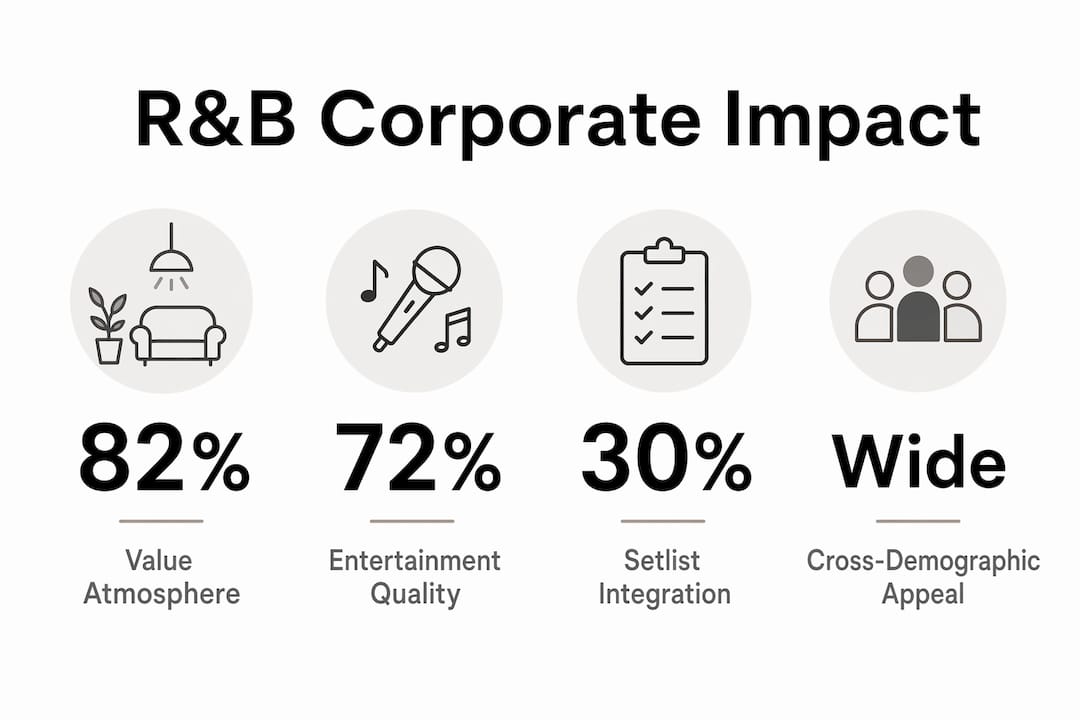
Industry guidance recommends that R&B occupy 25–30% of a corporate event setlist for maximum demographic engagement. That figure reflects a deliberate balance: enough R&B to anchor the atmosphere, but room for jazz, pop, and Motown to fill the gaps.
- Classic Motown and 1960s soul connect with attendees aged 50 and above and carry strong nostalgic warmth.
- 1970s and 1980s funk and soul appeal across the 35–55 age bracket and are consistently strong on the dance floor.
- Neo-soul and contemporary R&B engage younger attendees and signal that the event is current and considered.
- Crossover R&B and pop-soul serve as connective tissue between subgenres, keeping the setlist cohesive.
Pro Tip: Ask your band for a sample setlist before booking. A well-constructed R&B setlist for a corporate event should include at least three distinct subgenres, not just one era or style.
How does R&B enhance atmosphere and attendee satisfaction?
Atmosphere is the primary driver of corporate event satisfaction. 82% of corporate attendees cite atmosphere as the main factor in how they rate an event. That statistic reframes music from a background detail into a core deliverable. R&B’s smooth rhythms and warm harmonic palette are particularly effective at building the kind of atmosphere that registers as both professional and enjoyable.
R&B supports social interaction without overpowering it. The genre’s mid-tempo grooves sit at a volume and energy level that allows conversation to flow naturally. This is a practical advantage over harder rock or high-energy electronic music, which can fragment a room into those who want to dance and those who want to talk. R&B holds both groups comfortably.
Live R&B performance amplifies this effect considerably. A live band reads the room in real time and adjusts accordingly. Soul and light R&B signal sophistication without intimidation, which is exactly the tone most corporate events aim for. A recorded playlist cannot make that adjustment. A skilled live act can.
72% of planners believe entertainment quality defines the success of a corporate gala. That figure underlines why genre selection is a strategic decision, not an afterthought.
| Genre | Atmosphere quality | Conversation-friendly | Cross-demographic appeal |
|---|---|---|---|
| R&B and soul | Warm and sophisticated | High | High |
| Jazz | Refined and quiet | Very high | Moderate |
| Pop | Energetic and familiar | Moderate | High |
| Rock | High energy | Low | Moderate |
| Classical | Formal and subdued | High | Low to moderate |
Pro Tip: Brief your band on the room layout before the event. A band that knows whether attendees are seated at round tables or standing in a cocktail format will calibrate volume and tempo far more effectively.
For planners looking to go beyond music and build a fully engaging event environment, the corporate event engagement guide from RMD Photo Booths offers practical frameworks that complement live music choices well.
What are the best ways to incorporate R&B into the event timeline?
Mapping R&B subgenres to specific event phases is the difference between a good event and a great one. Corporate planners use a phase-based approach that assigns chill neo-soul and classic soul to arrival and cocktail periods, then shifts to upbeat funk and contemporary R&B for post-programme celebrations.
The logic is straightforward. Guests arrive at different times and in different social states. Soft, familiar R&B lowers the social temperature and gives people something pleasant to settle into. As the room fills and the programme concludes, the music can lift in energy to signal that the formal part of the evening is over and the celebration has begun.
A well-designed setlist arc works as follows:
- Arrival and cocktail hour (60–90 minutes): Neo-soul, classic soul ballads, and smooth R&B. Artists like Stevie Wonder, Erykah Badu, and Marvin Gaye work well here. Volume stays conversational.
- Dinner and programme (60–120 minutes): Lighter R&B and jazz-inflected soul. The music supports the room without competing with speeches or presentations.
- Post-programme and dancing (90–120 minutes): Upbeat 1970s and 1980s funk, contemporary R&B, and Motown classics. This is where the band lifts energy deliberately and invites the room onto the floor.
- Wind-down (30–45 minutes): A return to smoother, warmer R&B to close the evening on a positive note without an abrupt stop.
Industry guidance is clear that no single genre should exceed 30% of a corporate event setlist. Blending R&B with jazz, Motown, and pop ensures the programme serves the full demographic range of the room. Overreliance on one subgenre is one of the most common planning mistakes, and it is entirely avoidable with a well-briefed band.
Practical tips for planners using R&B at corporate events
Selecting R&B as your corporate event music genre is the right call. Executing it well requires a few specific decisions that many planners overlook.
The most important step is briefing your performers on the event’s social and brand goals. Briefing bands on event goals enables them to use subtle rhythmic cues to shift the room’s atmosphere at the right moments. R&B provides what industry professionals call “social permission” cues: musical signals that tell a room it is time to network, celebrate, or wind down. A band that understands your event’s arc can deploy those cues with precision.
- Avoid bands that specialise in only one R&B subgenre. A band that plays exclusively contemporary R&B will lose the 45-and-over demographic within the first hour. Cross-era versatility is non-negotiable for corporate work.
- Prioritise responsiveness over fixed playlists. Experienced bands adjust grooves live to steer event momentum. A band locked into a rigid set cannot respond when the room’s energy shifts unexpectedly.
- Check the band’s corporate event history specifically. Wedding and bar experience is valuable, but corporate events have different social dynamics, different audience expectations, and different programme structures.
- Confirm technical requirements early. Sound levels at corporate events are typically more restricted than at weddings or club gigs. A professional band will have experience working within those constraints.
The cultural dimension of R&B also carries weight in a corporate context. Many prominent R&B artists are successful entrepreneurs, and the genre carries a cultural association with ownership, ambition, and achievement. That subtext resonates with business audiences in a way that is subtle but real. The music feels aligned with the values of the room, not at odds with them.
Pro Tip: Send your band a one-page event brief covering the audience profile, the programme timeline, any brand sensitivities, and the desired energy arc. Bands that receive this brief consistently outperform those who do not.
Key takeaways
R&B suits corporate audiences because it delivers warmth, broad demographic appeal, and atmosphere quality that directly drives the engagement and satisfaction metrics planners are measured on.
| Point | Details |
|---|---|
| Demographic reach | R&B spans Motown, neo-soul, and contemporary styles, engaging attendees from their mid-20s to their 60s. |
| Atmosphere impact | 82% of corporate attendees cite atmosphere as the primary driver of event satisfaction, and R&B’s smooth rhythms deliver it. |
| Setlist proportion | R&B should occupy 25–30% of a corporate setlist, blended with jazz, pop, and Motown for full-room engagement. |
| Phase mapping | Assign neo-soul to arrivals, upbeat funk to post-programme dancing, and smooth R&B to the wind-down. |
| Band briefing | Brief performers on event goals and social dynamics so they can use rhythmic cues to steer the room’s energy. |
What two decades of corporate gigs taught me about R&B
Playing corporate events since 2003 has taught me one thing above all else: the room tells you everything within the first 15 minutes. With R&B, you have the tools to respond to what the room is saying. With most other genres, you do not.
The mistake I see planners make most often is treating music as decoration. They book a band, confirm the set times, and move on. What they miss is that a well-briefed R&B act is not just providing background sound. It is actively managing the social energy of the room. When the groove shifts from a slow neo-soul feel into something with a stronger backbeat, people lean in. Conversations get louder. People move toward each other rather than away. That is not accidental. It is what R&B does when it is played well and played live.
The other thing I have noticed is that R&B carries a credibility that other genres struggle to match in a corporate room. It is not as formal as jazz, not as divisive as rock, and not as anonymous as background pop. It sits in a space that feels considered and warm at the same time. Attendees who would never dance at a corporate event find themselves on the floor by 9:30 PM. That is the genre doing its job.
The R&B and soul atmosphere guide on the Brownsugarmusic site goes deeper into how the genre creates that specific tonal quality, if you want to understand the mechanics before your next booking.
— Deni
Brownsugarmusic for your next corporate event
Brownsugarmusic has been performing R&B and soul at corporate functions across Sydney and beyond since 2003. The band holds a residency at Marble Bar in the Hilton Sydney, one of Australia’s most respected live music venues, and brings that same level of professionalism to every corporate booking.
Every corporate performance is built around the event’s specific audience, programme, and brand goals. Brownsugarmusic constructs setlists that span classic soul, Motown, neo-soul, and contemporary R&B, giving planners the cross-demographic coverage that corporate events require. The band’s experience across hundreds of corporate functions means it reads rooms quickly and adjusts in real time. For planners who want to understand the full scope of what live R&B delivers, the R&B soul music guide is a useful starting point. To discuss a specific event, visit Brownsugarmusic events.
FAQ
Why is R&B a good choice for corporate events?
R&B balances professionalism with warmth, making it accessible to diverse age groups and cultural backgrounds. Its smooth rhythms support social interaction while maintaining a sophisticated atmosphere.
What percentage of a corporate setlist should be R&B?
Industry guidance recommends R&B occupy 25–30% of a corporate event setlist. The remainder should blend jazz, Motown, and pop to ensure cross-demographic engagement.
How does live R&B differ from a recorded playlist at corporate events?
A live R&B band reads the room and adjusts tempo, volume, and energy in real time. A recorded playlist cannot respond to shifts in audience mood or programme timing.
What R&B subgenres work best at corporate functions?
Neo-soul and classic soul suit arrivals and cocktail hours. Upbeat 1970s funk and contemporary R&B work best for post-programme dancing and celebration segments.
How should planners brief an R&B band before a corporate event?
Provide a one-page brief covering the audience profile, programme timeline, energy arc, and any brand sensitivities. Bands that receive this brief deliver measurably better results.