

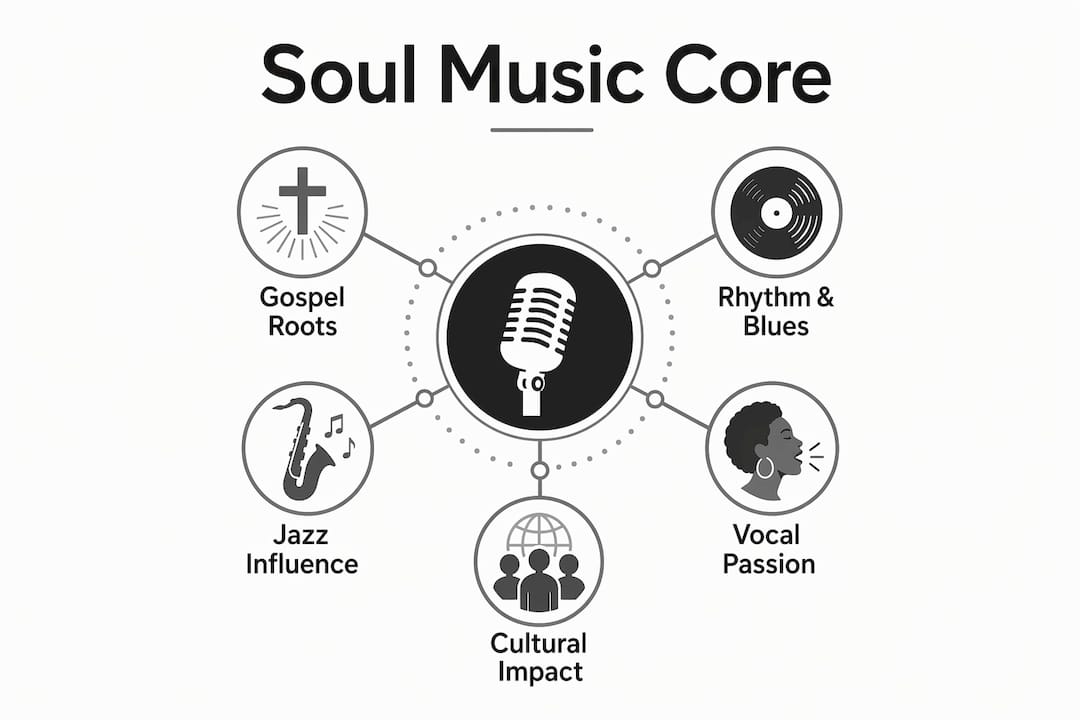
Soul music is defined as a genre born from the fusion of Black gospel, rhythm and blues, and jazz, emerging in the United States during the late 1950s and early 1960s. It carries the emotional intensity of the church and the rhythmic drive of secular music in equal measure. Record labels Motown, Atlantic, and Stax were central to its rise, each shaping a distinct flavour of the genre. Soul is not simply a style. It is a feeling representing African American emotional honesty and cultural affirmation.
Understanding soul music means recognising what makes it unlike anything else. The vocals are raw and unguarded. The groove is physical. The history is inseparable from the music itself. Whether you are hearing it for the first time or deepening your appreciation, soul rewards attention at every level.
What are the defining musical characteristics of soul music?
Soul music is built on a small set of elements that, when played together, create something far greater than their sum. The rhythm section sits at the core. Bass guitar and drum patterns lock together to form the foundational groove, and skilled musicianship is what separates a genuine soul feel from a pale imitation.
The full instrumentation typically includes:
- Drums and bass guitar forming the rhythmic backbone
- Hammond organ or electric piano adding harmonic texture and warmth
- Horn sections (trumpet, tenor saxophone, trombone) punching through the mix with rhythmic stabs
- Electric guitar providing rhythmic chops and melodic fills
- Handclaps emphasising the backbeat and encouraging physical response
Vocal delivery is where soul separates itself most clearly from related genres. Singers use melisma, the technique of sliding through multiple notes on a single syllable, to convey emotional depth. Call and response reflects its roots in Black church practice, creating an interactive and dynamic exchange between lead vocalist and backing singers. This mechanic actively engages audiences, pulling them into the performance rather than leaving them as passive listeners.
Pro Tip: Listen specifically to the interplay between the bass and the kick drum in any classic soul recording. That locked-in relationship is what creates the physical pull you feel in your chest. If the groove does not make you want to move, the rhythm section has not done its job.

Improvisation is also central. Soul singers rarely deliver a song the same way twice. Each performance is shaped by the moment, the room, and the emotional state of the singer. That spontaneity is not a lack of discipline. It is the genre’s most disciplined demand.
How did soul music shape African American culture and civil rights?
Soul music merged sacred church experience with secular life, capturing the transformative energy of America’s 1960s. That merger was not accidental. It was a direct response to the social conditions Black Americans faced during the civil rights era. Music became a vehicle for pride, resistance, and collective identity.
The origins trace back to Ray Charles, who pioneered soul by merging blues, R&B, and gospel in the 1950s. His work established the emotional and musical blueprint that artists built on for decades. Using sacred vocal techniques in secular songs sparked genuine controversy at the time. That tension between the holy and the worldly gave early soul its rebellious and authentic edge.
The cultural significance of soul during the 1950s–70s can be understood through several key developments:
- Gospel hybridisation. Artists took the call and response structures, the vocal runs, and the communal energy of Black church music and applied them to songs about love, loss, and everyday life.
- Motown’s crossover strategy. Berry Gordy built Motown in Detroit with a deliberate aim to reach white audiences without diluting Black artistry. The label’s polished production style made soul palatable to mainstream radio while retaining its cultural core.
- Atlantic and Stax as raw counterpoints. Atlantic Records in New York and Stax Records in Memphis took a grittier approach, recording artists like Aretha Franklin and Otis Redding with less studio gloss and more emotional directness.
- Soul as protest. Songs became anthems. The genre gave voice to a community demanding dignity and equality, and audiences understood the subtext even when the lyrics were not explicitly political.
“Soul music is more than style. It is a feeling representing African American emotional honesty and cultural affirmation.”
The tension around applying gospel’s sacred style to secular themes never fully disappeared. It became part of soul’s identity, a genre that always carries the weight of something larger than entertainment.
What are the main subgenres of soul music?
Soul music is not a single sound. It fractured into distinct regional and stylistic streams almost as soon as it formed. Understanding those streams helps you hear the differences between recordings that might otherwise seem similar.
Southern soul is distinct with a grittier, more rhythmically intense style compared to the polished Northern sound associated with Motown. It was produced in cities like Memphis and Muscle Shoals, Alabama, where studios like Stax and FAME Recording Studios favoured a looser, more spontaneous feel. The horn arrangements are rawer. The vocals sit closer to gospel. The tempo tends to drag slightly behind the beat, creating a heavy, swampy groove.
Southern soul’s raw energy complements Motown’s polished sound, and together they shaped soul’s diverse range. The contrast between the two is the genre’s most instructive lesson.
| Style | Origin | Sound character | Key influence |
|---|---|---|---|
| Southern soul | Memphis, Muscle Shoals | Gritty, raw, gospel-heavy | Stax, FAME Studios |
| Motown sound | Detroit | Polished, orchestrated, pop-accessible | Berry Gordy’s production model |
| Neo soul | 1990s urban centres | Introspective, jazz-influenced, organic | D’Angelo, Erykah Badu |
| Soul jazz | New York, 1950s–60s | Organ-led, bluesy, improvisational | Jimmy Smith, Ramsey Lewis |
Neo soul emerged in the 1990s as a conscious reaction against the heavily produced sound of mainstream R&B. Artists in this stream drew directly from classic soul traditions, prioritising live instrumentation, complex chord progressions, and lyrical depth. Soul jazz, meanwhile, took the organ-led groove of soul and applied jazz’s improvisational logic, creating a style that rewards close listening.
Pro Tip: If you want to understand the difference between Southern soul and the Motown sound quickly, compare Otis Redding’s “Try a Little Tenderness” with The Temptations’ “My Girl”. Both are soul. The contrast in production philosophy is immediate and unmistakable.
Each subgenre fed directly into later styles. Funk grew from Southern soul’s rhythmic intensity. Contemporary R&B absorbed Motown’s melodic polish. Hip-hop producers sampled both, carrying soul’s DNA into entirely new contexts.
How does soul music influence modern music and live performance?
Soul music continues to shape contemporary music through its core demand for emotional authenticity. Neo soul and contemporary R&B artists draw heavily from classic soul traditions, and that influence shows up in production choices, vocal technique, and song structure. The genre did not fade. It evolved and dispersed into almost every popular music form that followed it.
The hallmarks of soul’s modern influence include:
- Vocal runs and melisma appearing across pop, gospel, and R&B as standard technique
- Live horn arrangements returning to mainstream pop productions after decades of synthesised replacements
- Call and response structures embedded in hip-hop’s verse and hook dynamics
- Groove-centred production prioritising the feel of a rhythm section over technical perfection
- Emotional directness as a performance standard, with audiences now expecting vulnerability from singers across all genres
Soul’s role in live performance is particularly significant. The genre was built for rooms. The call and response dynamic only fully works when a singer can read an audience and adjust in real time. That is why soul translates so powerfully to weddings, corporate events, and live music venues. The music is designed to create shared feeling between performer and crowd.
Brownsugarmusic has performed soul and R&B live in Sydney since 2003, holding a residency at Marble Bar in the Hilton Sydney every Friday night for over 20 years. That kind of sustained live performance is exactly the environment soul music was built for. You can read more about why soul music transcends age groups and connects with audiences across generations.
Key takeaways
Soul music is a genre defined by its gospel roots, rhythmic precision, and emotional directness, making it one of the most culturally significant and enduring sounds in recorded music history.
| Point | Details |
|---|---|
| Soul music definition | Soul combines Black gospel, R&B, and jazz, originating in the late 1950s and early 1960s in the United States. |
| Core musical traits | Locked bass and drum groove, horn sections, melisma, and call and response are the genre’s defining sonic features. |
| Cultural significance | Soul was central to African American identity and the civil rights movement, with Motown, Atlantic, and Stax as key labels. |
| Subgenre diversity | Southern soul, Motown, neo soul, and soul jazz each offer distinct sounds while sharing the same emotional foundation. |
| Modern relevance | Soul’s influence runs through contemporary R&B, hip-hop, and pop, and the genre remains most powerful in live performance settings. |
Why soul still hits harder than most people expect
People often come to soul expecting something old-fashioned. They leave surprised by how physical and immediate it feels. That reaction tells you something important about what the genre actually does.
What strikes me most about soul, having spent years performing and listening to it, is the gap between how effortless it sounds and how technically demanding it is. The groove sounds natural because the musicians have worked hard to make it feel that way. The vocalist sounds spontaneous because they have internalised the tradition deeply enough to depart from it with confidence. That combination of discipline and freedom is rare in any art form.
The cultural history matters too, and not just as background information. When you understand that soul emerged from a community using music to assert dignity and resist oppression, the emotional weight of the performances makes complete sense. The singers were not performing emotion. They were reporting it. That distinction is what separates soul from genres that imitate its surface features without understanding its source.
Soul also has a quality that I find genuinely unusual. It includes people. The call and response structure, the communal groove, the physical invitation of the rhythm. These are not stylistic choices. They are the genre’s purpose. Soul was never meant to be listened to from a distance. It was built to close the gap between performer and audience entirely. That is why it connects across generations in a way that very few genres manage.
— Deni
Brownsugarmusic and the soul music experience
Soul music is best understood when you hear it live. Reading about melisma and call and response gives you the vocabulary. A live performance gives you the feeling.

Brownsugarmusic has been performing R&B and soul at Sydney’s finest venues, weddings, and corporate events since 2003. The band’s residency at Marble Bar in the Hilton Sydney spans over 20 years of Friday nights, making them one of Australia’s most experienced live soul acts. For couples planning a celebration, the R&B soul wedding atmosphere guide covers exactly how soul music shapes the mood and energy of a reception from the first song to the last. Soul is not background music. Brownsugarmusic treats it as the main event.
FAQ
What is the soul music definition?
Soul music is defined as a genre combining Black gospel, rhythm and blues, and jazz, originating in the United States during the late 1950s and early 1960s. Its core features are emotive vocals, a locked rhythm section groove, and call and response vocal technique.
How did soul music develop historically?
Soul developed when artists like Ray Charles began applying gospel vocal techniques to secular R&B material in the 1950s. Labels including Motown, Atlantic, and Stax then shaped distinct regional styles that spread the genre to mainstream audiences through the 1960s and 1970s.
What are the main soul music characteristics?
The defining characteristics are passionate lead vocals using melisma, a tight bass and drum groove, horn sections, organ or electric piano, and call and response between vocalist and backing singers. Handclaps emphasising the backbeat are also a consistent feature.
What is the difference between Southern soul and the Motown sound?
Southern soul, produced in cities like Memphis and Muscle Shoals, has a grittier and more gospel-influenced sound with a looser rhythmic feel. The Motown sound from Detroit is more polished and orchestrated, designed for broader pop radio appeal.
How does soul music influence music today?
Soul’s influence appears in contemporary R&B vocal technique, hip-hop production sampling, and the return of live horn arrangements in mainstream pop. Neo soul artists draw directly from classic soul traditions, keeping the genre’s emotional and musical values active in current music.