

R&B soul music is a genre that fuses rhythm and blues with gospel-inspired vocal intensity and emotive live performance, rooted in African American musical traditions from the mid-20th century. The term covers both a broad commercial category and a specific cultural movement. Artists like Sam Cooke, Aretha Franklin, and Otis Redding defined its emotional core. Labels like Motown and Stax Records gave it commercial shape. According to Grammy industry data, R&B and rap surpassed rock as the most consumed music genres in the United States in 2017. That shift reflects decades of cultural influence, not a sudden trend.
What are the historical origins of R&B soul music?
The story of R&B soul music begins with a name change. Billboard journalist Jerry Wexler coined “rhythm and blues” in the late 1940s to replace the term “race music,” which had been used to categorise recordings by Black artists. The new label was more commercially neutral. It also opened the door for wider distribution and radio play.
By the 1950s, rhythm and blues had become a broad umbrella. It covered everything from jump blues and boogie-woogie to early rock and roll. Then, in the late 1950s and into the 1960s, something more specific emerged from within it.
Soul music grew directly out of R&B, drawing heavily on the vocal traditions of Black gospel churches. The key shift was emotional directness. Where earlier R&B was often dance-focused and rhythmically driven, soul placed the voice at the centre. Artists like Ray Charles, Sam Cooke, and later Aretha Franklin brought church-trained vocal power into secular music. The result was raw, personal, and deeply felt.
Several forces shaped soul’s identity during this period:
- The civil rights movement gave soul music a political and cultural weight. Soul music embodied a collective African American consciousness, expressing lived experiences, pride, and resistance.
- Motown Records, founded by Berry Gordy in Detroit in 1959, refined soul into a polished pop format with artists like Marvin Gaye, Stevie Wonder, and The Supremes.
- Stax Records in Memphis took a rawer, grittier approach, producing Otis Redding, Isaac Hayes, and Booker T. & the MGs.
- Atlantic Records in New York signed Aretha Franklin and Ray Charles, bridging gospel, jazz, and blues into a commercially powerful sound.
By the 1970s, the R&B category had expanded again to include funk, disco, and quiet storm. Soul remained a distinct thread within it, defined by its gospel roots and live performance ethos.
How is R&B soul music defined stylistically and musically?
R&B soul music is defined by blues chord structures, jazz phrasing, and gospel vocal intensity, with tempos ranging from 60–140 BPM depending on the style. That range is wide by design. A slow Otis Redding ballad and an upbeat Aretha Franklin track both qualify because the defining element is not tempo. It is feel.
Vocal style
The voice is the instrument that separates soul from other genres. Soul singers use melisma (the technique of sliding through multiple notes on a single syllable), call-and-response patterns borrowed from gospel, and deliberate vocal roughness to convey emotion. Aretha Franklin’s Respect and Sam Cooke’s A Change Is Gonna Come are textbook examples. Neither track relies on studio polish to land its impact. The voice does the work.
Instrumentation
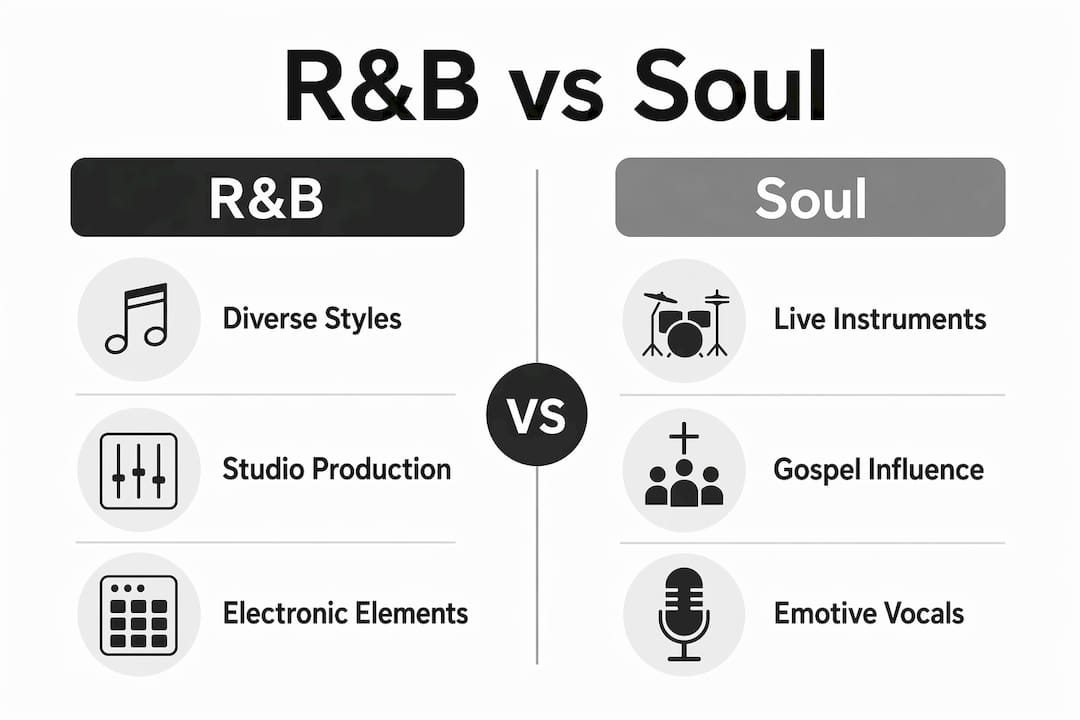
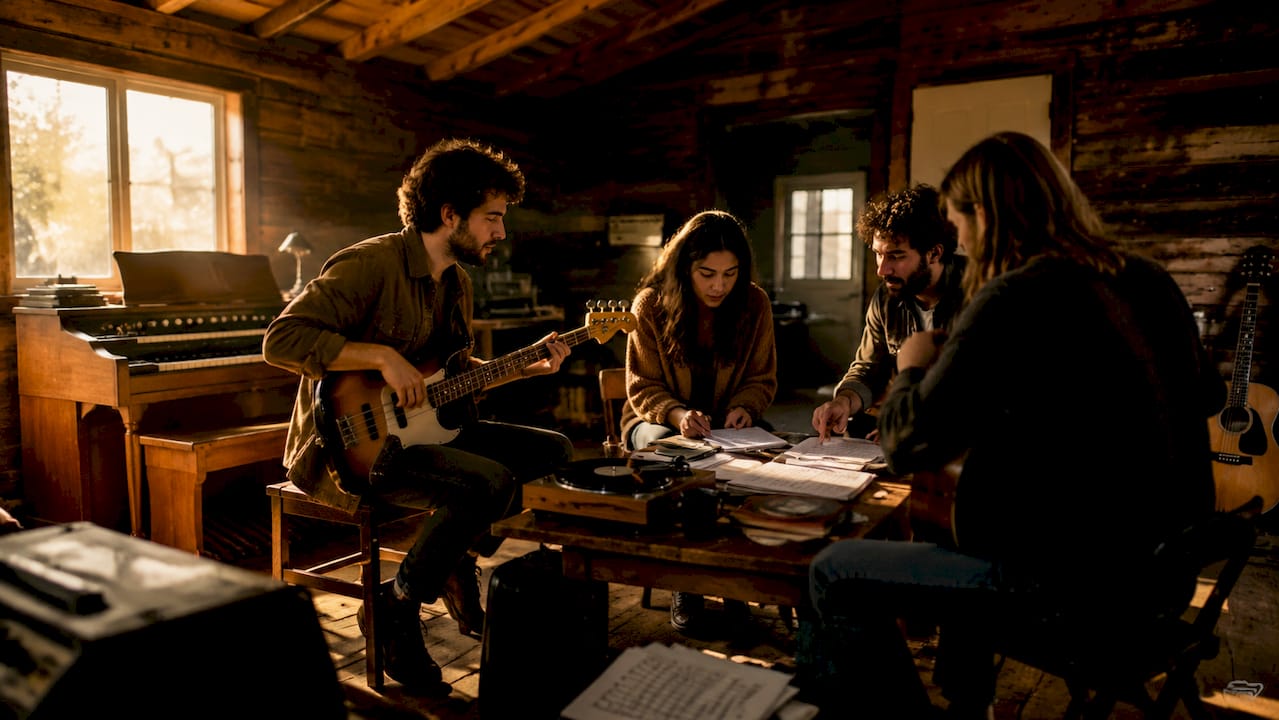
Traditional soul recordings feature live horns, Hammond organ, upright or electric bass, and a full drum kit. The band plays together in a room. That collective energy is captured in the recording. Modern R&B, by contrast, typically uses DAW production, programmed beats, and synth layering. The result is cleaner and more controlled, but it trades the live room energy for precision.
Rhythmic feel
Traditional soul features a shuffle or swing rhythmic feel, which gives the music a loose, human quality. Contemporary R&B typically uses straight beats influenced by hip-hop. If you tap along to an Otis Redding track and a modern R&B track back to back, the difference is immediately physical. One pushes and pulls. The other locks in tight.
Pro Tip: When identifying a soul track in a playlist, listen for the snare placement. A soul snare often lands slightly behind the beat. A modern R&B snare sits precisely on it. That single detail tells you more about the genre than the production budget.
| Feature | Classic soul | Modern R&B |
|---|---|---|
| Production method | Live band, analogue recording | DAW, programmed beats, synths |
| Vocal style | Gospel-inflected, raw, melismatic | Polished, Auto-Tuned, layered |
| Rhythmic feel | Shuffle or swing | Straight, hip-hop influenced |
| Tempo range | 60–100 BPM (typically) | 70–140 BPM |
| Key artists | Aretha Franklin, Otis Redding | Beyoncé, Frank Ocean, SZA |
What is the difference between R&B and soul music?
Soul is technically a subgenre and historical branch of R&B, not a separate genre entirely. Most people confuse the two because the overlap in vocal style and cultural origin is genuine. The distinction matters most when you are talking about production approach, era, and cultural intent.
R&B is the broader category. It has existed since the late 1940s and has absorbed soul, funk, disco, new jack swing, and contemporary urban pop. Soul is a specific movement within that history, concentrated in the 1960s and 1970s, defined by gospel vocal power and live instrumentation.
Here is where the practical differences show up:
- Cultural identity. Soul music was also an identity movement. It carried the weight of the civil rights era in a way that the broader R&B category did not. The word “soul” itself was chosen deliberately to signal Black pride and community.
- Production values. Soul recordings prioritise the organic live band feel over technical perfection. Modern R&B prioritises a polished, commercially competitive sound.
- Industry classification. The Recording Academy reflects this evolution. In 2021, the Grammys renamed “Best Urban Contemporary Album” to “Best Progressive R&B Album” to better describe modern sounds. That renaming acknowledged that the genre had moved well beyond its soul roots in many cases.
- Live performance. Soul music’s identity is inseparable from live performance. Recreating the original live band dynamics is central to how audiences receive and judge a soul performance. R&B events increasingly rely on backing tracks and DJ sets.
The simplest way to think about it: all soul is R&B, but not all R&B is soul. Soul is older, rawer, and more tied to live music and cultural identity. R&B is broader, more production-heavy, and commercially flexible.
How has R&B soul music influenced modern music and culture?
R&B soul music is the foundation beneath most popular music made in the last 60 years. Hip-hop samples soul records extensively. Pop borrows its vocal runs and emotional directness. Neo-soul artists like Erykah Badu, D’Angelo, and Lauryn Hill revived the live band ethos in the 1990s and early 2000s, proving the original formula still worked. The influence of jazz on hip-hop and rap runs parallel to soul’s influence, with both traditions feeding into the same creative lineage.
Modern artists who carry the soul tradition forward include Beyoncé, whose Lemonade album drew directly on Southern soul and gospel, and Leon Bridges, whose debut album Coming Home was recorded to sound like a lost 1960s Stax session. John Legend, Alicia Keys, and Amy Winehouse all built careers on the intersection of classic soul and contemporary production.
The genre’s cultural roots in urban music continue to shape how artists express identity, community, and lived experience. That connection is not nostalgic. It is structural.
Soul music also remains one of the most requested genres for live events. Weddings, corporate functions, and private parties consistently favour R&B and soul because the music is emotionally legible to a wide age range. It does not require genre knowledge to feel. That accessibility is a direct product of its gospel roots, where the goal was always to move people, not impress them. The appeal of R&B at weddings comes down to exactly this quality: it connects across generations without effort.
Key takeaways
R&B soul music is a gospel-rooted subgenre of rhythm and blues, defined by live instrumentation, emotive vocals, and deep cultural identity within African American history.
| Point | Details |
|---|---|
| Soul is a subgenre of R&B | All soul is R&B, but R&B covers far more ground than soul alone. |
| Gospel vocals define the sound | Melisma, call-and-response, and raw emotional delivery separate soul from other genres. |
| Live instrumentation matters | Classic soul uses live horns, organ, and drums; modern R&B relies on programmed production. |
| Civil rights context shaped soul | Soul music carried cultural and political identity during the 1960s civil rights movement. |
| The genre still drives live events | Soul and R&B remain the most requested genres for weddings and live performance settings. |
Why the distinction between R&B and soul still matters
After performing this music for over two decades, I find that most people who say they love “R&B” are actually describing a feeling that belongs specifically to soul. They mean the live band. They mean the voice that sounds like it costs something to sing. They mean the moment when a room stops talking and starts listening.
The distinction between R&B and soul is not academic. It changes what you book, what you listen for, and what you get out of a live performance. When someone books a soul band expecting polished pop R&B, both sides are disappointed. When someone understands what soul actually is, they know exactly why soul music transcends age groups in a way that most genres do not.
The genre’s history is also its instruction manual. The civil rights movement did not produce soul music as a side effect. Soul music was a deliberate act of cultural expression. Understanding that context makes the music more, not less, enjoyable. You hear what is actually in it.
My honest recommendation: start with the originals. Listen to Aretha Franklin’s I Never Loved a Man the Way I Love You, Otis Redding’s Dock of the Bay, and Marvin Gaye’s What’s Going On before you form an opinion about what the genre is. Then listen to D’Angelo’s Voodoo and Leon Bridges’ Coming Home to hear where it went next. The line between them is clear once you know what to listen for.
— Deni
Hear R&B soul music live with Brownsugarmusic
Brownsugarmusic has performed authentic R&B and soul music across Sydney and around the world since 2003. As the resident band at Marble Bar in the Hilton Sydney every Friday night for over 20 years, Brownsugarmusic brings the live band energy that defines genuine soul to every performance.

If you are planning a wedding or event and want to understand how this music translates to a live setting, the R&B soul wedding atmosphere guide covers everything from song selection to band setup. You can also browse upcoming live events to experience the sound firsthand before booking.
FAQ
What is R&B soul music in simple terms?
R&B soul music is a genre that combines rhythm and blues with gospel-inspired vocals and live band performance, originating in African American communities in the 1950s and 1960s.
How does soul music differ from R&B?
Soul is a subgenre of R&B focused on gospel vocal power and live instrumentation, while modern R&B is a broader category that includes digitally produced, pop-influenced styles.
Who are the most influential soul music artists?
Aretha Franklin, Sam Cooke, Otis Redding, Ray Charles, and Marvin Gaye are the most widely cited foundational artists in soul music history.
What instruments are typical in soul music?
Classic soul recordings feature live horns, Hammond organ, electric or upright bass, and a full drum kit played together in a room, which creates the genre’s characteristic warmth and energy.
Why is soul music still popular at events and weddings?
Soul music is emotionally accessible across age groups because its gospel roots were designed to move audiences directly, making it one of the most consistently requested genres for live events and weddings.