

A band set list is an ordered document created for a specific performance, listing songs, planned breaks, banter cues, and technical notes to shape the mood and flow of a live show. Also called a performance set list or running order, it functions as the central reference point for every person on stage and behind the mixing desk. For musicians, event planners, and concert-goers, understanding what goes into a set list explains why some live shows feel tight and electric while others drift and lose the room.
What is a band set list and what does it contain?
A band set list is defined as an ordered plan of songs and performance elements, tailored to a specific audience, venue, and occasion. It is not simply a playlist. Where a playlist is a passive sequence of recordings, a set list is an active performance document that guides decisions in real time.
The components of a well-built set list go well beyond song titles. Each entry typically carries information that serves both the performers and the production crew:
- Song titles and order. The sequence is deliberate, not random. Each position in the running order serves a purpose in the energy arc of the show.
- Planned breaks and encores. Breaks and encores are written into the document so the band and crew know exactly when to pause, reset, or extend the show.
- Banter cues. Short reminders for audience interaction, dedications, or announcements keep the performance feeling spontaneous without leaving anything to chance.
- Technical cues. BPM and dynamics are included so sound and lighting engineers can align audio and visual elements with each song’s tempo and mood.
The set list also functions as a quick on-stage reference. Visible set lists prevent awkward pauses and keep every band member aligned, particularly under the pressure of a live show with adrenaline running high.
Pro Tip: Keep the stage copy of your set list to essential information only. Song title, key, and any critical cue. Detailed lyrics and chord charts belong in a separate folder offstage.

How is a set list structured for maximum impact?
The structure of a set list follows what experienced performers call an energy arc. This is the deliberate rise and fall of intensity across the show, designed to hold audience attention from the first song to the last.
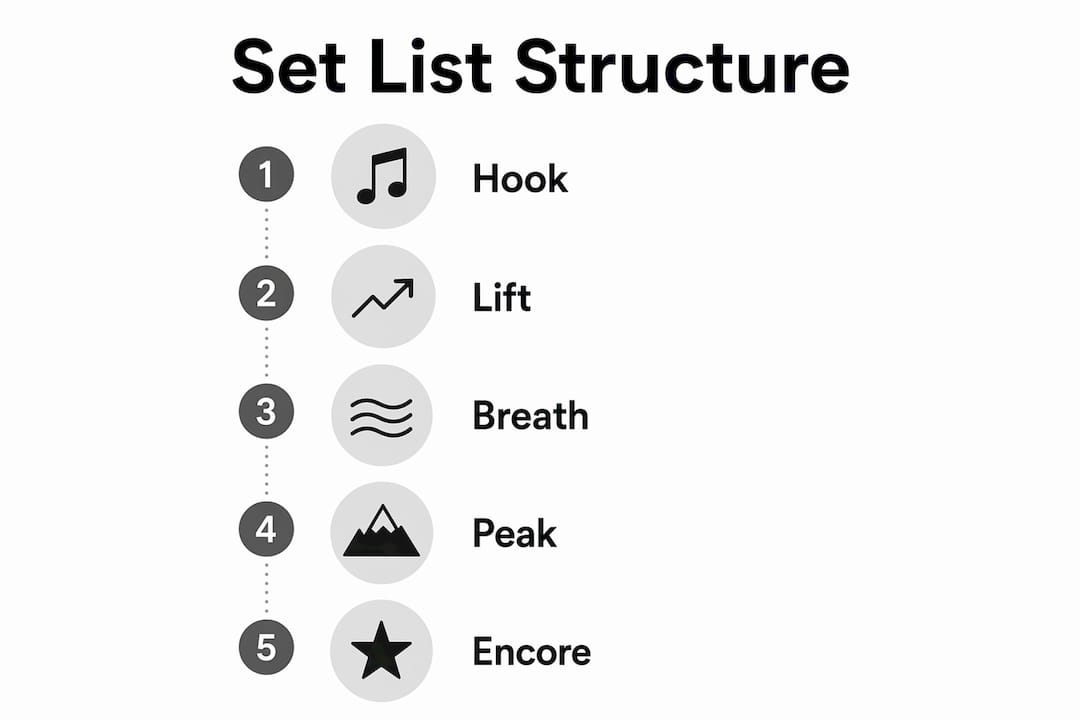
Effective set lists follow a five-part framework that most professional bands use in some form:
- Hook. Open with a song that is immediately recognisable or high energy. The first 60 seconds set the audience’s expectation for the entire show.
- Lift. Build momentum across the next two or three songs. Tempo and dynamics should rise, not plateau.
- Breath. A mid-set moment of lower intensity. A slower song or a brief pause gives the audience time to recover and re-engage.
- Climb. The second and stronger build. This is where the most crowd-pleasing material sits.
- Closer. The final song is the peak of the show. Most-known songs belong near the end, but not always last. Saving one strong track for an encore creates a memorable finish.
Pacing and transitions matter as much as song selection. Even minor gaps between songs can lose audience momentum, so transition lengths need to be planned alongside the running order itself.
| Structure element | Purpose |
|---|---|
| Hook (opening) | Captures attention immediately and sets the tone |
| Lift (early build) | Builds energy and establishes the band’s range |
| Breath (mid-set) | Prevents fatigue and creates contrast |
| Climb (second build) | Delivers the strongest crowd-pleasing material |
| Closer (finale) | Leaves the audience with the highest emotional peak |
Adaptability is built into this framework. A set list prepared for a corporate function in a hotel ballroom will differ from one built for a late-night bar crowd. Treating the set list as a draft that can be adjusted after soundcheck, based on venue size and crowd demographics, produces better results than following a fixed order regardless of conditions.
Pro Tip: Number every song on the stage copy. If the band needs to skip or swap a track mid-show, calling out a number is faster and clearer than whispering a song title across the stage.
Band set lists vs tech set lists: what is the difference?
Two distinct documents serve a live performance, and confusing them creates production problems. The performance set list is written for the musicians. The tech set list is written for the crew.
Tech set lists provide sound and lighting engineers with timing information, technical cues, and song-specific notes that the musicians do not need to see on stage. A tech set list might include BPM for lighting chases, notes on key changes that affect monitor mixes, or flags for songs that use backing tracks.
Both documents sit within a wider production workflow. Coordinated production documents including show worksheets, stage plots, and input lists help align the band and crew before the show begins. When these documents are consistent with each other, soundchecks run faster and load-in scheduling becomes predictable.
The table below shows how the two set list types divide responsibilities:
| Document | Primary user | Key content |
|---|---|---|
| Performance set list | Musicians on stage | Song order, keys, banter cues, encores |
| Tech set list | Sound and lighting crew | BPM, technical cues, timing notes, backing track flags |
Set list accuracy is critical across all production documents. A song that appears on the performance set list but not on the tech set list creates confusion during the show. All documents must match before the first soundcheck begins.
Professional bands also separate detailed musical content from the stage-facing copy. Chord charts, lyrics, and arrangement notes stay offstage. The floor sheet that sits on a monitor or music stand contains only what the performer needs to glance at in two seconds under stage lighting.
How bands and event planners use set lists in practice
Set lists serve different purposes depending on who is holding them. For musicians, the set list is a live performance tool. For event planners, it is a scheduling and production document. For fans, it is a record of the show.
The website setlist.fm has built an entire community around documenting set lists, with fans recording venue, date, and song order for shows around the world. Historically, fans collected physical set lists from the stage after performances. Today, real-time posting during shows is standard practice. This documentation matters for touring bands managing repertoire across multiple nights.
For event planners, the set list connects directly to the event timeline. Knowing when a band will take a break, how long each set runs, and where the energy peaks allows planners to coordinate catering, speeches, and other programme elements without disrupting the performance. Preparing a set list as a draft that the band can edit after soundcheck gives planners a reliable running order while preserving flexibility for live conditions.
Practical applications vary by event type:
- Weddings. The set list is built around key moments: first dance, dinner service, and late-night floor-fillers. The band gig repertoire must cover a wide age range and emotional register.
- Corporate functions. Background music sets require lower energy arcs. The set list prioritises consistency over peaks and valleys.
- Bar residencies. Bands playing weekly residencies, such as Brownsugarmusic’s long-running Friday night slot at Marble Bar in the Hilton Sydney, maintain a rotating band gig repertoire that keeps regulars engaged across multiple visits.
- Festivals and tours. Set lists are locked earlier and distributed to multiple crew members. Adaptations happen at soundcheck, not during the show.
The set list as a collaborative document serves musicians, sound engineers, lighting operators, and event planners simultaneously. Designing it with all users in mind produces a better show for everyone in the room.
Key takeaways
A band set list is a production document as much as a performance tool, and its structure directly determines the quality of the live show.
| Point | Details |
|---|---|
| Definition and purpose | A set list is an ordered performance document covering songs, breaks, banter cues, and technical notes. |
| Energy arc framework | Effective set lists follow a hook, lift, breath, climb, and closer structure to hold audience attention. |
| Two document types | Performance set lists serve musicians; tech set lists serve sound and lighting crews with additional cues. |
| Production integration | Set lists must align with show worksheets, stage plots, and input lists to avoid confusion at soundcheck. |
| Adaptability is key | Treating the set list as a draft and adjusting after soundcheck produces better results than a fixed order. |
Why the set list is the most underrated document in live music
After performing at Marble Bar every Friday night for over 20 years, I have seen what happens when a band walks on stage without a proper set list. Songs get called out mid-show. The lighting engineer misses a cue because nobody told them the order changed. The crowd loses the thread somewhere around the fourth song and never fully comes back.
The set list is not a constraint. It is the opposite. When the running order is settled before the show, every musician on stage can focus entirely on playing. The cognitive load of remembering what comes next disappears. What remains is presence, and that is what audiences actually respond to.
The part most bands get wrong is treating the set list as a song catalogue rather than a narrative. An energy-focused set list creates the best audience engagement, not simply a collection of hits played in no particular order. The difference between a good show and a great show is almost always in the structure, not the material.
Technology is changing how set lists are managed. Apps and digital tools now allow real-time edits that sync across the whole band’s devices. But the underlying logic has not changed since the first band taped a piece of paper to a monitor. Know your order, know your cues, and leave room to adapt.
— Deni
See Brownsugarmusic live: set list expertise in action
Brownsugarmusic has been building and performing expert set lists for over two decades, from intimate bar nights to large-scale corporate events and weddings across Sydney and beyond. Every show is built around a carefully structured running order that keeps the energy high and the crowd engaged from the first song to the last. Whether you are planning a wedding, a corporate function, or a private event, Brownsugarmusic brings the same level of preparation and professionalism to every performance. See Brownsugarmusic live in action and find out how to book them for your next event at brownsugarmusic.com.au.
FAQ
What is a band set list?
A band set list is an ordered document listing the songs, breaks, banter cues, and technical notes planned for a specific live performance. It guides both musicians and production crew throughout the show.
What should you include in a set list?
A set list should include song titles in performance order, planned breaks and encores, banter or announcement cues, and technical notes such as BPM for sound and lighting engineers.
How do you structure a set list for a live show?
Most professional bands follow an energy arc: open with a hook, build with a lift, ease with a breath, climb to a peak, and close on the strongest material. This framework holds audience attention across the full performance.
What is the difference between a performance set list and a tech set list?
A performance set list is written for the musicians on stage. A tech set list is written for the sound and lighting crew, containing additional timing and technical cues not needed by the performers.
How do event planners use a band’s set list?
Event planners use the set list to coordinate the event timeline, scheduling speeches, catering, and other programme elements around the band’s breaks and energy peaks to avoid disrupting the performance.