

Managing guest music requests for your wedding band works best when you set clear policies before the day itself. A structured approach lets guests feel involved without handing them control of the dance floor. The industry term for this process is request management, and it covers everything from collecting song suggestions to filtering them live. Done well, it produces a personalised wedding playlist that feels spontaneous yet never loses momentum. This guide covers every stage, from setting boundaries to collaborating with your band on the night.
How to set policies for guest music requests to your wedding band
A three-tiered request policy is the most effective structure for managing wedding band song requests without losing control of the evening. Sir Force defines the three tiers as: Tier 1 (your must-plays), Tier 2 (approved guest requests), and Tier 3 (songs excluded for content or fit). This framework gives guests a genuine voice while protecting the atmosphere you have planned.
Building your do-not-play list
A do-not-play list is not optional. HD Entertainment confirms that specific prohibitions on songs or artists help protect energy and avoid uncomfortable moments. The list communicates your tastes to the band without requiring a lengthy conversation on the day.
Common categories to exclude include:
- Explicit tracks that are unsuitable for mixed-age crowds
- Ex-related songs that carry personal baggage
- Genre mismatches that would empty the floor (think heavy metal at an R&B reception)
- Overplayed wedding clichés you have heard at every function for a decade
Keep the list to 10–20 songs. A longer list becomes difficult for the band to cross-reference quickly during a live set.
Setting tier 2: the approved request pool

Tier 2 is where guest involvement lives. Compile a pool of 40–60 songs that fit your vibe and that your band already knows. Guests choose from within that pool, so every request is playable and on-brand. This approach removes the awkward moment where a guest requests something the band has never rehearsed.
Pro Tip: Share the approved song pool with guests before the wedding via your wedding website or RSVP card. Guests who browse the list in advance make better requests on the night.
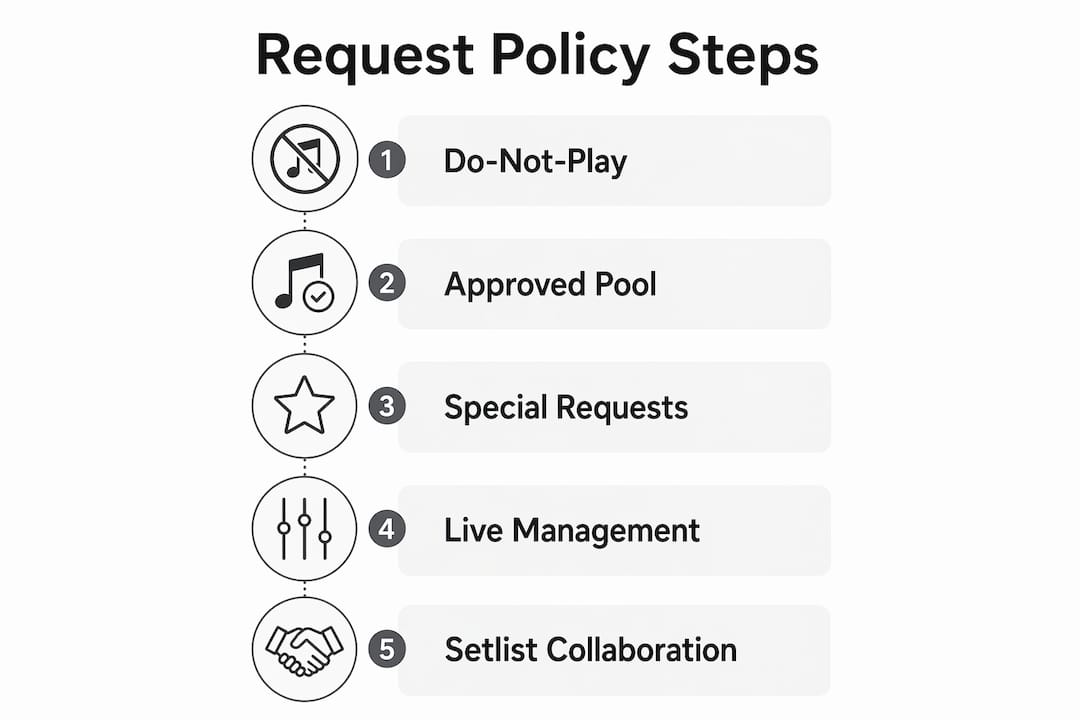
Clear upfront communication prevents frustration. Rekwest notes that guests generally understand live bands have a limited repertoire, and that setting expectations early stops awkward moments at the stage.
How to gather and organise guest song suggestions
Collecting live music guest requests before the wedding reduces chaos on the day. The four most practical methods are:
- RSVP cards with a single song request field
- Wedding website forms linked to a shared spreadsheet
- A dedicated wedding band request form emailed to guests two weeks before the event
- QR codes at the reception venue that link to a pre-approved song list
Once collected, sort requests into three columns: songs the band already knows, songs requiring minor preparation, and songs outside the band’s repertoire entirely. This table format makes the pre-wedding conversation with your band straightforward.
| Request Category | Action Required | Typical Outcome |
|---|---|---|
| Already in repertoire | Add to Tier 2 pool | Playable on the night |
| Requires preparation | Discuss with band | May incur a learning fee |
| Outside repertoire | Decline politely | Redirect to similar song |
Using digital tools for live request management
Rekwest is a purpose-built app that lets bands manage guest requests during live events. Guests scan a QR code, browse the approved song list, and submit requests without approaching the stage. The band sees requests in real time and accepts or declines based on suitability. This removes the disruption of guests queuing at the stage mid-set.
Pro Tip: Limit new song learning requests to one or two tracks beyond the first dance. Most bands charge £50–£100 per additional song to cover arranging and rehearsal costs, so the fees add up quickly for larger bands.
How to collaborate with your wedding band on the set list
FixTheMusic reports that most bands play two sets of 45–60 minutes each, covering around 30–40 songs across the evening. That number matters. It tells you how many guest requests can realistically fit without disrupting the band’s planned flow.
Negotiating custom song learning
Wedding bands distinguish between songs already in their repertoire and songs that require full rehearsal. FixTheMusic confirms that fees for learning additional songs typically range from £50 to £100 per track, with higher costs for larger ensembles. Budget for one or two custom requests beyond the first dance, and prioritise songs with genuine emotional significance over novelty choices.
Key points to discuss with your band before signing the contract:
- How many free custom songs are included in the package
- The deadline for submitting your final request list
- Who handles live requests on the night (most bands designate one member as request handler)
- How the band signals when a request cannot be accommodated
Trusting the band to read the room
Experienced bands filter and time requests rather than play them all. FixTheMusic is direct on this point: excessive guest control over the set list harms the experience because it prevents the band from reading the room and managing energy in real time. A band that has played 200 weddings knows when the floor needs a tempo shift. That knowledge is worth protecting.
Brownsugarmusic has been the resident band at Marble Bar in the Hilton Sydney every Friday night for over 20 years. That kind of consistent live experience produces exactly the crowd-reading instinct that makes a wedding floor work. You can see how professional bands approach set list structure to understand why this matters.
What mistakes should couples avoid with guest song requests?
Unfiltered guest requests are the single biggest risk to wedding floor energy. Sir Force confirms that a curated approved list and a do-not-play list directly reduce the risk of awkward moments and floor-clearing song choices. Without these tools, one misplaced request can shift the mood in under three minutes.
Common mistakes to avoid:
- No approved list: Guests request anything, including songs the band cannot play
- No do-not-play list: The band has no way to protect against songs you hate
- Unlimited requests: Guests monopolise the band’s attention and disrupt set flow
- Late submission: Sending requests the week of the wedding leaves no time for preparation
- Ignoring timing: Slow ballads at 10pm kill momentum; fast tracks during dinner feel jarring
“Most couples prefer that requests do not override their boundaries and do not kill momentum, requiring bands to filter requests professionally.” Sir Force
Politely redirecting a request is a skill. Train the band to offer an alternative from the approved list rather than a flat refusal. “We can’t do that one tonight, but we can play something similar” keeps the guest happy and the floor intact.
Creative ways to involve guests in music selection
A curated pool of approved songs gives guests genuine choice without exposing the set list to chaos. The pool works best when it covers multiple decades and genres, so guests of different ages find something familiar. For wedding entertainment for older guests, including Motown classics, 80s soul, and early 90s R&B alongside current tracks covers most age groups in one list.
Comparison: request methods at a glance
| Method | Guest Experience | Band Control | Setup Effort |
|---|---|---|---|
| RSVP card field | Simple, familiar | High (pre-filtered) | Low |
| Wedding website form | Convenient, digital | High (pre-filtered) | Medium |
| QR code at venue (Rekwest) | Interactive, live | Medium (real-time filter) | Medium |
| Open stage requests | Spontaneous | Low (unfiltered) | None |
Interactive methods work well for the reception. Place request cards at each table with a short list of 10–15 approved songs. Guests circle their choice and a member of the wedding party collects them before the first set. This creates involvement without open-mic chaos.
Additional ideas that work in practice:
- A “yes list” for family members: Give parents and siblings a short list of guaranteed plays so they feel included
- Announcement moments: Have the MC invite guests to submit requests via QR code at a set time, rather than throughout the night
- Genre voting: Let guests vote between two genre options for the final set, giving collective input without individual chaos
Songs that cross age groups reliably include tracks from artists like Stevie Wonder, Beyoncé, Bruno Mars, and Aretha Franklin. These sit naturally in an R&B and soul set without requiring stylistic compromise from the band.
Key takeaways
Managing guest music requests for a wedding band requires a tiered policy, a curated approved song pool, and clear pre-event communication with both guests and the band.
| Point | Details |
|---|---|
| Use a three-tier request policy | Separate must-plays, approved requests, and excluded songs before the wedding day. |
| Build a do-not-play list | Specific exclusions protect the atmosphere and remove guesswork for the band. |
| Collect requests before the event | RSVP cards, wedding websites, and tools like Rekwest reduce on-the-night disruption. |
| Budget for custom song fees | Most bands charge £50–£100 per additional track learned beyond the first dance. |
| Trust the band’s live judgement | Experienced bands read the room and time requests to maintain floor energy. |
What i have learned about guest requests after two decades of weddings
The couples who have the best nights are the ones who plan the framework and then let go. They submit their must-plays, build a solid approved list, and then trust the band to do its job. The couples who struggle are the ones who try to script every moment, or who let a vocal guest commandeer the request process halfway through the evening.
The three-tier policy sounds formal on paper, but in practice it feels invisible. Guests feel heard because they have genuine options. The band feels supported because it has clear boundaries. And the couple gets a floor that stays full from the first set to the last song.
One thing I would add that most guides skip: talk to your band about timing as well as song choice. A great request played at the wrong moment still kills momentum. Ask your band how they handle the transition between a guest request and the next planned track. A band that has a clear answer to that question is a band that has thought about it. That is the kind of experience that makes a real difference on the night.
Allow some spontaneity. Leave a few slots in the approved list genuinely open. The best moments at weddings are often the ones that were not planned to the minute.
— Deni
How Brownsugarmusic handles wedding song requests
Brownsugarmusic has been performing at Sydney weddings since 2003, and their approach to request management reflects that experience directly. They support the three-tier request structure, work with couples to build curated approved lists, and designate a band member to handle live requests without disrupting the set.
Their R&B and soul repertoire covers Motown, 90s R&B, neo-soul, and contemporary hits, which means the approved song pool is already broad enough to satisfy most guest lists. For couples who want to understand exactly how a professional set list is built around guest input, the Brownsugarmusic wedding set list guide covers the full process. To discuss your specific music wishes and request preferences, contact Brownsugarmusic directly through their wedding band page.
FAQ
How many guest requests should a wedding band accept?
Most wedding bands play 30–40 songs across two sets. Allocating 8–12 slots for guest requests from a pre-approved list is a practical balance that keeps guests involved without disrupting the band’s planned flow.
What is a wedding band request form?
A wedding band request form is a document or digital tool couples use to collect song suggestions from guests before the event. It filters requests against the band’s repertoire and the couple’s approved list before the wedding day.
Can guests request songs the band does not know?
Bands can learn additional songs, but most charge £50–£100 per track beyond one or two free custom songs. Submit any new song requests at least four weeks before the wedding to allow adequate rehearsal time.
What should go on a do-not-play list?
A do-not-play list should include explicit tracks unsuitable for mixed audiences, songs with personal negative associations, and genre mismatches that would disrupt the atmosphere. HD Entertainment recommends keeping it specific to songs and artists rather than broad genres.
How do digital tools like rekwest help with live requests?
Rekwest lets guests browse an approved song list via QR code and submit requests without approaching the stage. The band reviews and accepts or declines requests in real time, keeping the performance uninterrupted.