

Confirm four things first: a dedicated power source, a covered or sheltered performance area, a flat stage footprint, and a written wet weather plan with clear trigger conditions. Get those in writing before anything else. An outdoor wedding live music setup that skips any one of these four items risks equipment failure, a delayed ceremony, or a band that cannot legally perform.
Immediate checklist to send your venue and band:
- Confirm mains supply or generator size (3,500–5,000W minimum for a mid-size rig)
- Confirm a covered backup location and who triggers the move
- Confirm load-in route, surface type, and minimum stage footprint
- Confirm noise curfew, permitted sound levels, and who holds the licence
- Request a written setup and soundcheck timeline from the band
- Ask the band whether they bring their own power or need a dedicated circuit
The sections below unpack each item: space and stage layout, power and equipment, timing and load-in, weather contingency, band logistics, soundcheck and transitions, and UK permits. Before hiring a wedding band, confirm every item on this list in writing.
Key takeaways
A reliable outdoor wedding live music setup depends on confirming power, shelter, a flat stage footprint, and a written wet-weather plan before any other decision.
| Point | Details |
|---|---|
| Confirm power first | A mid-size band needs 3,500–5,000W; larger rigs need more than 5,000W. |
| Stage footprint by act size | A five to eight piece band needs at least an area adequate for five to eight-piece acts of flat, level space. |
| Build in the 30-minute buffer | Allow 30–60 extra minutes for outdoor load-in and a buffer between ceremony and reception music. |
| Write the wet-weather plan | Document trigger conditions and a backup location with confirmed power reach before the day. |
| Brownsugarmusic | An experienced R&B and soul band with over two decades of wedding and event performance. |
Table of Contents
- How much space does an outdoor wedding band need?
- What power and equipment does an outdoor band need?
- Timing, load-in and the 30-minute rule
- How do you plan for weather at an outdoor wedding?
- Band logistics: access, storage and hospitality
- How to run a soundcheck and manage set transitions
- UK permissions, noise rules and neighbour communication
- What most outdoor music guides get wrong
- Brownsugarmusic: experienced live music for your wedding
- Sources
How much space does an outdoor wedding band need?
Pick a flat, level area close enough for guest sightlines but set back from the registrar or celebrant so the band does not overpower the ceremony. Live musicians need stable ground, weather protection, and clear sightlines to time entrances and exits accurately. Hiding the band behind a floral arch or a hedge looks tidy on paper but causes missed cues.
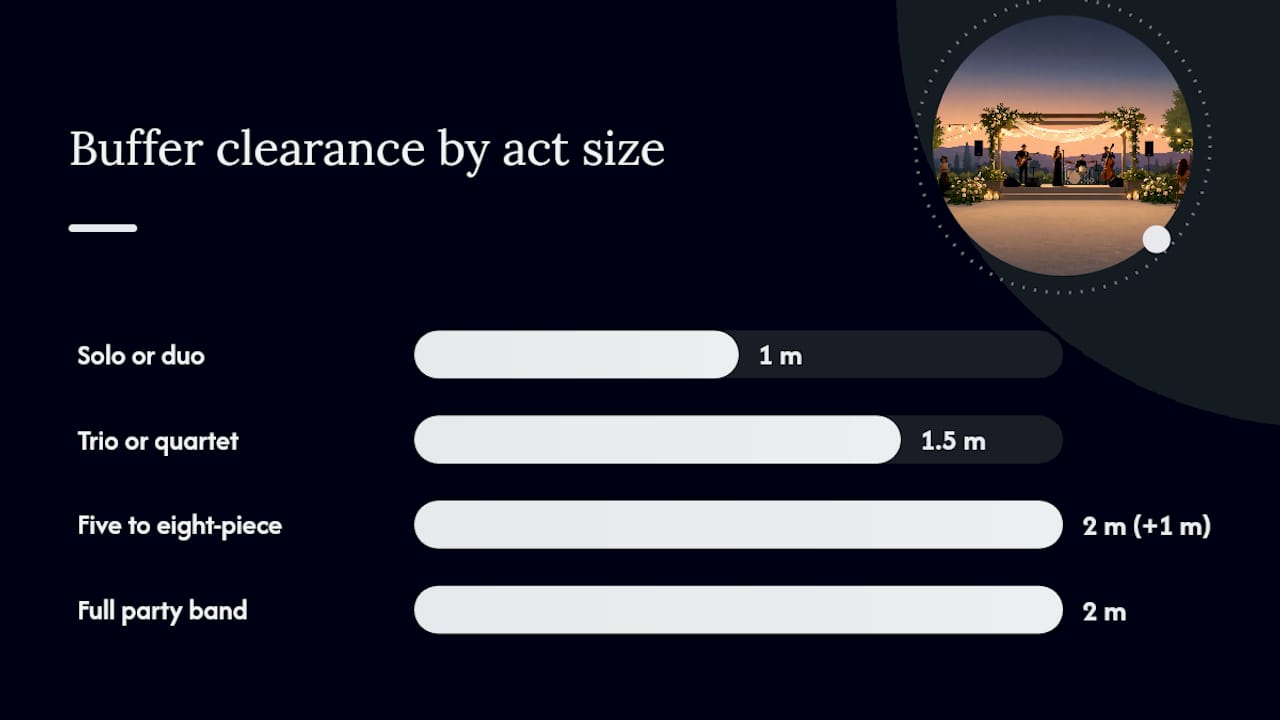
| Act size | Minimum footprint | Buffer note |
|---|---|---|
| Solo or duo | 3m × 2m | 1m clear on each side |
| Trio or quartet | an area adequate for trio or quartet acts | 1.5m clear at front and sides |
| Five to eight-piece | an area adequate for five to eight-piece acts | 2m clear at front; drum riser adds 1m depth |
| Full party band with drum riser | an area adequate for full party bands with drum risers | 2m clear all sides; sub placement needs floor coupling |
Face the band toward the audience and keep PA mains off guest walkways. Avoid pointing speakers at hard reflective surfaces such as stone walls or glass marquee panels. Outdoor venues have no reflective acoustics, so sound disperses quickly. Multiple speakers spread across the area outperform a single distant stack, particularly on large lawns.
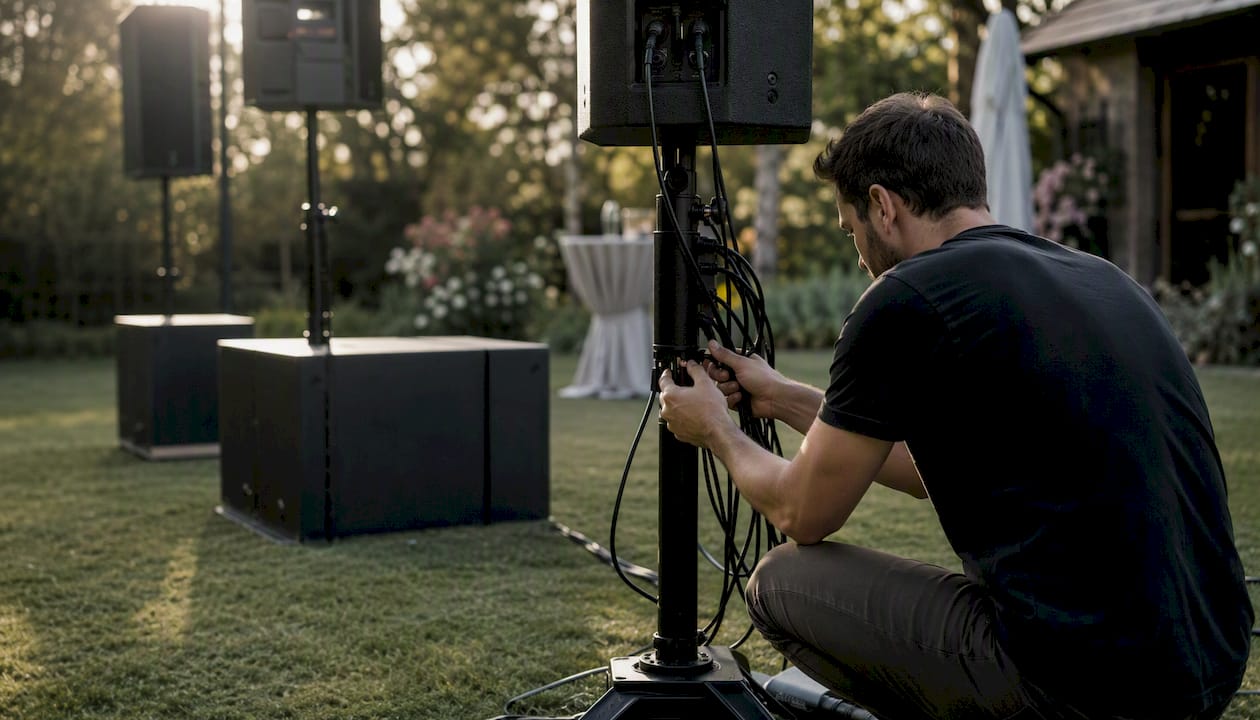
Pro Tip: Ask your photographer where they plan to stand during the first dance before finalising the band position. A 1.5m gap between the stage edge and the photographer’s spot gives clean sightlines without forcing them into the crowd.
What power and equipment does an outdoor band need?
Confirm a dedicated circuit or a correctly sized generator before the band arrives. Outdoor setups require specified generator wattage and 12-gauge outdoor-rated cabling; a generator suitable for mid-size rigs, with larger productions requiring higher capacity generators. Separate circuits for audio and lighting reduce interference.
Equipment checklist for a typical outdoor band setup:
- PA mains and fill speakers
- Stage monitors or in-ear monitor system
- Subwoofers
- DI boxes (at least two)
- Wireless microphone systems with spare batteries
- 12-gauge outdoor-rated extension leads and cable ramps
- Weatherproof covers for mixer and rack gear
- Surge-protected power distribution board
- UPS unit for ceremony microphone and mixer
Pro Tip: Specify a quiet inverter generator rather than a standard open-frame model. Inverter units run at 55–65 dB at 1 metre, compared with 70–80 dB for open-frame equivalents. Position it at least 10 metres from the nearest guest seating and downwind of the performance area.
Timing, load-in and the 30-minute rule
Allow 30–60 minutes more than you would for an indoor setup. Outdoor surfaces, cable runs across grass, and weather checks all add time. Confirm power availability early so the band brings the correct kit rather than improvising on the day.
Sample timeline for a typical outdoor wedding day:
- T minus 3 hours: Band vehicle arrives at load-in point; venue contact meets them
- T minus 2.5 hours: Equipment unloaded and moved to stage area
- T minus 2 hours: PA rigged, cables run and covered with ramps
- T minus 1.5 hours: Soundcheck complete; band off stage
- T minus 30 minutes: Ceremony area clear; registrar or celebrant briefed on music cues
- Ceremony: Live music for processional, signing and recessional
- Post-ceremony (30–45 minutes): Speaker repositioning for reception if needed
- Reception start: Band back on stage; second brief line check
The 30-minute rule: build a 30-minute buffer between the scheduled ceremony finish and the first reception music start. That window covers speaker repositioning, a quick line check, and any overrun in the ceremony itself. See the wedding entertainment timeline guide for a fuller scheduling template.
Pro Tip: Assign one named contact, either the wedding planner or the venue coordinator, as the single point of communication with the band on the day. The band’s tech should have that person’s mobile number before load-in begins.
How do you plan for weather at an outdoor wedding?
Document the wet-weather plan and the trigger conditions before the day. Outdoor setups need a written rain plan with clear relocation triggers agreed by venue and suppliers. “We’ll see how it goes” is not a plan.
Immediate weather actions:
- Canopy or marquee over all electrical equipment, regardless of forecast
- Waterproof covers for mixer, rack gear, and any open speaker tops
- Elevated cable runs where possible; cable ramps at all crossing points
- Shade for string instruments and keyboards in temperatures above 25°C
- Define two trigger conditions in writing: one for light drizzle (cover and continue) and one for heavy rain (relocate)
- Identify the backup indoor or covered location and confirm power reach
Sun and rain kit to keep on site:
- Equipment covers (mixer, speakers, rack)
- Cable ramps and gaffer tape
- Extra canopy weights or ground stakes
- Spare wired microphone (backup if wireless fails in wet conditions)
- Battery-powered speaker for acoustic acts if relocation cuts mains access
Even light wind and sun can damage instruments or upset tuning, so shade and a canopy are standard requests from most bands, not optional extras.
Pro Tip: Ask the venue to confirm the backup location in writing and check that mains power reaches it. A covered terrace 40 metres from the nearest socket is not a usable backup.
Band logistics: access, storage and hospitality
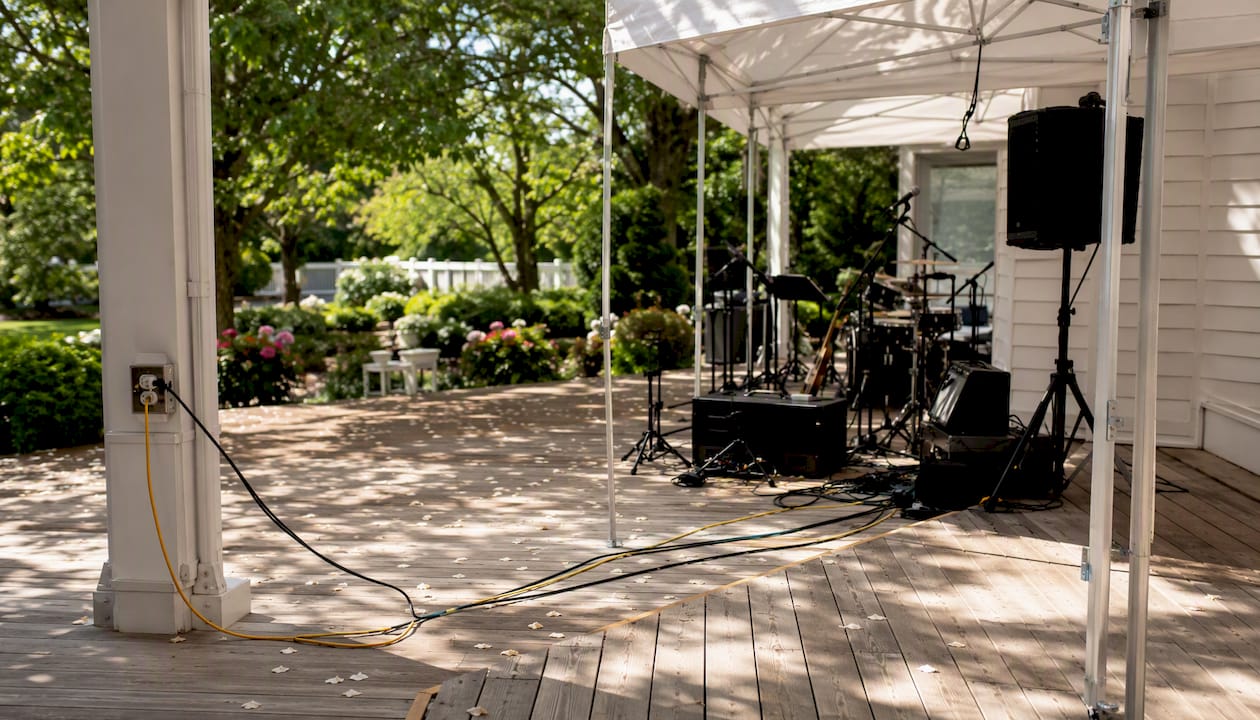
Confirm vehicle access, a dry storage area, and a meal plan before the day. Most outdoor bands require a covered performance area and a flat, stable surface; acoustic or roaming acts are the simpler option where cover or power is limited.
Check path surfaces between the load-in point and the stage. Gravel, steps, or soft grass can make trolley use impossible and add 20–30 minutes to load-in. Confirm whether the venue provides porters or whether the band handles their own kit.
Band brief template (send this to your venue and band at least two weeks before the event):
Arrival window: [time] to [time]. Unloading point: [location and description]. On-day contact: [name and mobile]. Meal break: [time and location]. Toilets: [nearest facility to stage]. Secure storage for cases and personal items: [room or locked area]. Emergency plan: [indoor backup location and trigger condition].
Scheduled breaks matter. A five-piece band playing two 45-minute sets needs at least 30 minutes off stage between sets, with access to hot or cold drinks and a meal. Stage the catering pickup away from the performance area so the band can eat without walking through the guest reception.
How to run a soundcheck and manage set transitions
Plan a dedicated soundcheck slot and assign one technician to manage system gain, EQ, and transitions between acts. Consistent levels throughout the event depend on a single person owning the desk.
Soundcheck quick steps:
- Line check: confirm signal from every input before testing levels
- Mic check: speak and sing at performance volume, not a whisper
- Monitor levels: set stage monitors before front-of-house levels
- Audience walk-test: walk to the back of the guest area and check coverage
- Wireless frequency scan: confirm no interference from other wireless devices on site
- UPS check: confirm the ceremony microphone is on battery backup
For transitions from band to DJ, agree in advance whether the DJ runs through the same PA or brings a separate output. A shared PA with a single tech managing the handover produces cleaner transitions than two separate systems fighting for the same space. Allow a minimum 10-minute gap for a clean handover.
Pro Tip: Ask the live band and DJ to share a channel list before the day. A five-minute pre-event check between the two acts prevents frequency clashes on wireless systems.
UK permissions, noise rules and neighbour communication
Check the venue licence, local council noise restrictions, and whether a Temporary Event Notice (TEN) or PRS/PPL licence is required. Confirm in writing who is responsible for each licence before the day.
Key steps for UK compliance:
- Ask the venue to provide written evidence of their premises licence covering live amplified music outdoors
- Check whether the event falls under the Licensing Act 2003 and whether a TEN is needed (required for events outside a licensed premises or above the 499-person threshold)
- Confirm the local council’s noise curfew for outdoor amplified music (commonly 11 PM, but varies by borough)
- Check permitted sound levels with the local environmental health team; many councils apply a limit of 65 dB(A) at the nearest noise-sensitive property
- Notify immediate neighbours in writing at least one week before the event, stating finish time and a contact number for concerns
PRS for Music and PPL licences cover the public performance of recorded and live music respectively. The venue typically holds these, but confirm it in writing rather than assuming.
Pro Tip: A brief, polite letter to neighbours stating the event date, finish time, and a direct contact number reduces the chance of a noise complaint call to the council. Keep a copy as evidence of notification.
What most outdoor music guides get wrong
Most planning guides treat the wet weather plan as a footnote. It is not. Weather is the single most common reason an outdoor ceremony runs late or a band cannot perform safely. The written contingency, with named trigger conditions and a confirmed backup power source, should be the first document you produce, not the last.
The second gap in most guides is sightlines; couples spend considerable effort on floral arrangements and stage dressing, then position the band where it looks tidy rather than where musicians can actually see the bridal entrance — working closely with Love You More Flower Boutique’s wedding-event services can help coordinate stage placement and sightlines. Couples spend considerable effort on floral arrangements and stage dressing, then position the band where it looks tidy rather than where musicians can actually see the bridal entrance. A musician who cannot see the processional cannot time the music correctly. Sightlines are a technical requirement, not a preference.
The third overlooked item is the single point of contact on the day. A band receiving timing calls from the venue coordinator, the photographer, and the couple simultaneously will make mistakes. One named contact, one mobile number, one decision-maker.
Brownsugarmusic: experienced live music for your wedding
Brownsugarmusic has performed at weddings, corporate events, and private parties for over two decades, with a resident slot at the Hilton Sydney’s Marble Bar running every Friday night since 2003. That depth of live performance experience translates directly into reliable outdoor setups: the band arrives with a clear tech rider, a confirmed load-in plan, and the flexibility to adapt when weather or timing shifts.

For couples planning a soul band wedding reception, Brownsugarmusic covers classic and contemporary R&B, soul, funk, and pop, with a repertoire built for both ceremony and reception settings. The band handles its own stage requirements and works directly with venue coordinators to confirm power, access, and timing well before the day.
Check availability and book your wedding date with Brownsugarmusic.
Sources
- Outdoor Wedding DJ Setup: Sound, Power & Weather Planning | WeddingDJFinder
- Outdoor Weddings & Live Music: Things You Need to Know | UK Outdoor Band Guide
- Can Live Wedding Musicians Play Outside? – JAM Duo Cello and Piano Duo
- Outdoor Wedding Bands: What You Need to Know Before Booking