

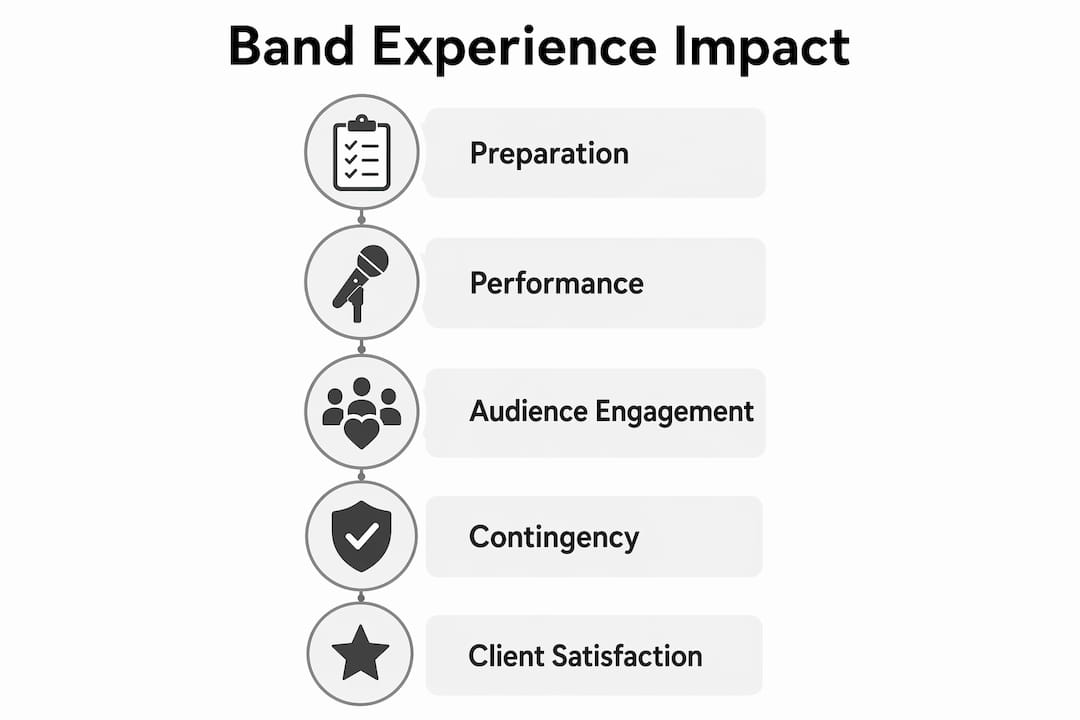
Band experience means more than musical ability. It refers to a professional track record of performing at functions, weddings and corporate events, where reliability, stagecraft and event management matter as much as playing well. In professional circles, this is often called GB experience (General Business experience), a shorthand for musicians who specialise in popular dance covers, formal presentation and tight event timings. Three signals tell you immediately whether a band has it: they arrive in formal attire, there is no dead air between songs, and the MC transitions feel rehearsed rather than improvised.
For clients, this matters because experienced bands absorb event stress. They manage the timeline, coordinate with the venue, and adapt the setlist on the fly. Peace of mind is the practical outcome.
Table of Contents
- What does band experience look like during a performance?
- Why does band experience matter to clients?
- How does band experience affect pay and contracts?
- How do you verify a band’s experience before booking?
- Key questions to ask an experienced band before you hire
- How does experience differ across weddings, corporate gigs and interactive shows?
- What transferable skills does band experience build?
- How does a band’s career progress from local gigs to major events?
- How do UK venue sizes and regions shape experience requirements?
- How does experience shape setlist choices and audience engagement?
- What challenges do experienced bands handle better?
- Key takeaways
- Why experience is the thing most clients underestimate
- Useful sources for UK clients and musicians
What does band experience look like during a performance?
The clearest signs appear before the first song. An experienced band arrives early, completes the soundcheck without drama, and communicates clearly with the front-of-house engineer and venue staff. Load-in procedures follow a stage plot the band supplies in advance.
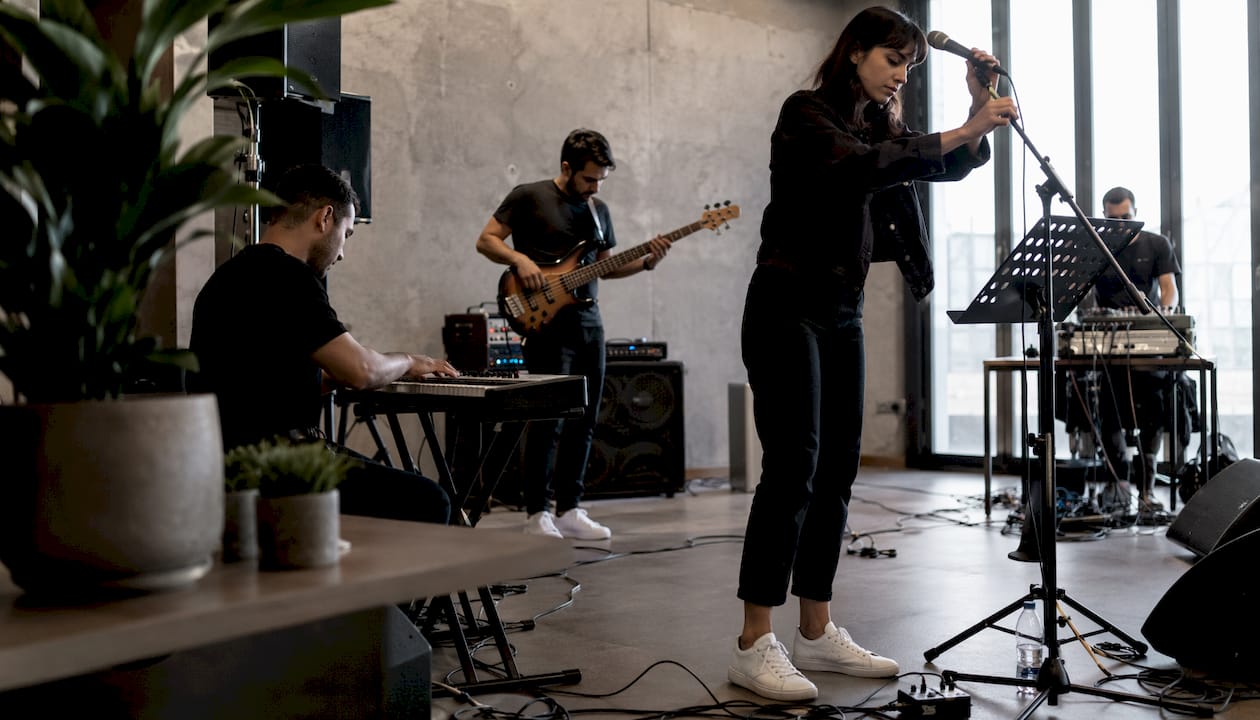
During the set, the repertoire is large and familiar. Songs are segued to keep the dance floor moving, with no awkward pauses while the band decides what to play next. Showmanship is measured: crowd interaction happens at the right moments, not constantly. A typical four-hour wedding set might open with background dinner music, shift into upbeat covers after the first dance, peak around the second hour, and close with high-energy crowd favourites, all without the client needing to prompt a single transition.
Experienced bands also carry contingency equipment: spare DI boxes, backup cables, and a stage plot that matches the venue’s technical specifications. They treat the event as a project, not a performance slot.
Why does band experience matter to clients?
Experienced bands do not practise on the day. That single fact separates them from talented-but-green acts.
For weddings, this means the band coordinates with the caterer, signals the speeches, and adjusts the setlist if the dinner runs late. For corporate events, it means brand-appropriate repertoire, formal presentation, and no surprises. The practical client benefits are a packed dance floor, a smooth timeline, and fewer conflicts between suppliers. Experienced bands act as a timeline partner, not a single line item on a run sheet.
How does band experience affect pay and contracts?
Experienced bands negotiate from a stronger position. The four common deal types are:
- Guarantee: a fixed fee regardless of attendance. Experienced bands usually insist on this for private events.
- Door split: a percentage of ticket revenue. More common for original-music or ticketed shows; experienced function bands avoid it for private hire.
- Hybrid: a lower guarantee plus a percentage above a ticket threshold. Used for semi-public events.
- Buyout: an all-inclusive fixed fee covering performance, travel and equipment. Standard for corporate bookings.
Bands with a strong track record negotiate guarantees rather than door splits, reducing financial risk on both sides. They also request a signed contract naming the fee type, deposit amount, cancellation terms, rider requirements and public liability insurance details. A deposit is typically required to secure the date, with the amount varying by agreement.
Pro Tip: Ask for a written contract that specifies the exact fee type, deposit schedule, cancellation policy and rider requirements before you pay anything. A band that resists putting this in writing is a red flag.
How do you verify a band’s experience before booking?
Request the following before committing:
- Recent live videos (not studio recordings) showing sound balance, transitions and MC work
- A full setlist or repertoire list covering at least three hours of material
- References from venues or event planners, not just private clients
- A technical rider and stage plot
- Proof of public liability insurance
When reviewing live band videos, watch for clean transitions between songs, confident MC delivery, and genuine crowd response. A polished studio clip tells you little. A shaky phone video from a real wedding tells you everything.
Pro Tip: Ask for a venue manager or recent event planner you can contact directly. A confident, experienced band will provide a name and number without hesitation. Vague answers (“we can send testimonials”) are worth noting.
Key questions to ask an experienced band before you hire
Use these verbatim on an enquiry call or in an email:
- How many events of this type have you performed in the past 12 months?
- Can you provide a full setlist and confirm you can learn one or two custom songs?
- What is your arrival and soundcheck schedule on the day?
- Who is the single point of contact for the event manager on the night?
- What happens if a band member is ill or unavailable close to the event?
- Do you carry public liability insurance, and can you provide a certificate?
- What are your power and space requirements, and do you have a stage plot?
- What is your cancellation and deposit policy?
- Have you performed at this venue or a similar one before?
- Can you provide a reference from a recent event planner or venue manager?
Green signs: specific numbers, immediate references, a written stage plot, and clear cancellation terms. Red flags: vague answers about line-up continuity, no insurance certificate, or reluctance to provide a contract.
How does experience differ across weddings, corporate gigs and interactive shows?
Experience is context-sensitive. What counts at a wedding differs from what counts at a corporate dinner or a Bandeoke night.
| Dimension | Wedding | Corporate | Interactive (e.g. Bandeoke) |
|---|---|---|---|
| Attire | Formal (suits, gowns) | Formal to smart-casual | Smart-casual, high-energy |
| Setlist focus | Crowd-pleasing covers, first-dance edits | Brand-appropriate, background-friendly | Short, well-known song menus |
| Crowd interaction | Measured; speeches and first dance cued | Minimal; professional tone | Central; audience participation managed |
| Contingency planning | Timeline flexibility, late-dinner adjustments | Strict schedule adherence | Audience management, mic logistics |
Interactive formats like Bandeoke raise the operational bar considerably. The band must manage audience members on stage, maintain a tight song menu, and keep the production running professionally while handling unpredictable participation. That requires performance arts platform skills beyond standard function work.
What transferable skills does band experience build?
Being in a band builds skills that employers value well outside music:
- Leadership: directing a group under live pressure translates directly to team management in client-facing roles.
- Time and project management: coordinating load-in, soundcheck, set times and pack-down mirrors event production workflows.
- Audience reading: adjusting energy and repertoire in real time is the same skill as reading a room in sales or presentations.
- Crisis problem solving: handling a failed monitor or a late-running schedule without the audience noticing is exactly what operations roles require.
- Marketing and self-promotion: building a booking pipeline, managing social media and negotiating fees are standard small-business skills.
Musicians can evidence these skills to employers through documented riders, rehearsal schedules, and client references, all of which demonstrate operational competence in writing.
How does a band’s career progress from local gigs to major events?
Most professional function bands follow a recognisable path. It starts with local pub gigs and small private parties, where the priority is building a reliable set and learning to read different crowds. From there, bands move into regular venue residencies, which sharpen punctuality, consistency and repertoire depth. A long-running residency, such as a weekly hotel or bar slot, is one of the strongest indicators of genuine GB experience because it demands the same professional standards every week.
The next stage typically involves corporate and wedding bookings, where formal presentation, rider compliance and timeline management become non-negotiable. Bands that perform consistently at this level build the references and reputation needed to access larger venues, festivals and high-profile private events. Festival experience adds a different dimension: larger stages, unfamiliar PA systems and compressed soundcheck windows. A band that has navigated all three stages, residency, private functions, and festival slots, has a well-rounded professional record.
How do UK venue sizes and regions shape experience requirements?
The UK’s event market varies considerably by region. London venues tend to have strict noise curfews, complex load-in logistics and high client expectations around presentation. A band experienced in London private hire will have navigated all of these. Outside London, large country house wedding venues in the Home Counties or the Cotswolds often require self-contained PA systems and longer travel logistics. Scottish venues add licensing considerations under the Licensing (Scotland) Act 2005, which differs from the Licensing Act 2003 covering England and Wales.
In Northern Ireland, the licensing framework differs again. Bands working regularly across UK regions will have adapted their riders and stage plots to suit different venue types, from listed buildings with power restrictions to purpose-built event spaces with full production infrastructure. When a band lists UK-wide experience, it is worth asking specifically which regions and venue types they have covered.
How does experience shape setlist choices and audience engagement?
An experienced band does not play the same set at every event. They gather information before the booking: the client’s preferred genres, the age range of guests, the event timeline, and any songs to avoid. That brief shapes the setlist before the first rehearsal.
On the night, experienced bands read the room continuously. If the dance floor empties during a particular song, they cut it short and shift tempo. If a crowd responds strongly to a specific era or genre, they extend that section. This kind of real-time adjustment requires a large, well-rehearsed repertoire, not just technical skill. Guest engagement is the outcome; a deep catalogue is the mechanism.
What challenges do experienced bands handle better?
Two situations separate experienced bands from talented ones: technical failures and difficult audience dynamics.
When a monitor fails mid-set, an experienced band keeps playing while the sound engineer resolves it. They carry redundant equipment and know the workarounds. A less experienced act stops, announces the problem, and loses the room. The same applies to a microphone cutting out, a power surge, or a late-running schedule that compresses the set by 30 minutes.
Audience dynamics are harder to script. A corporate crowd that does not want to dance, a wedding where the speeches run an hour over, or a mixed-age audience that needs constant tempo shifts: these are standard challenges for experienced bands. They plan for them in advance, discuss contingencies with the event manager, and execute without visible stress.
Key takeaways
Band experience signals professional reliability, not just musical skill, and it directly affects what you pay, what you can expect, and how much risk you carry as a client.
| Point | Details |
|---|---|
| Experience means reliability | Look for formal attire, tight transitions, MC skills, and a supplied stage plot. |
| GB experience is a specific standard | It denotes function and corporate track record: dance covers, formal presentation, tight timings. |
| Contracts protect both sides | Request a written deal covering fee type, deposit, cancellation terms, rider, and insurance. |
| Verify before you book | Ask for live videos, references from venues, and a direct contact you can call. |
| Pay a premium when risk is high | For weddings and corporate events, experience reduces timeline risk and guest-experience failures. |
Why experience is the thing most clients underestimate
Most people booking a band focus on how the band sounds in a demo video. That is the wrong filter. Sound quality in a studio clip tells you about musicianship. It tells you nothing about whether the band will arrive on time, manage the timeline, handle a failed monitor without flinching, or know when to read the room and shift tempo.
The operational side of a professional band is invisible until something goes wrong. Experienced bands have built systems precisely so that nothing goes wrong visibly. Their riders are detailed because they have learned what gets missed. Their contracts are clear because they have dealt with disputes. Their references are from venue managers, not just happy couples, because venue managers see the whole picture.
The gap between a talented band and an experienced one is not musical. It is the difference between a supplier and a partner. For a wedding or a corporate event, that distinction carries real weight. A band that has spent years in residency, worked across different venue types, and built a reputation through repeat bookings has earned its fee. The checklist and questions in this guide exist to help you find that band and confirm it before you sign anything.
Useful sources for UK clients and musicians
- Musicians’ Union UK: Contract templates, standard rates, and guidance on public liability insurance for UK musicians.
- GOV.UK — Licensing Act 2003: The primary reference for live music licensing in England and Wales, including the Live Music Act 2012 exemptions.
- Stage Portal — gig deal types: Clear explanations of guarantee, door split, hybrid and buyout structures. Use this when reviewing a contract.
- TalkBass — GB experience thread: Practitioner discussion of what GB experience means in function and corporate contexts. Useful for musicians assessing their own positioning.
- Brownsugarmusic — live band wedding guide: Practical guide to the client benefits of hiring a professional live band, with checklist detail.
- Brownsugarmusic — questions before hiring a wedding band: Ready-to-use question list for evaluating bands before booking.
- Brownsugarmusic — wedding band stage requirements: Technical rider and staging reference. Use this to check whether a band’s requirements match your venue.

Brownsugarmusic has performed at weddings, corporate functions and private events since 2003, including a long-running residency at Marble Bar in the Hilton Sydney. For clients looking for an R&B soul band with documented GB-level experience, a full rider, and verifiable references, Brownsugarmusic is available for enquiries via brownsugarmusic.com.au.