

A full wedding day music timeline runs from a 15–45 minute prelude through to the last dance, covering roughly 150–200 songs across ceremony and reception. Each segment has a distinct role. Get the order right and the day flows naturally. Miss a cue or skip a segment and guests notice the gap.
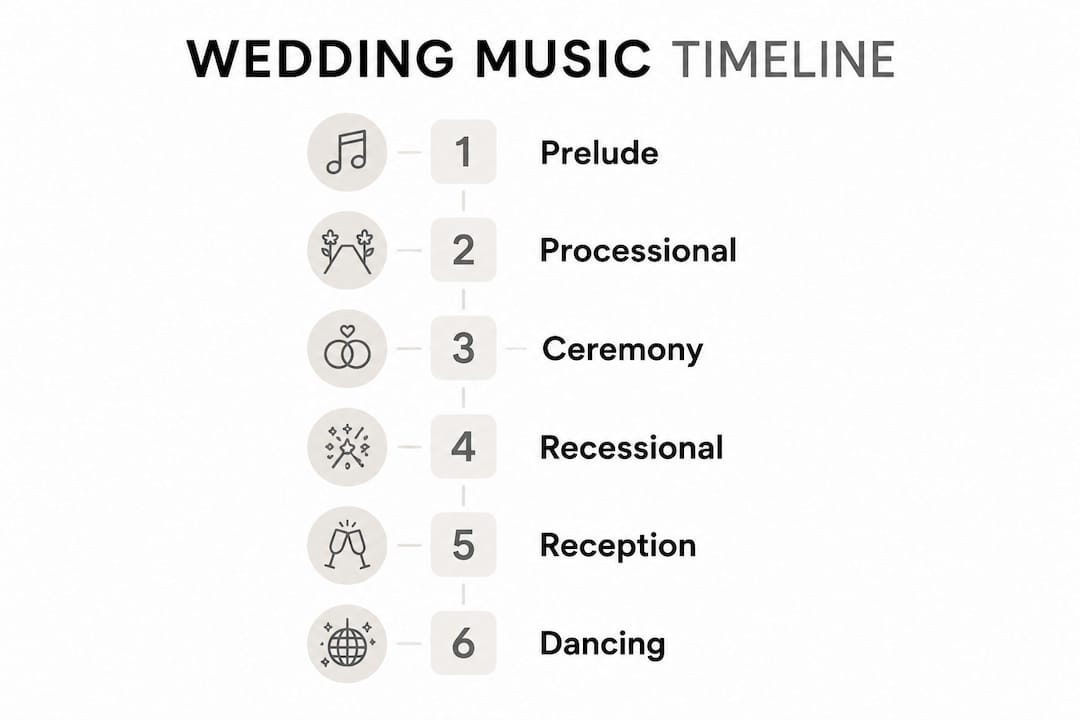
Here is the full sequence, with typical durations:
- Prelude — 15–45 minutes, 10–15 songs. Guests arrive and take their seats.
- Processional — 3–5 minutes, 1–3 songs. Wedding party walks the aisle.
- Bridal entrance — 1–2 minutes, 1 song. The couple’s entrance.
- Ceremony interludes — 5–15 minutes, 1–2 songs. Readings, unity ceremonies, signing.
- Recessional — 2–4 minutes, 1 song. Couple exits as newlyweds.
- Postlude — 5–10 minutes. Guests leave the ceremony space.
- Cocktail hour — 45–90 minutes, 20–30 songs. Drinks, canapés, mingling.
- Reception grand entrance — 2–3 minutes, 1–2 songs. Couple introduced to reception guests.
- First dance — 3–4 minutes, 1 song.
- Parent dances — 6–8 minutes, 2 songs.
- Dinner — 60–120 minutes, 20–35 songs. Background music during the meal.
- Open dancing — 2–3 hours, 40–60 songs. Dance floor open.
- Last dance — 3–4 minutes, 1 song.
Each segment connects to the next. The music does not just fill silence. It signals to guests what is happening and what comes next.
How the ceremony music schedule works, segment by segment
The ceremony music order follows a clear structure. Each part has a specific function and a typical duration. Understanding both helps you choose the right music and brief your musicians accurately.
Prelude
The prelude runs for 15–45 minutes as guests arrive and find their seats. It sets the emotional tone before anything formal begins. Soft instrumental pieces, acoustic covers, or gentle classical arrangements all work well. The volume should allow easy conversation. Think of it as an audio welcome rather than a performance.
Processional
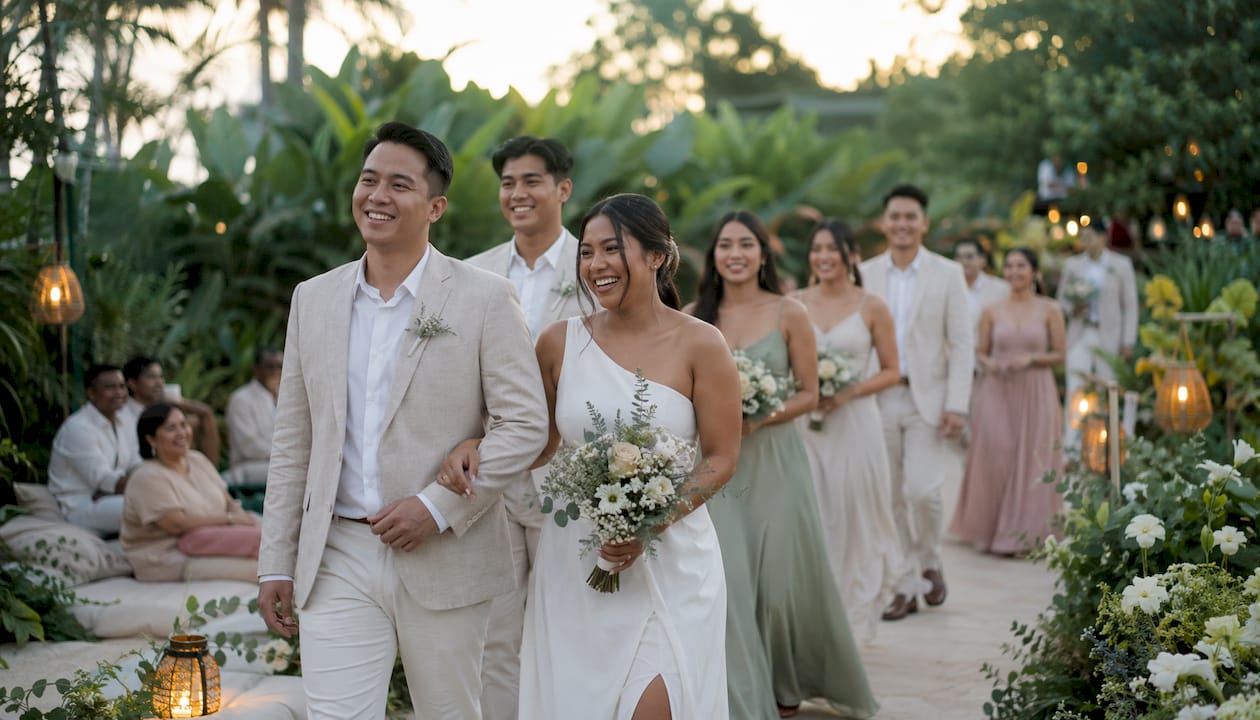
The bridal party processional typically lasts a few minutes. Many couples use one song for the wedding party and a separate, more personal piece for their own entrance. The song choice matters, but so does the arrangement. An orchestral version of a pop song reads as deliberate. The original recording reads as casual. Neither is wrong, but choose with intention.
Ceremony interludes
Interludes cover readings, unity ceremonies, and the signing of the register, running for several minutes in total. Not every ceremony includes them. When they do, soft instrumental music underneath a reading adds emotional weight without competing with the spoken word. Discuss these moments with your officiant so musicians know exactly when to play and when to stop.
Recessional and postlude
The recessional is the most celebratory moment of the ceremony. An upbeat, joyful song plays as the couple walks back up the aisle together. It signals to every guest that the party has started. The postlude then plays while guests file out, preventing an awkward silence as people gather their things and move towards the drinks reception.
Pro Tip: Discuss aisle length with your musicians before the day. A cathedral aisle takes far longer to walk than a registry office room. Musicians may need to loop or fade the processional track to fit the actual walking time.
How to plan the reception music timeline for atmosphere
The reception music schedule moves through distinct phases, each with a different energy level. Planning those shifts in advance keeps the evening flowing without awkward lulls or premature peaks.
Cocktail hour
The cocktail hour runs for 45–90 minutes. Guests are moving, drinking, and greeting each other. The couple is usually away for photographs. Music here should feel social, not like a dance floor warm-up. Jazz, bossa nova, acoustic pop, and Motown all work across age groups. The volume matters as much as the playlist. Too loud hinders conversation; too quiet makes the room feel empty.
Grand entrance and first dances
The grand entrance is a short, high-energy moment. One or two songs as the wedding party and couple are announced. It resets the room’s energy after dinner preparations. The first dance follows, typically 3–4 minutes, and carries the most emotional weight of the reception. Every guest stops and watches. Choose a song with a clear, immediate opening. A long instrumental fade-in makes the walk to the dance floor feel uncomfortable.
Parent dances follow the first dance and usually run 6–8 minutes across two songs. The room stays attentive through this. Songs should be emotionally resonant rather than high-energy.
Dinner
Dinner runs for 60–120 minutes. Music here is background, not entertainment. Mellow soul, acoustic covers, and light jazz all suit the mood. The energy should sit slightly below cocktail hour level. Avoid songs with strong lyrical hooks that pull attention away from conversation. Plan 20–35 songs to cover the full duration.
Open dancing and last dance
Open dancing typically runs for 2–3 hours. Build energy gradually, hit a peak around 90 minutes in, then wind down intentionally. The last dance closes the night. Some couples choose a slow, intimate song. Others choose a crowd singalong. Both work. The mistake is treating it as an afterthought.
Pro Tip: Share a must-play and a do-not-play list with your band or DJ. Finalise both at least 4–6 weeks before the wedding so they have time to source any unusual requests.
Venue, musicians, and cost: what to sort before you book
Practical planning decisions shape the music timeline as much as song choices do. Venue, musician type, and budget all affect what is possible on the day.
Venue acoustics and restrictions
Venue acoustics vary considerably. High ceilings and older buildings often create echo or distortion that requires tailored sound equipment. Many UK venues operate sound limiters, which cap volume levels automatically. Ask your venue about their limiter threshold and speaker placement restrictions before booking musicians. What works in a modern hotel ballroom may not work in a listed barn.
Outdoor ceremonies add further complexity. Wind, ambient noise, and the absence of walls all affect how sound carries. Musicians performing outdoors typically need amplification even for acoustic instruments.
Musician options
- Live bands create atmosphere and energy that a recorded playlist cannot replicate. They read the room and adjust in real time. A full band suits receptions where dancing is a priority. For a comparison of options, the live band vs DJ question comes down to budget, venue size, and the kind of energy you want.
- DJs offer flexibility, a broader catalogue, and lower cost. They suit couples who want specific recorded versions of songs or a wide genre range across the night.
- Soloists and duos work well for ceremonies and cocktail hours where a full band would overpower the space. A solo cellist, guitarist, or pianist adds elegance without volume.
Technical requirements and setup time
Live musicians need time to set up and sound-check before guests arrive. Factor this into your venue access schedule. If musicians are performing at both the ceremony and reception, they need 15–20 minutes to relocate and reset between spaces. This is not optional. Build it into the timeline.
Pro Tip: Ask your venue about speaker placement and any sound restrictions before your musicians quote for the job. Some venues require specific equipment or restrict where speakers can be positioned, which affects both sound quality and cost.
Common timing challenges and how to handle them
Even well-planned weddings face timing issues on the day. Knowing the common ones in advance makes them easier to manage.
Aisle timing and music cues
The processional is the most precisely timed moment of the ceremony. Aisle length, the size of the wedding party, and the pace of walking all affect how long the music needs to run. A small venue with four attendants may need 90 seconds. A large church with twelve may need five minutes. Discuss this with your musicians and give them a clear cue for when to start, not just a time on a clock.
Delays and overruns
Ceremonies run late. Speeches run long. Photographs take longer than planned. Build transition buffers into your schedule rather than assuming everything will run to the minute. A 15-minute buffer between the ceremony end and the cocktail hour start gives musicians time to relocate and guests time to move without feeling rushed.
Communicating cues clearly
Musicians need more than a song list. Live musicians benefit from a detailed script that includes the pronunciation of names, the order of entrances, and specific cue instructions for moments like the grand entrance and first dance. A DJ or bandleader will often prepare this script themselves, but you need to review it and confirm every detail at least one to two weeks before the wedding.
- Provide a written timeline with music notes at each moment.
- Include pronunciation guides for all names being announced.
- Confirm which person on the day gives each music cue.
- Agree on a signal for extending or cutting a song short.
Pro Tip: Trust your musicians to read the room. Over-scheduling every song leaves no room for them to respond to guest energy. Anchor the key personal moments with specific songs, then give them latitude for the rest.
Cultural and traditional music: what to consider
Cultural and traditional music requests add meaning to a wedding day. They also add planning complexity. Address them early.
Communicating requirements to musicians
Not all musicians are familiar with every cultural tradition. If you want Indian classical music for a ceremony, a specific Irish reel for the recessional, or a particular hymn arrangement for a church service, tell your musicians at the earliest opportunity. Some pieces require specialist performers. Others need specific instruments not in a standard band setup. Sourcing these takes time.
Timing and ceremony structure
Cultural ceremonies often follow a different structure from a standard civil or Church of England service. Some include multiple processionals, extended rituals, or moments of silence that affect where music sits in the order. Share your full ceremony structure with your musicians, not just the song list. They need to understand the sequence to time their cues correctly.
Blending styles across the day
Many couples blend cultural music in one part of the day with a more contemporary playlist for the reception. This works well when the transitions are planned. A clear handover point, such as the end of the cocktail hour, gives musicians a natural moment to shift style and energy without the change feeling abrupt.
Key takeaways
A full wedding day music timeline covers roughly 150–200 songs across 11 distinct segments, from the prelude through to the last dance.
| Point | Details |
|---|---|
| Ceremony order is fixed | Prelude, processional, interludes, recessional, and postlude each have a specific role and duration. |
| Reception phases shift in energy | Cocktail hour (45–90 min), dinner (60–120 min), and open dancing (2–3 hours) each require a different musical mood. |
| Finalise lists early | Share must-play and do-not-play lists with musicians at least 4–6 weeks before the wedding. |
| Build in transition time | Musicians need 15–20 minutes to relocate between ceremony and reception spaces. |
| Trust musicians to adapt | Anchor key moments with specific songs, then allow musicians to read the room for the rest. |
Planning your wedding music with Brownsugarmusic

Brownsugarmusic has performed at weddings, corporate events, and private functions across Sydney and internationally since 2003. As a soul band for weddings, the band brings R&B and soul repertoire that works across cocktail hours, dinner sets, and open dancing. The live band reception benefits are clear: real-time energy, crowd reading, and a sound that a playlist cannot replicate.