

Book a multiple-hour coverage block to secure two to three live sets, with a total music duration varying accordingly. Most bands split that time into blocks like 2×60 minutes or 3×45 minutes, with breaks in between for dinner and speeches. That’s the standard offered by most professional acts, including Cap City Band’s editable timeline template.
Two things to know before you call a band:
- Load-in and soundcheck typically take 60 to 90 minutes, done before guests arrive.
- Booked hours aren’t nonstop music — breaks for dinner and speeches are built into the block, not extra.
Copy this into your enquiry: “We’d like to book a four-hour block for two 60-minute live sets, with breaks scheduled around dinner and speeches.”
Key Takeaways
A four to five-hour booking split into two or three live sets, backed by a runsheet planned backwards from curfew, gives couples the clearest path to a well-timed reception.
| Point | Details |
|---|---|
| Book four to five hours | This typically covers two to three sets, roughly 90–150 minutes of live music. |
| Allow 60–90 minutes for setup | Load-in and soundcheck must finish before guests arrive, per Alive Network. |
| Start peak sets after dinner | Schedule high-energy sets around 8:30–9pm, once speeches and mains are done. |
| Plan backwards from curfew | Build 15–20 minute buffers around speeches to protect the dance window. |
| Brown Sugar Band works to this checklist | Sample runsheets and stage riders are built into every booking, drawn from over 20 years of Sydney weddings. |
Table of Contents
- How long do wedding bands play: typical set patterns
- When does the band arrive: load-in, setup and soundcheck
- When should the band start playing at the reception?
- How many songs fit in a wedding band set?
- Acoustic acts, ceremony sets, and DJ extensions
- Handling delays and building the runsheet
- What a professional band needs from your venue
- Sources
How long do wedding bands play: typical set patterns
Three structures cover most weddings. Two 60-minute sets suit shorter receptions where you want a strong opening set after dinner and a second push before the send-off. Three 45-minute sets give more flexibility for a longer evening with speeches, cake cutting, and multiple formalities squeezed between blocks. Three 40-minute rotations work well when you want frequent breaks for background music or a DJ playlist to keep the room moving without the band on stage the whole time.
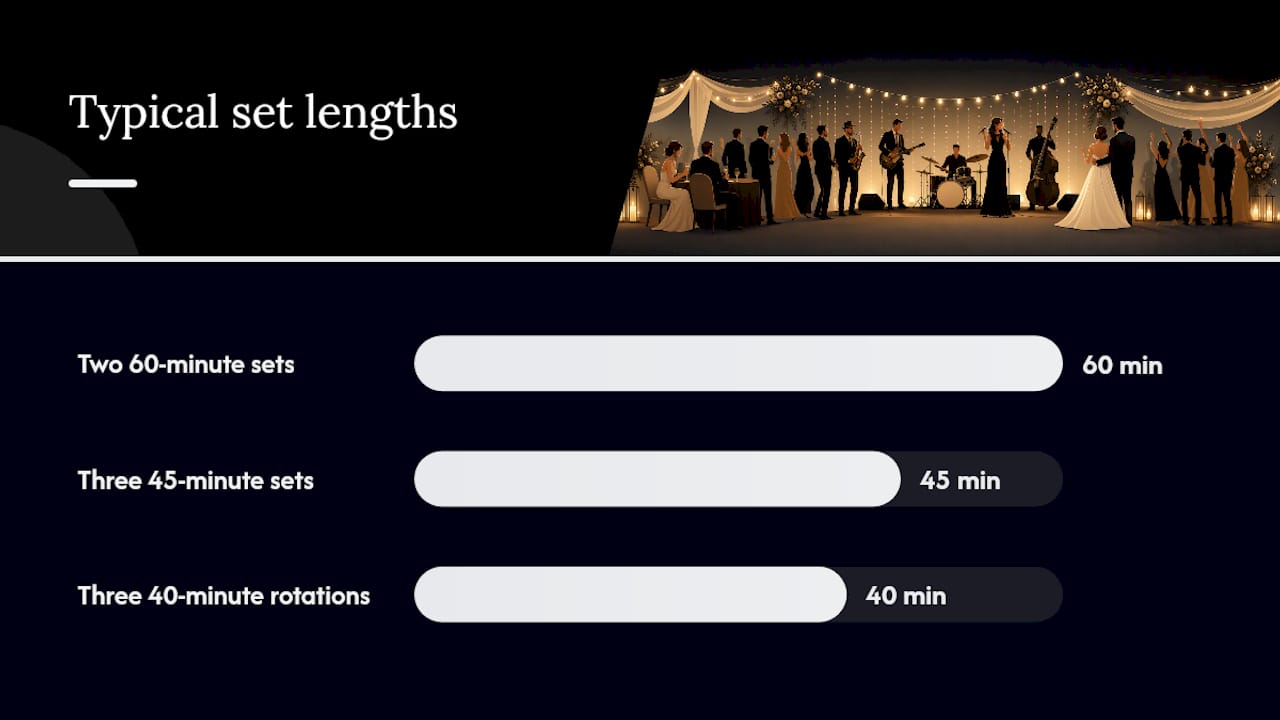
A common industry pattern pairs 45-minute sets with 15 to 20-minute breaks, according to Cap City Band’s timeline guide, which balances musician stamina against keeping the dancefloor warm.
Two example fragments show how this works in practice:
- Dinner service → Set 1 (60 min) → speeches during the break → Set 2 (60 min) → last dance.
- Cocktail hour → Set 1 (45 min) → dinner and toasts → Set 2 (45 min) → cake cutting → Set 3 (45 min).
Statistic callout: A common commercial package pairs two 60-minute sets with background music filling the gaps, according to Alive Network’s booking guide — one of the most frequently booked formats for UK and Australian receptions alike.
If you think you’ll want more than the standard block, raise it early. Extending on the night is possible with most bands, but locking in extra time during booking tends to be cheaper than negotiating an hourly add-on at 10pm.
When does the band arrive: load-in, setup and soundcheck
Most bands need 60 to 90 minutes to load in, build the stage, and run a line check before a single guest walks in. For a five or six-piece band, that means finding 9 to 12 square metres of usable stage space, according to Cap City Band’s production notes, plus safe power access away from foot traffic. A DJ setup takes a fraction of that time and space, which is worth remembering if your venue timeline is tight.
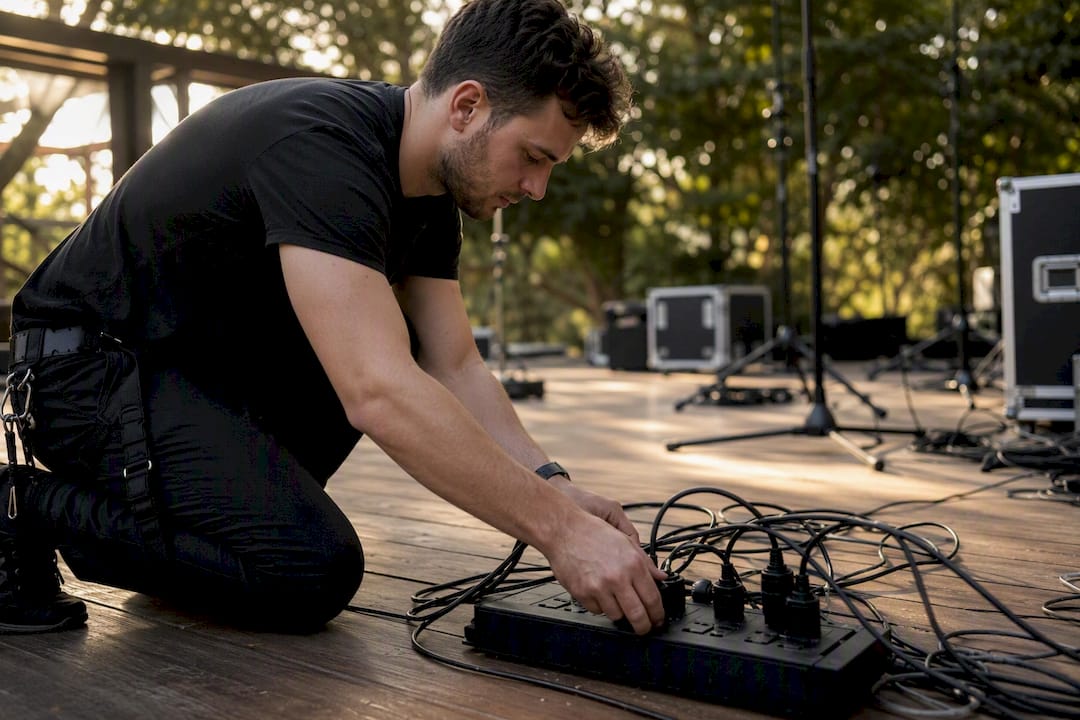
The order usually runs: arrival → stage setup → line check → prelude music while guests take their seats. Soundcheck should always land before doors open, never as guests filter in.
Before the band arrives, confirm:
- A stage area with power within reach of the amps.
- Clear parking or a loading path close to the room.
- A private space to change and store cases.
- A hot meal timed to arrive during a break, not mid-set.
When should the band start playing at the reception?
Start the band’s first high-energy set after dinner and speeches, typically in the evening after the main course. Live music during dinner tends to compete with conversation, so peak energy is best saved for later.
A sample runsheet fragment shows how this fits together: guests seated → starters served → speeches → main course → first dance → band’s opening set → cake cutting during the break → second set → last song.
Pro Tip: Plan the entire evening backwards from your venue’s curfew or your band’s final song, not forwards from guest arrival. If the room must be clear by midnight and the band’s last song is at 11:30pm, work backwards through pack-down, sets, breaks, and dinner to find your actual start time — this single shift catches more scheduling errors than any other planning step. This backward method is echoed in The Counterfeiter$’s timeline guide, which treats the final song as the fixed point everything else must be scheduled around. For help placing the bridal entrance and first dance within that structure, a dedicated planning guide walks through the cueing detail.
How many songs fit in a wedding band set?
A medium-length set usually holds around ten to a dozen songs, depending on song length, medleys, and instrumental breaks. Bands pace a night in an arc: slower numbers for the first dance and parent dances, a mixed middle stretch to build energy, then floor-fillers stacked toward the end of each set. For a fuller sense of which songs typically show up where, this list of wedding staples breaks down common choices by moment.
| Set length | Approximate song count | Best use |
|---|---|---|
| 40 minutes | 9–11 songs | Cocktail hour or dinner background |
| 45 minutes | around ten to a dozen songs | Standard reception set |
| 60 minutes | around ten to a dozen songs | Main dance block, open floor |
- Slower songs cluster around first dance and parent dances, not mid-set.
- Floor-fillers get saved for the final 10 to 15 minutes of each set to peak the energy before a break.
Acoustic acts, ceremony sets, and DJ extensions
Full bands, acoustic duos, and DJs each solve a different part of the day, and mixing them is common. An acoustic act suits a ceremony or cocktail hour where volume needs to stay low and setup has to be minimal. A full band needs more stage space and load-in time but delivers the reception’s main energy. A DJ or playlist handover works well for late-night hours once the band has finished, especially if your venue curfew runs past what the band’s booked block covers.
| Format | Space/load-in needs | Best fit |
|---|---|---|
| Acoustic duo | Minimal, quick setup | Ceremony, cocktail hour |
| Full band | 9–12m² stage, 60–90 min load-in | Reception dance sets |
| DJ/playlist | Minimal, fast turnover | Late-night extension |
- Combine acoustic sets for ceremony and cocktails with a full band for the main reception.
- Schedule the handover clearly so there’s no dead air between the band’s last song and DJ start.
Late hours usually carry an extension fee if you keep the live band going. Many acts prefer a wait-and-see approach on the night: if the floor is still packed at the scheduled finish, they’ll often extend for an hourly rate, or hand straight to a DJ or curated playlist, which is typically the cheaper route for the final stretch.
Handling delays and building the runsheet
Speeches run long. Dinner service slips. Build buffers of 15 to 20 minutes around every formality so a fifteen-minute delay doesn’t cannibalise your dance window. The method that protects the night: plan backwards from curfew, share a written cue sheet with every vendor, and treat the band’s final song as the fixed point rather than a target that moves with the day.
A simple runsheet snippet you can copy into a spreadsheet:
- 6:00pm — Band load-in and soundcheck complete.
- 6:30pm — Guests seated, prelude music begins.
- 7:15pm — Speeches (buffer: 20 minutes).
- 8:00pm — First dance, band Set 1 begins.
- 9:15pm — Break, cake cutting.
- 9:35pm — Band Set 2 begins.
- 11:00pm — Final song, pack-down begins.
If the day falls behind, your options are: extend the band’s booked block for a fee, trim a formality (combine speeches, shorten the cake cutting), or bring the DJ handover forward. A wedding entertainment timeline guide and this UK wedding checklist template both offer ready-made structures worth adapting.
What a professional band needs from your venue
A five to six-piece band needs roughly 9 to 12 square metres of stage, dedicated power circuits away from catering equipment, and 45 to 60 minutes for safe pack-down after the final song, according to Alive Network’s booking checklist. Skimping on pack-down time is one of the most common venue-side scheduling mistakes.
Practical rider items worth confirming two weeks out: a hot meal timed during a break (not mid-set), a private changing space, clear parking or loading access, and one single point of contact for cues on the day. Brown Sugar Band, performing weddings and Sydney’s Marble Bar residency for over 20 years, works from exactly this checklist on every booking, detailed in full on how wedding band performance works.
Pro Tip: Nominate one person, not the couple, as the band’s day-of contact. Whoever briefs the DJ, cues the first dance, and flags when speeches are running long should be the same person the band checks in with — juggling five different opinions on timing is how sets start late.
A performer’s view on getting the hours right
Standing on stage at hundreds of receptions, the pattern is always the same: the night lives or dies on what happens between sets, not during them.
- Cue the first dance the moment mains are cleared, not before.
- Group speeches into one block rather than scattering them across breaks.
- Confirm the runsheet and point of contact two weeks out, not two days.
A single day-of contact matters because a band responding to five different cues loses the thread of the night fast.
Book the right hours with Brown Sugar Band
Brown Sugar Band books to the pattern this guide describes: a four to five-hour reception block covering ceremony, cocktail, and reception sets, with a DJ handover available for late-night hours instead of an expensive extra live set.
Two decades of Sydney weddings and the Marble Bar residency at the Hilton have shaped a checklist that removes the guesswork from booking hours:
- Sample runsheets and stage requirement guides ready to hand to your venue coordinator.
- Direct support setting first dance, speech, and set timing so nothing clashes.
- Flexible extensions on the night if the dancefloor is still packed at the scheduled finish.
If the R&B and soul sound described throughout this guide fits your reception, explore the atmosphere Brown Sugar Band creates and enquire about booking your date.
Sources
- Editable Wedding Timeline Template for Live Bands
- How to Plan Wedding Band Timeline Right – The Counterfeiter$