

Choose live music for your wedding ceremony when you want a soundtrack that responds to the moment. A recorded track cannot slow down for a longer bridal walk or hold a note while a guest finds their seat. A live musician can. The practical plan is straightforward: decide your key moments first (processional, signing, recessional), match your ensemble size to the venue, confirm sound rules before you book, and brief your musicians with a mood summary rather than a rigid playlist. Here is a quick checklist to start with.
- Ensemble size: choose a smaller ensemble for intimate gatherings and a larger group for bigger venues to suit the number of guests and space.
- Key moments to cover: prelude, processional, signing of the register, recessional
- Amplification: confirm whether the venue permits PA equipment before choosing instruments
- Who to brief: musicians, celebrant or registrar, and your venue coordinator, at least 6–8 weeks before the day
- Run sheet: one shared document with cue times, contact numbers and song order
Pro Tip: Give Brownsugarmusic or any live act a mood brief alongside your non-negotiable songs. Phrases like “warm and unhurried” or “joyful and upbeat” let performers adapt dynamics in real time far better than a fixed track list.
Table of Contents
- How does ceremony music order actually work?
- Which instruments suit a wedding ceremony?
- What venue checks do you need before booking live music?
- When should you book, and what does it cost in the UK?
- What should your booking contract include?
- How do you coordinate musicians with the celebrant?
- What mistakes do couples most often make with ceremony music?
- Why live musicians make the ceremony ‘breathe’
- Sample ceremony programmes by style
- Key takeaways
- The part most couples overlook
- Useful UK resources and further reading
How does ceremony music order actually work?
The ceremony divides into five distinct musical phases. Each has a different emotional weight and a different timing challenge.
Prelude runs from roughly 20 minutes before the ceremony begins until the first processional cue. Guests are arriving and finding seats. Music here sets the atmosphere without demanding attention. Live musicians typically play continuously, repeating or varying pieces as needed, which removes the awkward silence of a playlist running out.
Wedding party processional covers bridesmaids, groomsmen, and other attendants walking the aisle. Aim for a tempo of 60–80 BPM so the walk feels composed rather than rushed. One song usually covers the full party; longer parties may need two.
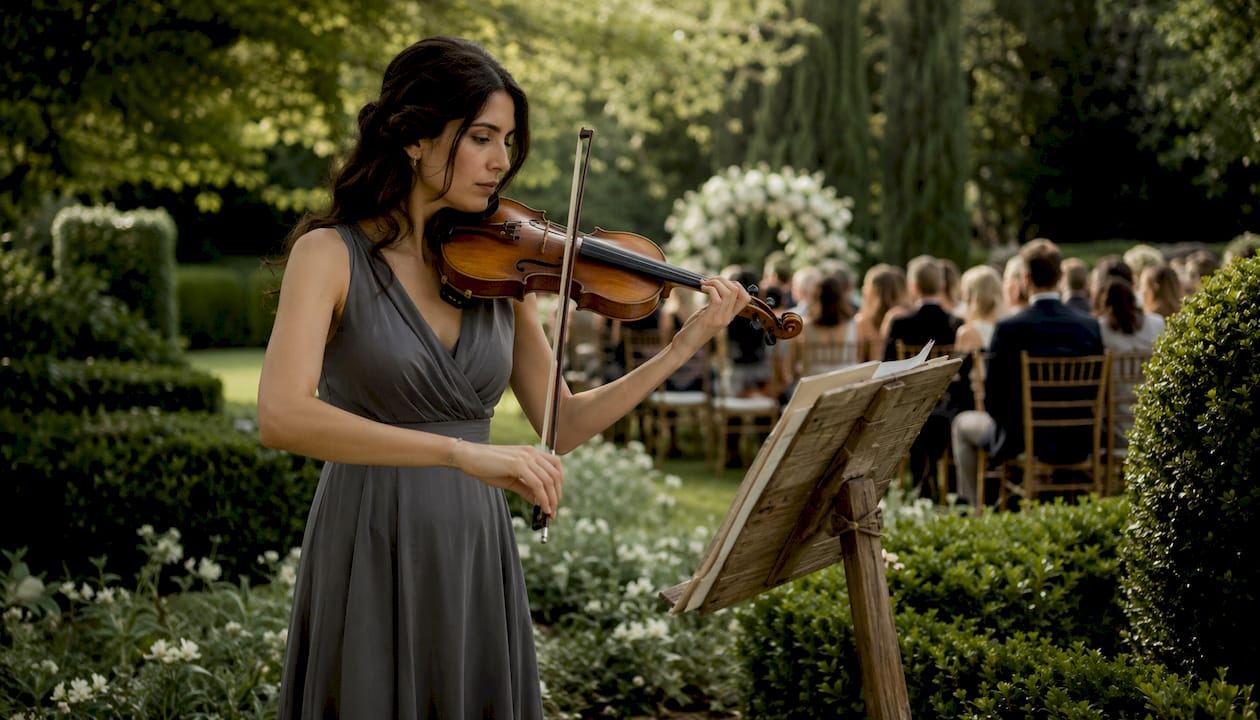
Bridal entrance is the single most emotionally significant moment. The song should begin 8–10 seconds before the bride appears, so the music is established when she comes into view. A typical mid-length aisle at a comfortable pace takes roughly under a minute; longer aisles can take noticeably more time. Live musicians can extend intros or repeat a bridge to match a slower-than-expected walk without any audible cut.
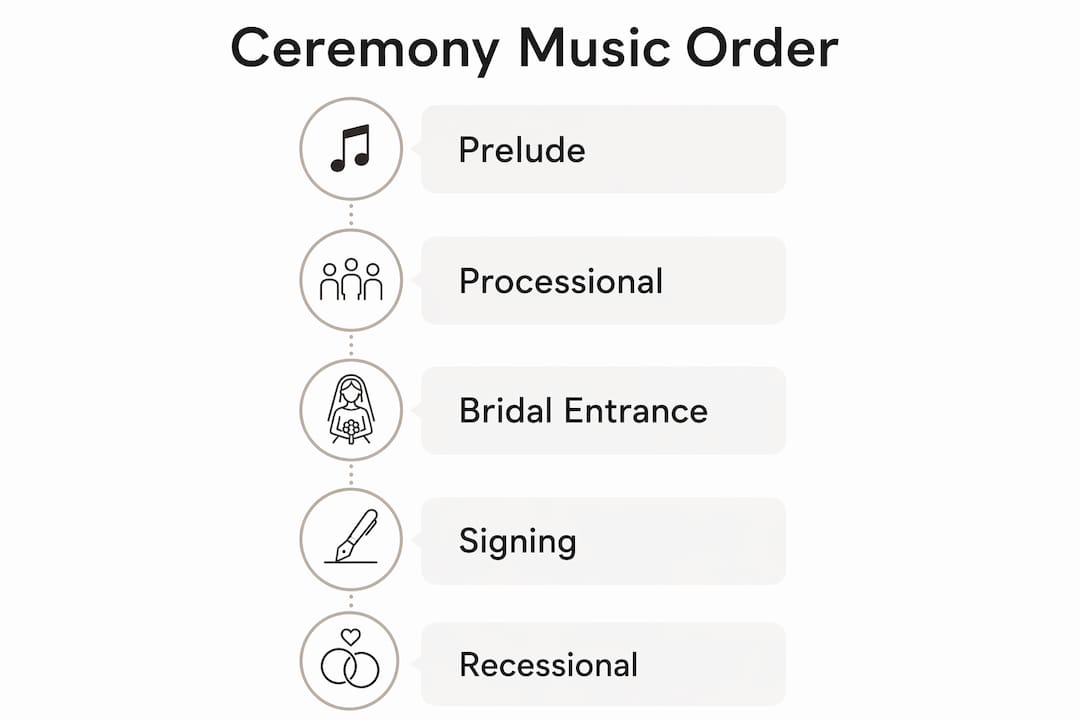
Signing of the register often runs 8–10 minutes once the photographer is involved. Prepare at least two songs for this section. Dead air here is the most common timing problem couples face.
Recessional plays immediately after the pronouncement. The energy shifts sharply from solemnity to celebration. Choose something upbeat and keep it playing until the couple and wedding party have cleared the aisle.
Pro Tip: Walk the aisle yourself before the wedding day. Count your steps, note the distance, and share that information with your musicians so they can calibrate the processional length accurately.
Sample timing map for a typical civil ceremony
| Moment | Typical duration | Songs needed |
|---|---|---|
| Prelude | about twenty minutes | several pieces |
| Wedding party processional | few minutes | one or two songs |
| Bridal entrance | a couple of minutes | one song |
| Signing of the register | several minutes | a couple of songs |
| Recessional | a couple of minutes | one song |
Which instruments suit a wedding ceremony?
The right ensemble depends on three things: venue size, acoustic conditions, and the emotional tone you want. Understanding ceremony music formats before you book saves time and avoids mismatches.
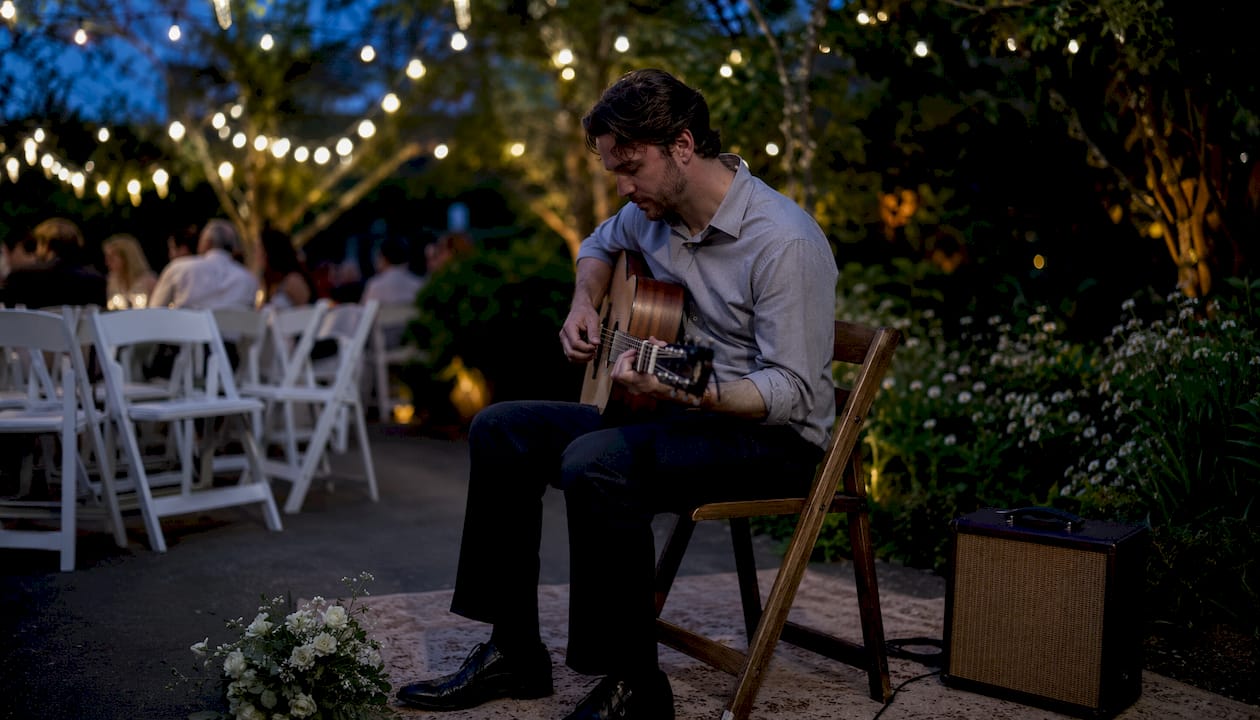
Solo acoustic guitarist or pianist works well for intimate ceremonies of up to 50 guests in a room with reasonable acoustics. The sound is personal and warm. The limitation is range: one instrument cannot fill a large hall or compete with outdoor wind.
Solo singer with accompanist adds vocal presence and emotional impact. This is a strong choice for couples who want a specific song performed rather than played. It requires rehearsal time and is priced accordingly.
String duo or trio (violin and cello, or violin, viola, and cello) projects well in mid-sized venues and suits both classical and contemporary repertoire. Arrangements of pop songs work effectively in this format. A string quartet fills larger spaces and produces a full, layered sound that suits church acoustics particularly well.
Harp is distinctive and beautiful, but needs careful placement outdoors. Wind affects both the instrument and the sound projection. Close mic’ing is usually necessary in open-air settings, which means amplification is required even if the venue prefers acoustic performance.
Small acoustic band (guitar, bass, keys, and vocalist) gives the widest repertoire range and suits contemporary or R&B/soul-themed ceremonies. This format needs more floor space and a PA system, so venue clearance is essential before booking.
Pro Tip: Ask for instrumental versions of your chosen songs for the processional. Vocals draw attention to lyrics, which can distract from the moment. An instrumental arrangement keeps the focus on the couple.
When choosing arrangements, consider whether the venue has natural reverb (stone churches amplify beautifully) or is acoustically dry (modern halls and marquees absorb sound). A string quartet that sounds full in a church may feel thin in a marquee without amplification. For soul and R&B choices, a small band with a vocalist is usually the better fit than a classical ensemble.
What venue checks do you need before booking live music?
Practical site checks prevent expensive surprises. Do these on your venue visit, before you sign anything with musicians.
- Floor space and stage footprint: a string quartet needs roughly 4m x 3m; a small band needs at least 5m x 4m plus cable runs
- Power supply: confirm the number of available sockets and their location; outdoor venues may need a generator
- Load-in access: ask about door widths, steps, and whether a lift is available for heavy equipment
- Floor surface: hard floors carry vibration well; thick carpet can muffle acoustic instruments
- Permitted instruments: some places of worship restrict amplified music or prohibit certain instruments entirely
Sound restrictions are the most commonly overlooked issue. Always check venue sound limits and local council rules before confirming repertoire or amplification. Some venues have electronic sound limiters that cut power automatically above a set decibel level. Ask the venue coordinator for the limiter threshold in writing.
For outdoor ceremonies, a site-specific sound check is essential. Wind and ambient noise from traffic or water features can significantly reduce projection for unamplified instruments. Harp and solo acoustic guitar are particularly vulnerable. Position speakers to face the seated guests, not the open sky, and plan for shelter if the forecast is uncertain.
Pro Tip: Ask the venue whether previous couples have used live musicians and request contact details. A five-minute conversation with someone who has already navigated the same space is worth more than any checklist.
Venue sound checklist
| Check | What to confirm |
|---|---|
| Sound limiter | Threshold in dB; who resets it if triggered |
| Power supply | Number of sockets, amperage, outdoor generator policy |
| Permitted amplification | PA allowed, restricted, or prohibited |
| Stage/performance area | Dimensions, surface, proximity to guests |
| Outdoor shelter | Gazebo, marquee, or covered area for musicians |
| Load-in time | Earliest access for setup and sound check |
For stage and technical requirements, share the venue’s answers with your musicians as soon as you have them.
When should you book, and what does it cost in the UK?
Book live ceremony musicians 9–12 months ahead for popular summer dates (June–September) and for Saturdays throughout the year. Fridays and Sundays in spring or autumn allow slightly shorter lead times, but 6 months is still the safe minimum for quality acts. Rehearsal scheduling should be confirmed at least 4–6 weeks before the wedding, with a final run-through of cues no later than one week before the day.
Main cost drivers
- Musician experience and reputation — established professionals charge more and deliver more reliable timing under pressure
- Ensemble size — each additional performer adds to the fee; a quartet costs significantly more than a soloist
- Travel and accommodation — UK musicians typically charge travel costs beyond a set radius, often 30–50 miles
- Bespoke arrangements — learning a specific song not in the standard repertoire usually carries an arrangement fee
- PA hire — if the musician does not own a PA, hire costs are added to the quote
- Overtime — agree a per-half-hour rate in advance; ceremonies run long more often than short
Typical UK price ranges
These figures are indicative. Prices vary by region, with London and the South East typically at the higher end. Always request an itemised quote so you can compare like for like. Ask specifically whether PA hire, travel, and arrangement fees are included.
Practical tip: lock the date with a deposit (typically 20–30% of the total fee) as soon as you have confirmed the venue. Do not wait until the full contract is signed. Popular musicians book out months in advance.
What should your booking contract include?
A clear contract protects both parties. Read every clause before signing, and keep a copy accessible on the day itself.
Contract checklist
- Deposit amount and payment schedule — confirm the percentage due on booking and the balance due date
- Cancellation terms — what percentage is retained if you cancel, and at what notice periods
- Force majeure clause — what happens if the venue closes or a public emergency prevents the event
- Performance times — exact start and finish times, including prelude and postlude
- Overtime rate — agreed cost per additional 30 minutes, stated in the contract
- Substitution policy — what happens if the named musician is ill; who provides a replacement and at what standard
Rider essentials
- Exact load-in time and access route
- Parking provision or reimbursement
- Power socket locations and availability
- Stage dimensions confirmed in writing
- Sound check time (minimum 30 minutes before guests arrive)
- Refreshments and rest area for musicians during the reception
Insurance and indemnity: ask whether your musicians hold public liability insurance. In the UK, professional musicians performing at events should carry at least £5 million public liability cover. Equipment insurance is separate; confirm who is liable if venue property is damaged during setup. For questions to ask before signing, the hiring a wedding band checklist covers the key points.
Pro Tip: Nominate one person (a wedding coordinator or trusted friend) to hold a printed copy of the contract and run sheet on the day. Musicians and celebrants should have their own copies, but a neutral third party holding a master copy prevents disputes.
How do you coordinate musicians with the celebrant?
Music cues fail when musicians and celebrants have not spoken before the day. Many ceremony musicians collaborate directly with the celebrant to align pauses and volume changes with spoken parts. Make this collaboration a requirement, not an optional extra.
The run sheet is the coordination tool. One document, shared with every vendor, eliminates ambiguity.
Essential run sheet items:
- Venue address and musician load-in time
- Sound check time and who is the venue contact
- Order of service with exact cue descriptions (not just song titles)
- Named cue-giver for each musical moment (who signals the musician to start)
- Mobile numbers for the celebrant, lead musician, and venue coordinator
- Backup plan if a cue is missed
Pro Tip: Prepare a one-page cue summary for the day: song title, cue-giver’s name, and the signal used (a nod, a hand gesture, or a specific phrase). Laminate it. Give copies to the musician and the celebrant. Under pressure, simple visual references work better than memory.
Sample run sheet: standard civil ceremony
- 12:30 — Musicians arrive; load-in and sound check
- 13:15 — Prelude begins; guests seated
- 13:28 — Venue coordinator signals musician: wedding party processional starts
- 13:32 — Celebrant nods: bridal entrance song begins
- 13:35 — Celebrant signals: music fades; ceremony begins
- 13:55 — Celebrant cues musician: signing of the register (two songs)
- 14:05 — Celebrant signals: recessional begins immediately after pronouncement
- 14:08 — Recessional ends; musicians move to postlude or break
Share this document with the celebrant at least two weeks before the day and confirm they are comfortable with each cue signal.
What mistakes do couples most often make with ceremony music?
Most problems are avoidable. Here are the most frequent errors and their fixes.
- Leaving music decisions until the last minute. Popular musicians book out 9–12 months ahead. Waiting until three months before the wedding limits your options significantly.
- Ignoring tempo. A processional above 80 BPM feels rushed. Test any song by walking to it before you commit.
- Failing to check venue sound rules. Venue-specific sound restrictions can prohibit amplification entirely, which changes the instrument choice. Confirm this before booking musicians.
- Overprescribing the playlist. Giving musicians a rigid 12-song list with no flexibility removes their ability to respond to the room. A mood brief with three non-negotiable songs works better.
- No backup plan for the signing. The register signing routinely runs longer than expected. One song is rarely enough. Always prepare two.
Accessibility and guest experience
- Seat hearing-impaired guests close to the musicians, not at the back of the room
- Test the PA volume at a level that works for elderly guests before the ceremony begins
- Confirm that the sound check covers the full seating area, not just the front rows
- If a guest uses a hearing loop, check whether the venue’s loop system is compatible with the PA
For a recorded backup, keep a playlist on a phone with a reliable speaker connection. If a musician is delayed or equipment fails, a backup track prevents silence. Assign one person to manage it.
Why live musicians make the ceremony ‘breathe’
Music shapes the emotional arc of a ceremony and should be treated as a structural element, not background. This is the core argument for live performance over recorded tracks.
A live musician reads the room. If the bridal walk takes longer than rehearsed, they extend the melody. If the celebrant pauses for an unexpected moment of laughter, the musician holds a soft note rather than cutting abruptly to silence. Recorded tracks cannot adapt without sounding jarring. That responsiveness is what makes live music worth the additional cost.
The most common planning mistake is ignoring the ceremony’s emotional ‘shape’. Professionals recommend a mood brief and flexible arrangements rather than rigid playlists, because the ceremony never runs exactly to time.
Wedding music professionals advise prioritising feel over a technical track list. Give performers a mood brief and a few non-negotiable songs rather than an exhaustive playlist. This lets them adjust dynamics and phrasing to the moment.
Musician brief template
- Overall mood: (e.g. “warm and intimate”, “joyful and celebratory”)
- Non-negotiable songs: list no more than three, with the exact moment each should play
- Timing flex points: which sections can run long (signing) and which must be precise (bridal entrance)
- Celebrant contact: name and mobile number
- Absolute exclusions: any songs or styles you do not want played under any circumstances
Understanding what a music brief involves before your first conversation with musicians saves time and sets clear expectations. For the emotional planning side, why music matters for wedding memories explains how live performance creates lasting impressions that recorded tracks rarely match.
For couples interested in how Indian classical instrumentation works in ceremony contexts, sitar and related instruments offer a distinctive option for culturally blended ceremonies.
Sample ceremony programmes by style
These programmes are starting points. Adapt song choices to your own taste and venue rules.
Traditional church ceremony
- Prelude: Pachelbel’s Canon in D; Jesu, Joy of Man’s Desiring (Bach); Air on the G String (Bach)
- Wedding party processional: Trumpet Voluntary (Clarke)
- Bridal entrance: Bridal Chorus (Wagner)
- Signing of the register: Ave Maria (Schubert); Pie Jesu (Fauré)
- Recessional: Ode to Joy (Beethoven)
Contemporary civil ceremony
- Prelude: instrumental versions of “Thinking Out Loud” (Ed Sheeran); “Make You Feel My Love” (Bob Dylan/Adele); “The Luckiest” (Ben Folds)
- Wedding party processional: “A Thousand Years” (Christina Perri) — instrumental
- Bridal entrance: “Can’t Help Falling in Love” (Elvis Presley) — instrumental
- Signing of the register: “At Last” (Etta James); “Better Together” (Jack Johnson)
- Recessional: “Happy” (Pharrell Williams) or “Signed, Sealed, Delivered” (Stevie Wonder)
R&B/soul ceremony
- Prelude: “Isn’t She Lovely” (Stevie Wonder); “Let’s Stay Together” (Al Green); “Ribbon in the Sky” (Stevie Wonder)
- Bridal entrance: “At Last” (Etta James) — vocal performance
- Signing: “My Girl” (The Temptations); “Lovely Day” (Bill Withers)
- Recessional: “Signed, Sealed, Delivered” (Stevie Wonder) or “September” (Earth, Wind & Fire)
For couples drawn to this genre, R&B and soul create a warm, celebratory atmosphere that works across ceremony and reception without feeling out of place in either.
Acoustic folk/informal ceremony
- Prelude: fingerpicked guitar instrumentals; “The Book of Love” (Peter Gabriel version)
- Bridal entrance: “Turning Page” (Sleeping at Last)
- Signing: “Better Together” (Jack Johnson); “First Day of My Life” (Bright Eyes)
- Recessional: “Ho Hey” (The Lumineers) or “Dog Days Are Over” (Florence + The Machine)
Blending cultural and religious music
Mixing traditions requires early communication with the venue and the officiant. Catholic churches in the UK often require pre-approval of all music; sacred music is typically required for the ceremony itself, with contemporary songs restricted to the prelude and recessional. For ceremonies incorporating Indian classical elements, planning a cohesive music experience across different traditions requires a clear brief and a musician comfortable with both styles.
For guests with varied tastes, keep the prelude broad and save the most personal choices for the processional and recessional. A prelude that mixes classical and contemporary pieces signals to all guests that the ceremony will feel inclusive.
| Style | Best ensemble | Key consideration |
|---|---|---|
| Traditional church | String quartet or organist | Confirm sacred music requirements |
| Contemporary civil | Vocal duo or acoustic band | No restrictions; mood brief is key |
| R&B/soul | Small band with vocalist | PA required; confirm venue sound rules |
| Acoustic folk | Solo guitarist or duo | Works well acoustic in small venues |
Key takeaways
Live ceremony music works best when couples book early, brief musicians with a mood summary, and confirm venue sound rules before signing any contract.
| Point | Details |
|---|---|
| Book 9–12 months ahead | Popular musicians fill summer Saturdays well in advance; secure the date with a deposit immediately. |
| Confirm venue sound rules first | Sound limiters and instrument restrictions affect your ensemble choice before anything else. |
| Use a mood brief, not a rigid playlist | Give musicians a mood description and three non-negotiable songs; let them adapt the rest in real time. |
| Prepare two songs for the signing | The register signing routinely runs 8–10 minutes; one song is rarely enough. |
| Share the run sheet with everyone | Musicians, celebrant, and venue coordinator all need the same cue document before the day. |
The part most couples overlook
Most planning guides focus on song selection. The harder problem is timing, and timing is where live music earns its cost.
The ceremony never runs exactly to schedule. A reading runs long. A guest arrives late. The photographer asks for an extra moment. A recorded track cannot respond to any of that. A live musician can hold a note, repeat a section, or shift dynamics without the audience noticing. That flexibility is not a luxury. It is the difference between a ceremony that feels controlled and one that feels anxious.
Brownsugarmusic has performed at weddings, corporate events, and live venues for over two decades, including a long-running residency at Marble Bar in the Hilton Sydney. That experience across hundreds of live events makes one thing clear: the couples who have the smoothest ceremonies are the ones who brief their musicians well and share a run sheet with every vendor. Not the ones with the longest song lists.
If you want live music to carry through from the ceremony into the evening, the case for continuity is strong. A band that knows your taste from the processional can carry that energy into the reception without a reset. Live band reception benefits are well documented, and the transition is far smoother when the same musicians cover both.
Useful UK resources and further reading
These resources are practical starting points for UK couples planning live ceremony music.
- Incorporated Society of Musicians (ISM) — the UK’s professional body for musicians. Use the ISM directory to verify that a musician holds professional membership, which typically indicates public liability insurance and a code of conduct.
- Wedding ceremony music types explained — a plain-language breakdown of ensemble formats and instrument choices; share this with your partner before your first musician conversation.
- What is a wedding music brief? — a template and step-by-step guide for writing the mood brief described in this article; download and complete it before contacting any musician.
- Wedding band stage requirements — technical checklist for venue visits; take this to your site inspection.
- Guest experience and music best practices — covers PA placement, hearing accessibility, and how to synchronise music with ceremony moments for all guests.
- Wedding entertainment timeline planning — a full-day timeline guide that places ceremony music within the broader event schedule.
Share the music brief template and the run sheet with your celebrant and musicians at least six weeks before the wedding. Confirm venue sound rules in writing. Keep a printed copy of everything accessible on the day itself.