

A live-band bridal entrance works when one song is locked, one person gives the cue, and the band has a written cue sheet confirmed at least 2–4 weeks before the wedding day. That is the short version. Bridal walks usually last between 60 and 180 seconds depending on aisle length and pace, so the song choice and arrangement must be tested against a real, timed walk before the arrangement is finalised. Confirm the band has both the cue sheet and a rehearsal slot booked. Send this checklist to your band and venue now:
- Chosen entrance song(s) with the exact intro cue point noted
- Measured aisle time from a rehearsal walk in actual shoes
- Name of the single designated cue person
- Venue sound limiter threshold, power access, and stage dimensions
- Fallback plan if the cue is delayed (hold, loop, or extend)
Brownsugarmusic has coordinated live entrances across hundreds of weddings. The guidance below is drawn from that experience and structured so you can hand it directly to your band and venue.
Table of Contents
- What does a complete live-band entrance checklist look like?
- How does the live band fit into the ceremony timeline?
- How do you choose and arrange the right entrance music?
- What logistics do you need to confirm with the band?
- Sample aisle timings and song-style ideas for a live band
- What should you ask the band and include in the contract?
- What mistakes do couples most often make with live-band entrances?
- Key takeaways
- What experienced bands wish couples understood
- Further reading worth checking
- Brownsugarmusic: live R&B and soul for your wedding entrance
What does a complete live-band entrance checklist look like?
A checklist keeps decisions, deadlines, and contract points in one place. Share this with your band leader, venue manager, wedding planner, and lead bridesmaid or usher.
- Decide ceremony vs reception use. Confirm whether the band plays for the ceremony processional, the reception grand entrance, or both. These are different musical jobs and need separate arrangements.
- Choose single or two-song approach. Decide whether the bridal party walks to one piece and the bride enters to a separate, stronger piece. Two songs create emotional escalation; one song is simpler to cue.
- Shortlist songs by 6–9 months out. Finalise the arrangement 2–3 months before the wedding so the band has time to rehearse and adapt the arrangement.
- Confirm a final cue rehearsal 2–4 weeks before the day. This is the last chance to test the walk, the cue, and the arrangement together.
- Agree a live or recorded fallback. If a band member is unavailable, confirm what the contingency is and put it in the contract.
- Check contract essentials. Arrangement fee, rehearsal fee, arrival and setup time, soundcheck duration, cancellation terms, and proof of public liability insurance must all be stated in writing.
- Distribute the checklist. Send it to the band leader, venue manager, wedding planner, and lead bridesmaid or usher at least 4 weeks before the wedding.
How does the live band fit into the ceremony timeline?
Build the cue backward. Confirm where the bride will stop and who will be in frame for the photographer, then set the band’s starting cue so every partner synchronises to that endpoint.

| Segment | Sample duration | Buffer | Who cues |
|---|---|---|---|
| Guest seating / prelude music | 20–30 min | 5 min | Venue coordinator |
| Parents / VIP seating | 3–5 min | 2 min | Usher signals band |
| Bridal party processional | 60–180 sec | 1 min | Lead bridesmaid nods to cue person |
| Bride entrance | 60–120 sec | 30–60 sec | Designated cue person (written cue) |
| Register signing | 5 min | 2 min | Officiant signals band |
| Recessional | 2–3 min | None | Officiant signals band |
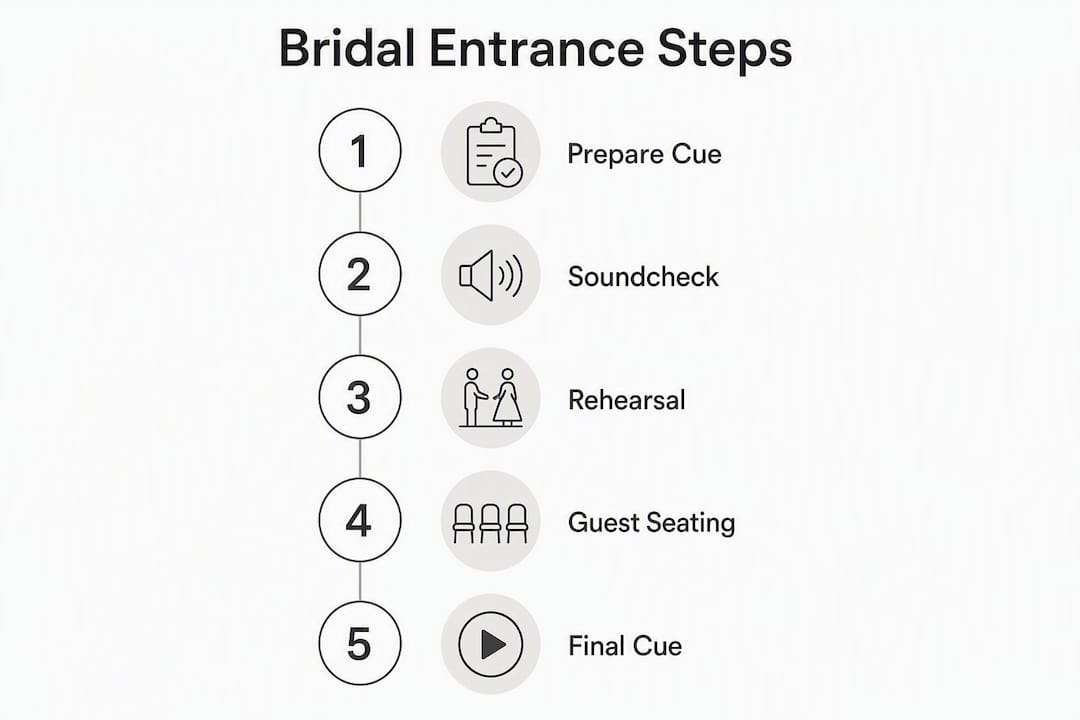
The band’s soundcheck and final run-through should be completed 60–120 minutes before guests arrive, or at an agreed rehearsal session. Do not leave soundcheck until the last 30 minutes before doors open.
Pro Tip: Build a 30–60 second contingency buffer into every critical cue. If the bride is delayed at the door, the band needs a clear instruction to hold or loop rather than stop. Put that instruction on the cue sheet.
The cue person is the single most important role in the room at the moment of the entrance. One person, one signal, one written cue. That person watches the showrunner or wedding planner, not the clock.
How do you choose and arrange the right entrance music?
Start with the feeling you want in the room: romantic, dramatic, or celebratory. Then narrow by tempo and by how recognisable the intro is in the first two bars.
Single song vs two-song approach. Using the same piece for the bridal party and the bride flattens the emotional arc. A separate, stronger piece reserved for the bride creates a genuine escalation. Many ceremony musicians recommend this structure precisely because the contrast is what makes the bride’s entrance land.
Tempo and aisle length. A slower tempo suits a long aisle; a medium tempo suits a short one. Live musicians can adjust tempo and phrasing in real time so the music ends exactly when the bride reaches the altar. This is the principal operational advantage of live performance over a recording. Give the band your measured aisle time and let them shape the arrangement around it.
Arrangement request template. Give the band these specifics in writing:
- Intro cue point (which bar the band starts on)
- Number of bars to repeat if the walk runs long
- Fade or full stop at the altar
- Loop points if the walk is extended
Common mistakes to avoid:
- Choosing a track with a long, soft intro that guests do not recognise for 20 seconds
- Picking a song purely for sentimental value without testing it against the actual walk time
- Selecting a piece the band cannot arrange within the available lead time
- Forgetting to specify whether the song ends on a fade or a definitive final chord
A track with an identifiable opening bar gives guests an immediate emotional signal. That recognition is what produces the room reaction couples are hoping for.
What logistics do you need to confirm with the band?
Venue technical constraints are the leading logistical cause of live-performance failure when not shared with the band early. Confirm these in writing at the time of booking.

| Item | What to confirm | Deadline |
|---|---|---|
| Stage size | Minimum footprint in metres; access route | At booking |
| Power access | Number of sockets, amperage, distance from stage | At booking |
| Sound limiter | Threshold in dB; whether it cuts power or triggers warning | At booking |
| Mic stands / monitors | Venue-supplied or band-supplied | 4 weeks before |
| Arrival and setup time | Earliest access; load-in route | 4 weeks before |
| Soundcheck window | Duration and time slot | 4 weeks before |
| Insurance | Public liability certificate | 4 weeks before |
Cue-sheet template. The cue sheet should state: who gives the cue, the exact cue word or signal, what the band plays on that cue, and what happens if the cue is delayed. Keep it to one page.
Rehearsal lead times: the band needs the final arrangement no later than 4 weeks before the wedding. The full run-through with the cue person, photographer, and venue staff should happen 2–4 weeks out. A final check on the day is not a substitute for a proper rehearsal.
Ask the venue about fire and sparkler restrictions before the rehearsal. Brief photographers and videographers on the band’s tempo so camera positions are set before the entrance begins. A wedding band stage requirements guide covers the technical specifics in detail.
Sample aisle timings and song-style ideas for a live band
Measure the aisle and do a timed walk in rehearsal clothing and shoes. It is the only reliable way to match song structure to a real walk.
| Aisle length | Typical walk duration | Recommended tempo range | Notes |
|---|---|---|---|
| Short | 60–90 sec | 60 BPM | One verse and chorus; clear final chord |
| Medium | 90–120 sec | — | Verse, chorus, short repeat; band extends on cue |
| Long (over 20 m) | — | — | Full arrangement with planned loop point |
Song-style ideas for live arrangements:
- Acoustic band or duo: Stripped arrangements of soul and pop classics work well for intimate venues; the band can adjust dynamics without a PA system.
- Small ensemble (3–4 piece): Adds harmonic depth; suited to mid-size venues where a full PA is available.
- Full band (5–8 piece): Best for large venues with a proper stage; the fuller sound fills the room without amplification strain.
Ceremony vs reception entrances. These are different musical jobs. A reception grand entrance typically runs 30–60 seconds and needs an immediately recognisable, high-energy intro. If the walk to the destination takes longer, the band continues or loops the high-energy section rather than slowing the tempo. Do not reuse the ceremony arrangement for the reception without a deliberate creative reason.
Practical cue examples for live bands:
- “Doors open” as the verbal cue to start the intro
- Four-bar count-in from the band leader before the first note
- Hand signal from the cue person for a delayed start
What should you ask the band and include in the contract?
Questions to ask before signing:
- Do you charge an arrangement fee for custom intros or extended versions?
- Is a rehearsal fee included, or is it billed separately?
- What is your arrival time and how long does setup take?
- Do you supply your own PA, or does the venue need to provide one?
- What is your contingency if a band member is unavailable on the day?
- Can you provide a public liability insurance certificate?
- Do you have experience with sound-limited venues?
Contract items to include:
- Exact arrival, setup, soundcheck, and finish times
- Number of sets and their duration (common structures: 2×60 or 3×40 minutes)
- Arrangement fee and rehearsal fee, itemised
- Overtime rate per 30-minute block
- Cancellation and postponement terms with notice periods
- Recording and use-of-performance clauses
- Travel and accommodation costs if applicable
- VAT status of the fee
| Deliverable | Deadline |
|---|---|
| Final song list | 6 weeks before |
| Arrangement requests | 4 weeks before |
| Rehearsal booking confirmed | 4 weeks before |
| Insurance certificate | 4 weeks before |
| Final cue sheet distributed | 2 weeks before |
A pre-booking questions guide covers contract points in detail and includes a checklist couples can take to the first meeting with any band.
What mistakes do couples most often make with live-band entrances?
- Using the same song for the bridal party and the bride. This removes the emotional escalation. Reserve the strongest piece for the bride’s entrance and use a different, lighter piece for the bridal party.
- Not measuring the aisle or testing the walk. A song that feels right in a living room may be 40 seconds too short on a long aisle. Time a real walk in the actual shoes before finalising the arrangement.
- Failing to share venue constraints with the band. Stage size, power access, and sound limiter thresholds must go to the band at the time of booking, not the week before the wedding.
- Relying on verbal cues on the day. Appoint one person, give them one written cue, and put it on the cue sheet. Multiple ad hoc signals produce missed starts and premature entries.
- Allowing the couple to be visible before the announcement. If guests see the bride waiting, the reveal is gone. A physical barrier or a hidden approach keeps the moment genuine.
Key takeaways
A live-band bridal entrance succeeds when the song, tempo, and a single written cue are locked at least 2–4 weeks before the wedding and rehearsed once in the venue with all key partners present.
| Point | Details |
|---|---|
| Lock song and aisle time early | Shortlist by 6–9 months; finalise the arrangement 2–3 months before the wedding. |
| One cue person, one written cue | Appoint a single person and document the cue on the band’s cue sheet to prevent missed starts. |
| Share venue logistics at booking | Stage size, power access, and sound limiter threshold should be communicated to the band at the time the contract is signed. |
| Rehearse in the venue | A timed walk in rehearsal clothing is the only reliable way to match song structure to a real aisle. |
| Brownsugarmusic for the entrance | Brownsugarmusic coordinates cue sheets, arrangements, and venue logistics as part of every wedding booking. |
What experienced bands wish couples understood
The most common source of a missed or ragged entrance is not the song choice. It is the absence of a single, clear, written cue. Bands work with dozens of signals on a wedding day: lighting changes, door movements, whispered instructions from three different people. When the cue is verbal and comes from multiple sources, the band leader has to make a judgement call in real time. That is when entrances start too early or too late.
A short, repeatable arrangement is also far more reliable than a long, improvised one. If the band knows the piece runs to 90 seconds with a defined loop point at bar 16, they can extend or compress it to match the walk without any visible adjustment. Last-minute improvisation, by contrast, produces tempo drift and uncertain endings.
Ceremony and reception entrances serve different emotional purposes and should be planned separately. The ceremony processional is measured and intimate; the reception grand entrance is high-energy and immediate. Bands prepare differently for each. Couples who treat them as interchangeable often end up with an arrangement that is wrong for both.
One practical note: share the venue’s technical constraints with the band at the time of booking, not four days before the wedding. Stage size, power access, and sound limiter thresholds shape every decision about instrumentation and PA setup. Late notice means late changes, and late changes cost money or produce compromises.
Further reading worth checking
- The Ultimate Guide to Wedding Entertainment: covers venue logistics, contracts, and what to ask before booking live music. Check the section on sound limiters and PA requirements.
- Songs for a Wedding Processional: useful for song-style ideas and how live performance transforms processional music. Check the notes on arrangement structure.
- Wedding Ceremony Entrance Music Guide: covers shortlisting timelines, arrangement deadlines, and the case for live tempo adjustment. Check the rehearsal checklist.
- How to Plan Your Grand Reception Entrance: focused on reception grand entrances and the 30–60 second timing rule. Check the looping guidance for longer walks.
- Brownsugarmusic resources: the wedding band performance checklist covers onsite setup and soundcheck steps; the wedding entertainment timeline guide integrates the entrance into the full day schedule.
Brownsugarmusic: live R&B and soul for your wedding entrance
Couples who want a live band that arrives with a cue sheet already drafted, a rehearsal plan built in, and two decades of wedding-day experience behind every arrangement will find Brownsugarmusic a direct fit.
Brownsugarmusic has performed at weddings, corporate events, and private functions since 2003, with a resident slot at the Marble Bar in the Hilton Sydney running for over 20 years. The band covers classic and contemporary R&B, soul, funk, and pop, and adapts arrangements to match aisle length, venue size, and the couple’s chosen emotional tone. Stage requirements, power needs, and sound limiter constraints are confirmed at the time of booking, not the week before. For couples planning a soul and R&B wedding atmosphere, the band brings the repertoire and the operational detail to make the entrance work. Check availability and enquire about dates at the Brownsugarmusic events page.