

Live music fills a dance floor by pairing familiar, steady-beat songs with performer-led interaction and carefully paced energy across the evening. The mechanism is straightforward: familiarity lowers the barrier to movement, a clear pulse at 100–150 BPM synchronises bodies, and a visible, responsive performer gives guests permission to dance.
Quick checklist: six actions that work on the night
- Open with a recognisable hook. Start the first set with a song most guests already know. Familiarity, not novelty, gets people up.
- Hold tempo in the 100–150 BPM range for the first 20 minutes. This sits in the walking rhythm band where group synchrony peaks.
- Use call-and-response. The vocalist asks a question; the crowd answers. This breaks the spectator habit within the first two songs.
- Control lighting from the start. Dim table lights and bring up warm floor wash before the first song ends.
- Place the band or DJ facing the floor, not the wall. Visible performer movement increases audience movement energy.
- Brief a floor captain. Assign one member of the event team to signal the band when food is cleared and speeches are done.
In the first ten minutes, the floor captain should confirm the sound level is audible but not overpowering at the tables, the dance floor is physically clear of chairs or centrepieces, and the band has received the go-ahead cue. A medley of cross-generational chorus-only edits at 110 BPM — think classic Motown into 90s R&B into a current pop hook — covers multiple age groups in under four minutes and rarely fails to draw the first wave of dancers.
Pro Tip: Instruct the band to shorten verses and extend choruses for the first two songs. Guests recognise choruses; verses are where they sit back down.
Table of Contents
- How do you plan a reception playlist and tempo map?
- How do you brief and hire the right performer?
- When should the party start, and how do you avoid peaking too early?
- What performance tactics actually pull people onto the floor?
- What production choices make the dance floor work?
- A printable brief for planners and couples
- Why does live music work? The research explained
- Key takeaways
- What a professional band actually does to read the room
- Brownsugarmusic: R&B and soul sets built for full dance floors
- Useful sources
How do you plan a reception playlist and tempo map?
Tempo mapping treats the evening as a single arc with deliberate rises and falls. The goal is to avoid burning through peak energy before the room is ready.

| Set segment | Target BPM | Song types |
|---|---|---|
| Arrival / cocktail hour | lower tempo | Acoustic soul, light jazz, mid-tempo R&B |
| Dinner | moderate tempo | Familiar ballads, classic soul, soft funk |
| Post-speech warm-up | moderate tempo | Upbeat Motown, feel-good pop, 80s funk |
| Main dance floor | higher tempo | Dance R&B, disco, current chart hits |
| Late-night peak | high tempo | High-energy anthems, crowd favourites |
| Wind-down | lower tempo | Slow jams, classic love songs |
A sample five-song opening set for the main dance segment might run: a classic soul anthem with a strong brass intro, into a mid-80s funk track, into a 90s R&B hit with a singalong chorus, into a current pop track with a familiar hook, into a slow-build anthem that lets the band call the crowd in. Each song should flow into the next without a full stop.
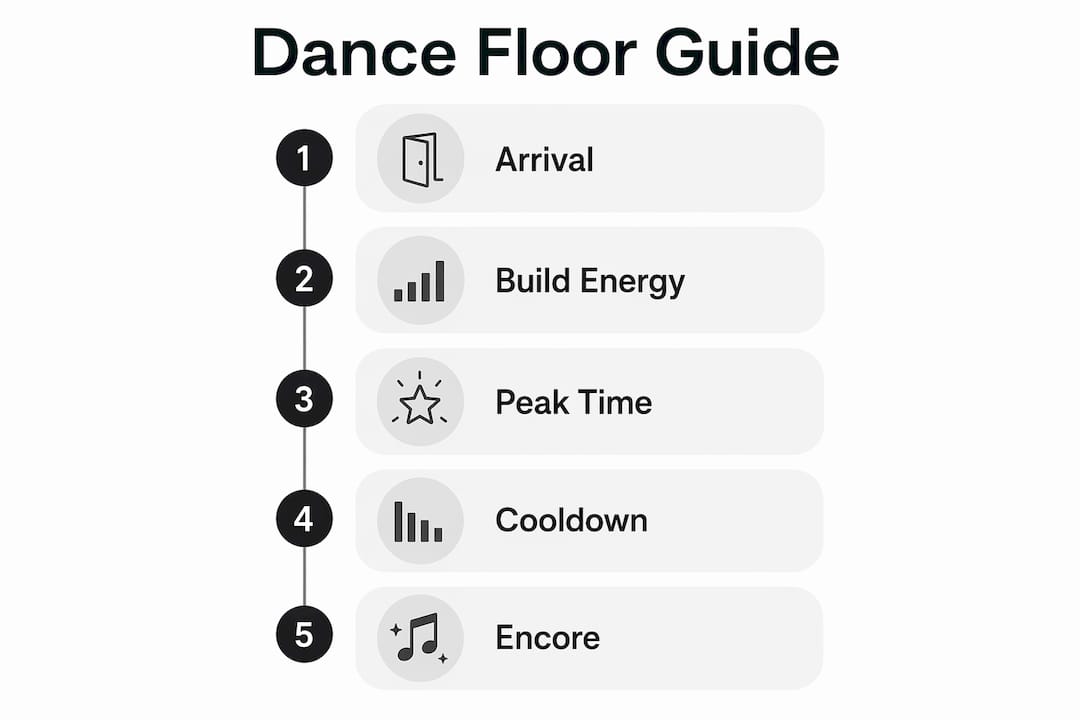
Medleys work best when the key change is upward and the tempo nudges slightly higher with each song. Keep each section to 90 seconds maximum before the transition. This sustains familiarity without overstaying any single track.
Pro Tip: Map your tempo arc on a single sheet before the event. Mark the speech slot, the food-clear window, and the first-dance moment. Share it with the band and the venue coordinator so everyone works from the same plan.
- Build a must-play list of 10–15 song types, not just titles. Titles limit the band; types give them room to read the room.
- Mark three to five songs as “play no matter what” and three as “do not play under any circumstances.”
- Note the age range of guests. A room with guests aged 20–70 needs at least two generational anchor points per set.
How do you brief and hire the right performer?
The choice between a live band, a DJ, and a hybrid setup affects how quickly the performer can respond to the room.
Band vs DJ vs hybrid: key differences
- A live band reads the room visually and can shift arrangements mid-song. Response time for a major change is roughly one song.
- A DJ can switch tracks in under 30 seconds but cannot alter the feel of a recording. Crowd-reading is faster; musical adaptation is shallower.
- A hybrid setup (live vocalist or instrumentalist over DJ backing) combines adaptability with speed. It suits venues where a full band is logistically difficult.
For most wedding receptions, a live band with a strong R&B and soul repertoire covers the widest age range. Soul music suits mixed audiences precisely because its rhythmic clarity and familiar hooks work across generations.
Briefing checklist for your performer
- Guest age range and approximate split (e.g., 60% aged 30–55, 40% aged 18–30 and 60+).
- Must-play song types and any specific tracks for key moments (first dance, cake cut, send-off).
- Must-not-play list: genres, artists, or specific tracks to avoid.
- Key time windows: when food is served, when speeches start and end, when the floor opens.
- Energy targets per window (see tempo map above).
- Point of contact on the night and how to signal the band for changes.
Contract points to request
- Set length flexibility: the band should be able to extend or shorten a set by 15 minutes without penalty.
- Break timing coordination: breaks must align with food service, not interrupt dancing.
- PA and lighting responsibilities: confirm who supplies, sets up, and operates each element.
- Repertoire review: request a set list for approval at least two weeks before the event.
Request video references before booking. Watch for how the performers move, whether the vocalist makes eye contact with the audience, and whether the band adjusts tempo or energy between songs. A band that plays the same way regardless of crowd response will not fill a floor.
When should the party start, and how do you avoid peaking too early?
The most common mistake at receptions is opening the dance floor at full energy before guests are ready. Food, alcohol, and social settling all take time.
| Time window | Energy target | Performer instruction |
|---|---|---|
| Arrival (first 60 min) | Low | Background level, no announcements |
| Dinner (60–120 min) | Low–medium | Conversational volume, familiar background |
| Speeches | Silence | Band off or very low ambient |
| First dance | Focused | Single spotlight moment, then invite guests |
| Open floor (first 30 min) | Medium–high | Warm-up tempo, familiar hooks |
| Peak dancing (60–90 min) | High | Full energy, call-and-response |
| Late night | Medium–high | Sustain, avoid dropping energy suddenly |
Do warm up with familiar mid-tempo songs for the first 20 minutes of open dancing. Do not play the peak set before food is cleared. Do not schedule the first dance immediately after a long speech without a short musical buffer.
If speeches run long, the band should move to a gentle instrumental version of a familiar song. This fills silence without competing with the MC and keeps the room warm. The floor captain signals the band when the room is ready to shift up.
- Avoid scheduling high-energy sets before 9 PM at most UK evening receptions.
- Build in a 10-minute buffer after food service before the floor opens.
- Confirm the MC knows not to make announcements over the opening dance set.
What performance tactics actually pull people onto the floor?
The first 30 seconds of a song determine whether guests move or stay seated. Bands that open with a recognisable riff — the first four bars of a classic soul track, for instance — give guests an immediate cue that they know this song and can join in.
On-stage tactics that increase movement
- Open with the hook, not the verse. Skip the intro and go straight to the most recognisable part.
- Use abbreviated verses. Two lines, then straight to the chorus. Guests move during choruses.
- Extend the final chorus by one repeat. This gives latecomers time to reach the floor.
- Insert a percussion break mid-song. Eight bars of drums alone raises energy and signals a peak moment.
- Use a key change for the final section. An upward shift of a semitone or tone creates an audible lift that prompts physical response.
Call-and-response phrases work across generations. A vocalist who calls “Everybody say yeah!” and waits for the crowd to answer has broken the spectator barrier. Once guests have responded vocally, physical movement follows quickly. This works particularly well between the second and third song of a set.
Novelty elements — dance-offs, guest-request segments, dedications — are most effective after the floor is already populated. Introduce them 30–40 minutes into the open dance period, not at the start. A dance-off with an empty floor is awkward; with 30 people already dancing, it draws more in.
What production choices make the dance floor work?
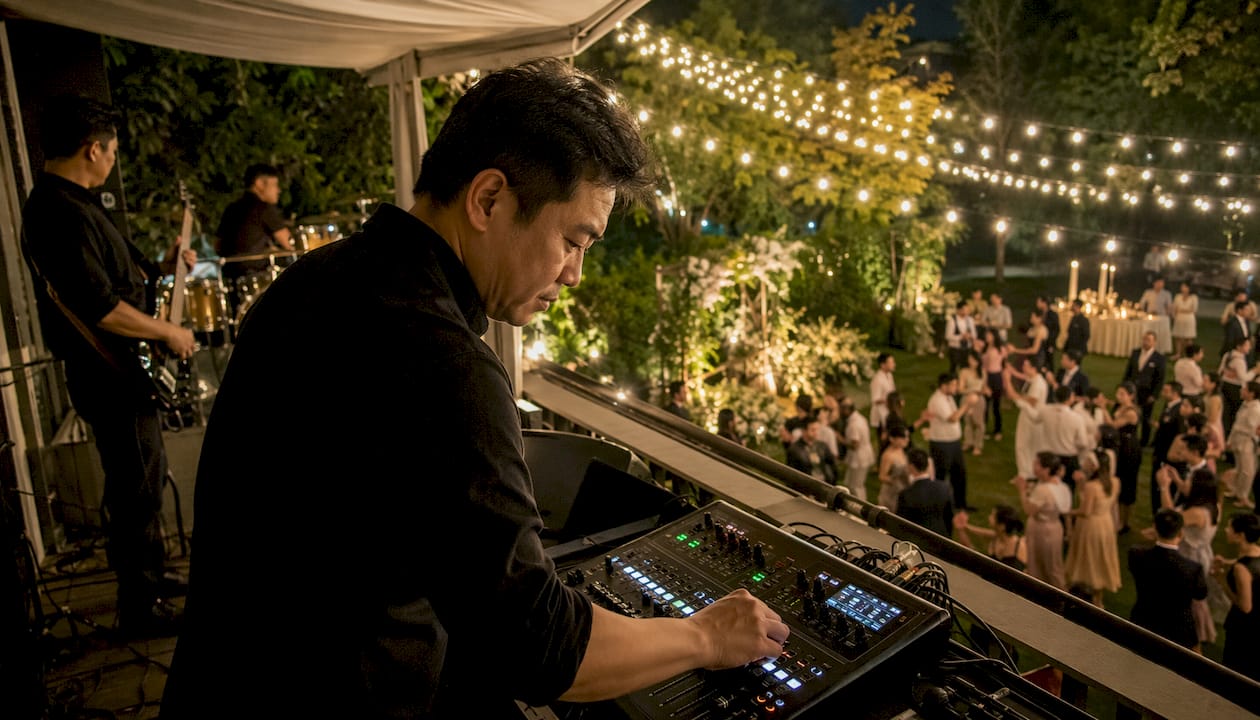
Band placement is the single most controllable factor in whether guests feel invited to dance. The performer should face the floor directly, with no more than five metres between the front of the stage and the edge of the dancing area.
Production checklist
- Sightlines: every guest at a table within 15 metres should have a clear view of the performer’s face.
- PA placement: speakers should cover the floor evenly. Avoid a single central stack that creates a loud centre and dead edges.
- Monitor volume: stage monitors should be low enough that the band can hear the room, not just themselves.
- Volume at tables: aim for a level where guests can speak at normal volume at tables beyond the floor edge.
- Lighting: warm front fill on the performers, colour wash on the floor, timed colour shifts at energy peaks.
- Floor clearance: remove chairs, cords, and any physical barriers from the dancing area before doors open.
Visible musician presence increases audience immersion and physiological synchrony. This means the band should be lit so guests can see faces and movement, not silhouetted against a backlit rig. Run a full lighting and soundcheck before guests arrive, including a sightline check from the furthest table.
A printable brief for planners and couples
Hand this to your band, DJ, and venue coordinator at least one week before the event.
Event brief: one-page version
- Event timeline: arrival time, dinner start, speech slot, first dance, open floor, finish time.
- Must-play song types: list 10–15 types or specific tracks in priority order.
- Must-not-play: list three to five genres, artists, or tracks.
- Special moments: first dance song, cake-cut song, send-off song.
- Guest profile: age range, approximate numbers, any accessibility considerations.
- On-the-night contacts: who signals food clear, who handles guest requests, who is the band’s single point of contact.
- Spare set list location: confirm where a printed backup is kept.
On-the-night roles
- Floor captain: signals the band for energy changes and manages the timeline.
- Guest request handler: collects requests and filters them through the floor captain, not directly to the band mid-set.
- Venue coordinator: confirms PA, lighting, and floor clearance before doors open.
For cross-generational inclusivity, include at least two song types from each decade represented in the guest list. Keep tempo between 100–150 BPM for the first open-floor set so older guests can join before the energy peaks. Wedding music for every generation offers a practical breakdown by age group.
Why does live music work? The research explained
The effect of live performance on dancing is measurable, not just felt. Three bodies of research explain the mechanism.
Research from the University at Buffalo found that live music creates collective effervescence: a shared emotional intensity that increases happiness and social connection, with effects that persist for days after the event. This is the psychological state that makes a wedding dance floor feel different from a playlist in a living room.
A PLOS One study conducted in a real-world club environment found that group synchrony peaks at tempos of 100–150 BPM, aligning with the body’s natural walking rhythm. Song familiarity was a stronger predictor of synchrony than any other variable tested. Songs with higher real-world play counts produced greater intersubject phase synchronisation across the crowd.
Physical co-presence of musicians increases self-reported immersion and produces measurable heart-rate synchrony in audiences. Livestream viewers of the same performance showed neither effect at the same level. The implication for event planning is direct: a live band in the room does something a recording cannot replicate.
A Frontiers in Psychology study using motion capture found that head movements were more vigorous during live concerts than during equivalent recorded playbacks, even when song familiarity was controlled. Fans showed stronger beat entrainment than neutral listeners, which supports booking performers whose style the audience already recognises.
Musical features that correlate with group synchrony include strong metrical clarity, high spectral flux (perceived liveliness), and rhythmic regularity. In practical terms: choose arrangements with a clear, prominent beat, live percussion, and minimal rhythmic ambiguity. An R&B or soul arrangement with a tight rhythm section delivers all three.
Key takeaways
Live music fills a dance floor when familiar songs at 100–150 BPM are delivered by visible, interactive performers whose energy is paced to match the room’s readiness.
| Point | Details |
|---|---|
| Tempo range matters | Keep the open-floor set between 100–150 BPM to match the body’s natural synchrony range. |
| Familiarity drives movement | Song play count predicts group synchrony; prioritise cross-generational hits over new material. |
| Performer visibility is functional | Physical co-presence increases immersion and heart-rate synchrony; light the band so guests see faces. |
| Pacing prevents early peaks | Hold peak energy until food is cleared and the room has warmed up for at least 20 minutes. |
| Brownsugarmusic approach | R&B and soul sets with call-and-response, tempo-mapped sets, and a pre-event brief covering must-plays and guest profile. |
What a professional band actually does to read the room
The first thing a trained band does when they walk into a venue is count the tables and estimate the age spread. That information shapes the opening set before a single note is played.
When the floor is slow to fill, the adjustment is usually subtle. Drop the tempo by five BPM, bring the bass forward in the mix, and shift to a song with a chorus the whole room knows. Most guests do not notice the change. They just find themselves moving.
At Brownsugarmusic’s long-running Friday residency at Marble Bar in the Hilton Sydney, the band has played to rooms ranging from corporate groups to wedding after-parties to regular bar crowds. The brief the band asks for before any event covers guest age range, three must-play moments, and the name of the on-the-night contact. That is enough to build a working set plan. Everything else is read live.
The small adjustment that makes the difference is almost always timing. A band that waits for the room to settle after speeches, then opens with something immediately familiar, will fill a floor that a band playing the right songs at the wrong moment will not.
Brownsugarmusic: R&B and soul sets built for full dance floors
Brownsugarmusic delivers R&B and soul wedding sets tailored to mixed-age crowds, with tempo-mapped energy, call-and-response crowd work, and a pre-event briefing process that covers must-plays, must-not-plays, and key timeline moments.
The band has performed at weddings, corporate functions, and private events across Sydney and internationally since 2003. Every booking includes a briefing call to confirm the guest profile and timeline. For couples wanting to see the format in action, elegant wedding entertainment examples are available on the website.
To check availability or make an enquiry, visit the events and booking page and include the event date, venue, and approximate guest numbers.
Useful sources
- University at Buffalo (2026): Press release summarising research on live music and collective effervescence. Explains why live performance increases happiness and social connection beyond the event itself. Read the release
- PLOS One (2016): Club-environment study identifying tempo (100–150 BPM) and song familiarity as the strongest predictors of group synchrony on a dance floor. Read the study
- Frontiers in Psychology (2018): Motion-capture study showing more vigorous head movement during live concerts than recorded playbacks; fan familiarity with the performer strengthened beat entrainment. Read the study
- Scientific Reports: Study comparing live and livestreamed concerts, finding higher immersion and heart-rate synchrony in physically present audiences. Read the study
- PMC / Experimental study: Groove and visual social cues increase movement energy and interpersonal coordination in collective listening situations. Read the study
- Duke University Space (peer-reviewed): Full paper on collective effervescence, live music, and lasting positive outcomes including meaning in life and continued happiness one week post-event. Read the paper
Peer-reviewed research was used throughout this guide to translate academic findings into practical decisions for set planning, staging, and performer briefing.