

Book bands to arrive with a 75 to 90 minute buffer before their required “ready” time. That margin covers load in, PA setup, instrument rigging and a proper soundcheck without anyone rushing.
This buffer isn’t padding. Experienced bookers treat it as standard insurance against parking delays, tight loading bays and the odd faulty cable.
- Solo or duo act: 30 to 45 minutes for full setup.
- 3 to 4 piece band: around 60 to 75 minutes, including a basic soundcheck.
- 5+ piece band with a larger PA: 90 minutes or more, especially if the band supplies its own sound system.
Key Takeaways
Reliable band setup time depends on band size, PA responsibility, load in logistics and a 75 to 90 minute arrival buffer built into the schedule.
| Point | Details |
|---|---|
| Standard arrival buffer | Book bands 75 to 90 minutes before their required ready time. |
| Setup scales with band size | Solo acts need 30 to 45 minutes; 5+ piece bands with full PA need 90 to 120 minutes. |
| Loading logistics matter most | Stairs, distance to stage and parking access are the biggest hidden time sinks. |
| Brief early, not last minute | Send stage dimensions, power details and a loading photo at booking confirmation. |
| Brown Sugar Music fits any timeline | Resident band experience means fast, reliable setup for Sydney weddings and events. |
Table of Contents
- Band setup time by band size and PA responsibility
- Why band equipment setup time varies so much
- A planner checklist to brief the band and venue early
- A sample day-of timeline for a wedding reception
- Common delays and how planners avoid them
- What happens during a band soundcheck
- Tear-down and clear-out timing to plan for
- A note from the stage: what we always ask planners for
- How Brown Sugar Music takes the guesswork out of your booking
- Frequently asked questions
- Sources
Band setup time by band size and PA responsibility
Setup duration hinges on two variables: how many musicians are on stage and who owns the sound system. A solo acoustic act with a compact PA can be stage ready in well under half an hour. Add a rhythm section, brass, or a full soul band lineup, and the maths changes fast.
Small PA setups typically take 30 to 45 minutes on their own, while a four piece band’s PA setup tends to sit around the one hour mark before soundcheck even starts. Larger ensembles bringing full monitoring, multiple DI boxes and a mixing desk regularly need one to two hours or more, based on musician forum reports gathered across dozens of gigs.
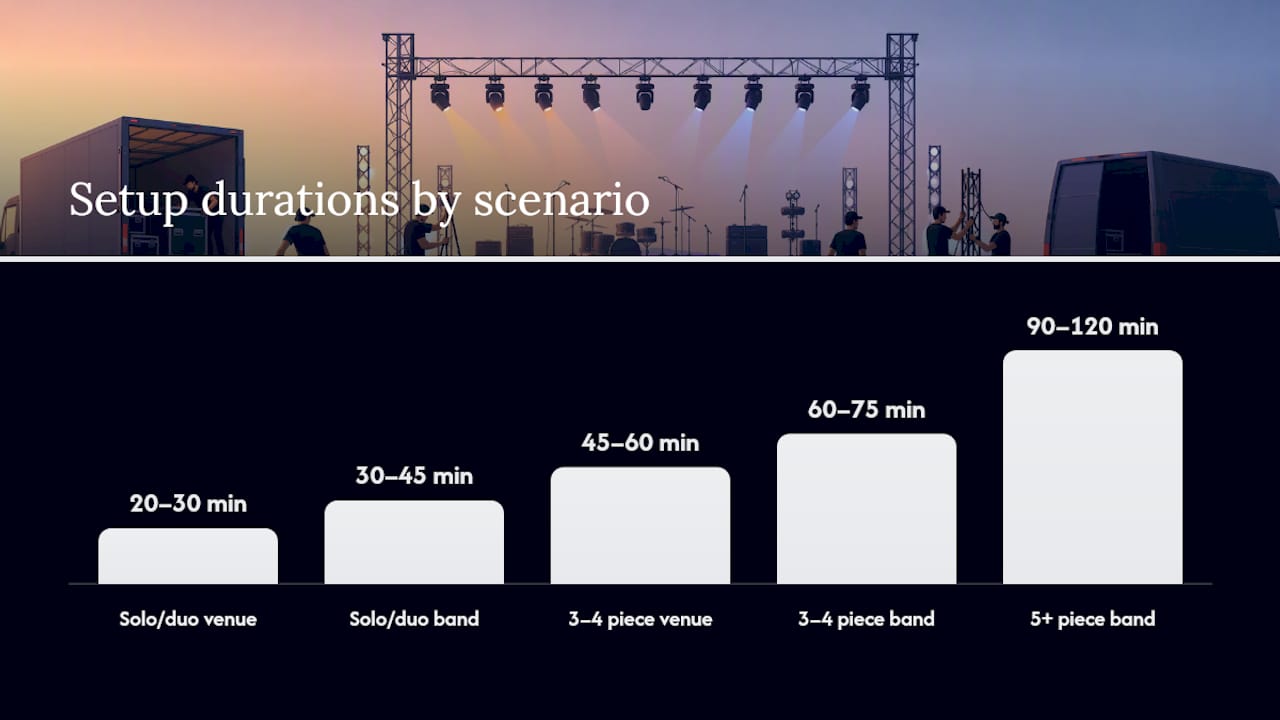
Here’s how that breaks down for planning purposes:
| Band size | Band-supplied PA | Venue-supplied PA (FOH) |
|---|---|---|
| Solo/duo | 30–45 minutes | 20–30 minutes |
| 3–4 piece | 60–75 minutes | 45–60 minutes |
| 5+ piece / large PA | 90–120 minutes | 60–90 minutes |
- If the venue already has a house PA and engineer, shave 20 to 30 minutes off every estimate above.
- If the band is bringing its own full rig, including monitors and a snake, build in the higher end of the range.
Why band equipment setup time varies so much
Three things drive the swing between a tidy 45 minute setup and a stressful two hour scramble. None of them are about the musicians’ skill.
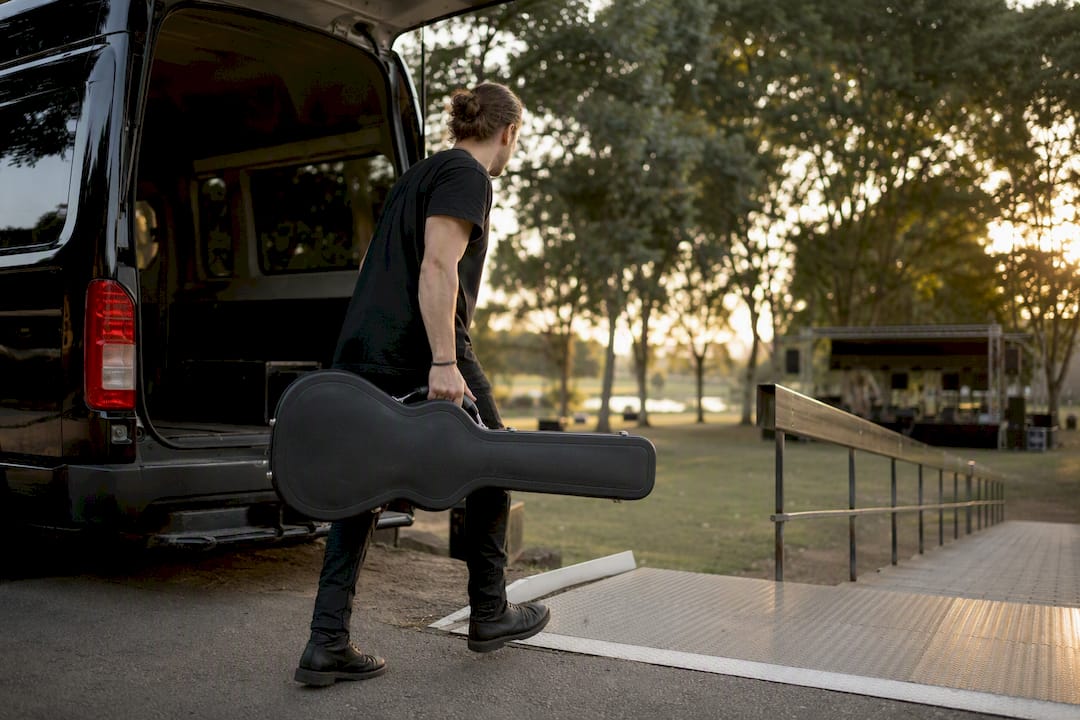
Logistics comes first: how far is the load in from the stage, is there a lift or only stairs, and can a van actually park near the door? A venue with a loading dock 200 metres from the stage adds real time that no amount of band experience can claw back.
Technical complexity is the second driver. More inputs mean more cables. Mic’d drum kits, multiple DI boxes, in-ear monitoring and a larger mixing desk all add setup steps that a duo with a single powered speaker never faces.
Crew and habits matter too. Bands with pre-labelled cases, a fixed stage plot and a consistent packing order move faster than bands who repack differently every gig. Modular packing and a stepwise setup order (power first, then mixer, then signal snakes, then instruments) cuts wasted movement and repeated cable runs.
Pro Tip: Ask the venue for the exact loading path in advance, including any stairs or lifts. An unexpected flight of stairs is the single most common reason a band’s setup runs over.
A planner checklist to brief the band and venue early
Send this information at the time of booking confirmation, not the week before. It removes almost every avoidable delay.
- Venue access details: loading bay location, nearest parking, whether there’s a lift, and the exact walking distance to the stage.
- Stage and power specifics: stage dimensions, breaker locations, and how many power circuits are available near the performance area.
- Sound setup information: whether the venue supplies a house PA, or whether the band needs to bring its own full rig.
- Noise and timing rules: any curfew, decibel limits, or council noise restrictions that affect load in or performance times.
- On-the-day contacts: a named venue contact with a mobile number, gate or entry codes, and confirmation of the vehicle(s) arriving.
A minimal rider covers the same ground from the band’s side: stage plot, input list, power requirements and preferred monitor setup. Guides on how a wedding band’s stage requirements work are worth sharing with the venue coordinator so nobody is guessing on the day.
- Share a photo of the actual stage area if possible.
- Confirm who is responsible for cases and cabling if multiple vendors share the space.
- Ask the band whether they use pre-assembled snakes, which shortens rigging time considerably.
A sample day-of timeline for a wedding reception
A typical reception with a 5 piece band supplying its own PA might run like this:
- 4:00pm: Band arrives, begins load in (75 to 90 minute buffer before first set).
- 4:15pm to 5:00pm: PA setup, stage rigging and cable runs.
- 5:00pm to 5:30pm: Soundcheck with venue contact present to sign off levels.
- 5:30pm to 5:45pm: Contingency buffer for late guests, technical fixes or a delayed room changeover.
- 6:00pm: First bracket begins.
For outdoor ceremonies, add extra time for power runs and weather contingencies. When the venue supplies FOH, shift the whole block earlier by 20 to 30 minutes, since load in tends to be simpler.
Common delays and how planners avoid them
Most day-of delays trace back to a handful of repeat offenders: vehicle congestion at the loading bay, missing or mismatched cables, power that trips under load, and vendors arriving out of sequence.
- Reserve a dedicated loading bay slot rather than sharing it with catering or florists.
- Ask the band to carry spare cables and a spare DI box as standard.
- Test venue power before the event, not during soundcheck.
- Assign one on-site runner to help with parking and access.
Pro Tip: Name a single day-of lead, whether that’s the planner, MC or venue manager, who coordinates vendor arrivals. One point of contact prevents three vendors arriving at the same loading door at once.
What happens during a band soundcheck
Soundcheck covers levels for each instrument, monitor mixes, feedback checks and any in-ear adjustments. For a small band with a sound engineer present, this can run in 10 to 30 minutes. A larger band with more inputs and monitor channels will need closer to the fuller one hour range.
The venue contact or planner should be present, ready to approve volume levels and flag any noise restrictions before the band commits to a final mix.
Tear-down and clear-out timing to plan for
Pack down usually mirrors setup, though slightly faster: a duo can clear in 15 to 20 minutes, while a 5 piece band with a full PA typically needs 45 to 60 minutes. Build this into the venue’s loading bay schedule and confirm any late-night noise rules apply to load out too. The band remains responsible for its own cases and cabling until everything is loaded into the vehicle.
A note from the stage: what we always ask planners for
After years of Friday nights on the same stage at the Hilton Sydney, the one thing that saves everyone time is a stage photo and clear loading instructions sent before the day. Send those two things the moment you book, and setup almost always runs on schedule.
How Brown Sugar Music takes the guesswork out of your booking
Brown Sugar Music has spent over 20 years learning exactly how much setup time a Sydney wedding or corporate event actually needs, from tight inner city venues to open air marquees. That resident experience at the Hilton Sydney’s Marble Bar means the band arrives knowing how to move fast without cutting corners on sound quality.
If you’re planning a reception and want a band that handles its own logistics with minimal back and forth, see how a live band lifts your wedding reception or head straight to book an R&B band for your event to check dates and get a quote.
Frequently asked questions
How long does a band typically need to set up?
Most bands need 30 to 120 minutes depending on size and whether they supply their own PA, with a 75 to 90 minute arrival buffer recommended.
Does the venue’s PA system change setup time?
Yes. When a venue supplies house sound and an engineer, setup can shrink by 20 to 30 minutes compared with a band bringing a full rig.
What’s the biggest cause of setup delays?
Loading access, including stairs, distance to the stage and parking, causes more delays than any technical issue.
How long does soundcheck take?
A small band with an engineer present often finishes in 10 to 30 minutes; larger bands typically need closer to an hour.
How long does band tear-down take?
Pack down usually runs 15 to 60 minutes depending on band size, generally faster than the original setup.
Sources
- Gig setup time: how to reduce it – Easy Music Gig
- Talkbass
- How long do my musicians need to set up – Xoxos