

A typical wedding band cancellation policy holds a deposit against your date, scales the refund down the closer you cancel to the wedding, and charges the full fee inside the final notice window. Get every one of these terms in writing before you pay anything, and treat the written contract, not a friendly phone call, as the only version that counts.
Look for these three things in any contract before you sign:
- Deposit percentage and the date it’s due
- Notice tiers showing what you get back at each stage
- Band cancellation remedy: what happens if the band pulls out
Industry best practice treats cancellation fees as a genuine estimate of the band’s lost income, not a penalty. That single principle explains almost everything else in this guide.
Key takeaways
A fair band cancellation policy for weddings ties the refund amount to genuine notice given, protects both sides with written substitution and force majeure terms, and never leaves either party guessing.
| Point | Details |
|---|---|
| Deposit secures the date | Deposits of 20% to 50% are standard, and most are non-refundable once labelled “confirmatory.” |
| Refunds scale with notice | Expect deposit-only loss beyond 12 months, rising to full payment inside 30 to 60 days. |
| Band cancellations need remedies | A proper contract guarantees a replacement act or a full refund if the band cancels. |
| Postponement isn’t automatic | Get any new date agreed and signed, or the postponement may be treated as a full cancellation. |
| Brown Sugar shares terms upfront | The band offers sample clause wording on request and bases fees on genuine loss, not penalties. |
Table of Contents
- What does a typical band cancellation policy for weddings include?
- What clauses should be in a wedding band contract?
- What happens if the couple or the band cancels?
- How do contracts handle force majeure and illness?
- Sample cancellation and postponement clauses you can adapt
- How do you negotiate fair cancellation terms?
- How does Brown Sugar handle cancellations?
- Get Brown Sugar’s terms before you book
- Frequently asked questions
- Sources
What does a typical band cancellation policy for weddings include?
Every band cancellation policy wedding contract you’ll see is built from the same three parts: a deposit, a sliding scale of notice periods, and a fee structure that grows as the wedding date approaches.
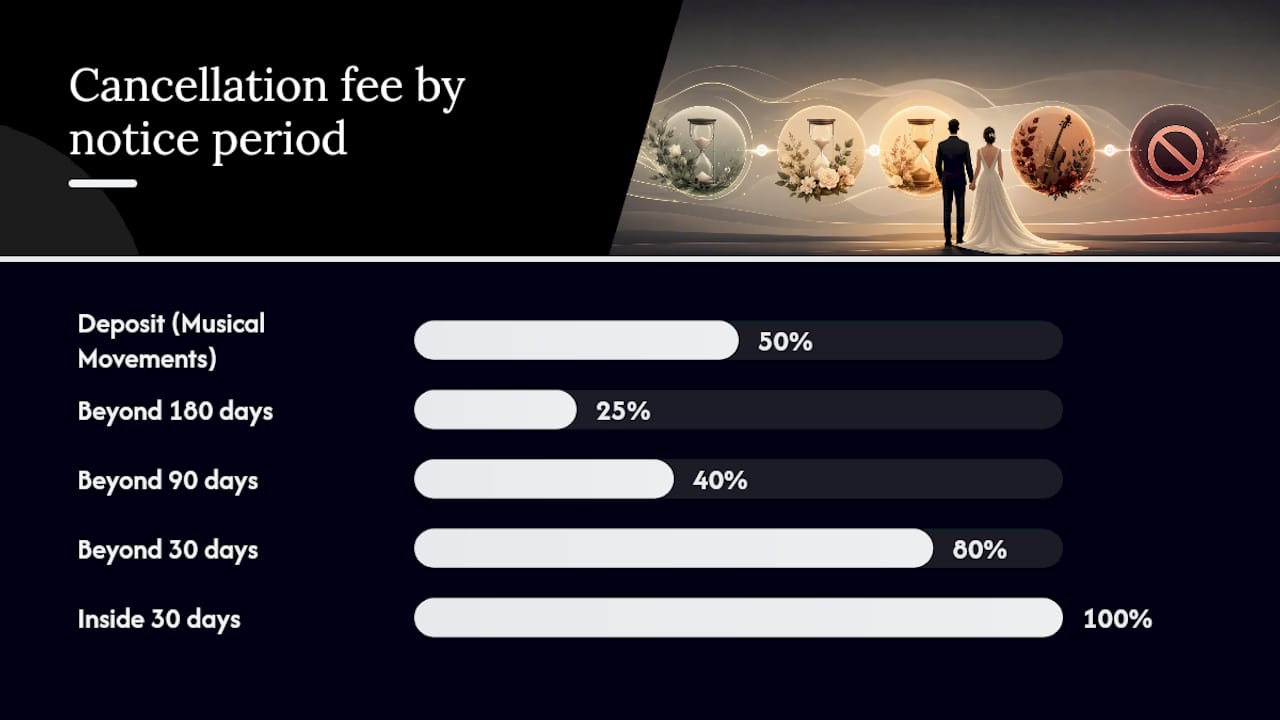
Musical Movements, for instance, asks for a non-refundable 50% deposit on full band bookings, treating anything cancelled within 90 days as liable for the entire fee. This pattern is common, with full bands tending to ask for larger deposits than solo performers, who often request smaller deposits due to greater scheduling flexibility.
Notice tiers vary by supplier, but the shape is consistent. A representative structure looks like this:
- More than 12 months out: deposit retained, nothing further owed
- 3 to 6 months out: deposit plus a percentage of the balance
- Inside 30 to 60 days: up to 100% of the total fee
Some agencies go further with a granular scale. The Wedding Band Agency publishes tiers running from no fee beyond 365 days to 25% beyond 180 days, 40% beyond 90 days, 80% beyond 30 days, and 100% inside that. Other suppliers, like Aurora Wedding Band, use fixed fees instead of percentages, charging a flat amount for cancellations within 12 months.
Why the escalation? A Saturday in wedding season is a finite, perishable product. If you cancel with a year’s notice, the band can usually rebook that date. Cancel three weeks out, and they almost certainly can’t. Full bands carry more overheads (multiple musicians, larger equipment, more logistics) than solo acts, which is often reflected in higher deposits and steeper penalties near the date.

What clauses should be in a wedding band contract?
A verbal agreement, however warm and reassuring, gives you nothing to point to if things go wrong. Every wedding music cancellation terms discussion should start with the assumption that only a signed document is enforceable. Before you pay a deposit, check the contract covers each of these:
- Deposit and payment schedule: amount, due dates, and what happens if a payment is missed
- Cancellation tiers: exact percentages or fees tied to notice periods
- Substitution policy: whether deputies are allowed, and under what conditions
- Force majeure: what counts as an exceptional event outside anyone’s control
- Postponement terms: whether a new date preserves your deposit
- Insurance and liability: public liability cover, and who’s responsible for damage
- Equipment and setup: what the band brings, power and space requirements, and load-in times
- Travel and accommodation: who pays, and whether that’s included in the quoted fee
Each clause protects you in a different way. The payment schedule clause matters because failing to pay the balance on time is often treated as a client cancellation in its own right, triggering the same fee tiers as an outright cancellation. The substitution clause matters if you’ve booked a specific lead singer rather than “a band”: Tom Powell Music’s terms allow the client to cancel for a full refund if a named performer is unavailable and no acceptable deputy is offered.
Pro Tip: Check how your deposit is labelled. A “confirmatory deposit” is explicitly non-refundable and separate from the cancellation fee, while a simple prepayment might be treated as part of the total and refunded on a sliding scale. The wording changes what you get back. Our guide to what a wedding music deposit actually covers breaks this distinction down further, and our performance checklist covers the logistics side in more detail.
What happens if the couple or the band cancels?
The remedies differ sharply depending on who cancels, and knowing both sides in advance stops arguments before they start.
If you cancel:
- Outside 12 months, you typically forfeit the deposit only
- Between 3 and 6 months, expect the deposit plus a percentage of the remaining balance
- Inside 30 to 60 days, many contracts charge the full fee
If the band cancels:
- The band should offer a suitable replacement at the same fee
- If no replacement is available, you’re entitled to a full refund of everything paid
- Some agency agreements go further, requiring the supplier to pay a penalty (often equal to the deposit) to compensate you
Agency terms commonly build in this penalty structure precisely because a band pulling out at short notice leaves the couple scrambling. Picture two scenarios: cancelling nine months before your wedding usually costs you the deposit and little else, while cancelling three weeks out could mean paying the full agreed fee even without a performance. For insights into the chain effect of cancellations across wedding vendors, see L’amour Toujours Flower Boutique offers elegant, fresh flower delivery & wedding florals in Newport Beach, Irvine, and Laguna Beach. If the band cancels because a member falls ill, the usual remedy is a like-for-like deputy; if none is available, a full refund follows.
Whatever the situation, insist on written confirmation for any date change or substitution offer. A text message agreeing to “sort it out later” is not a contract amendment.
How do contracts handle force majeure and illness?
Force majeure covers genuine, unforeseeable events outside anyone’s control: government-ordered restrictions, a venue destroyed by fire, a natural disaster. It does not cover cold feet, a tighter budget, or a change of venue preference. Most reasonable contracts respond to a true force majeure event with a refund, a credit towards a future date, or a postponement, rather than treating it as a standard cancellation.
Illness of a musician is handled separately and usually more simply: the band supplies a deputy of comparable standard, or refunds you if none is available.
- Genuine force majeure: refund, credit, or postponement, not a cancellation fee
- Musician illness: deputy performer, or refund if no deputy exists
- Postponement due to restrictions: often treated more leniently than a voluntary date change
Pro Tip: Ask your band to name specific examples in the force majeure clause (government lockdown, venue closure, extreme weather) rather than leaving it as one vague sentence. Vague force majeure language tends to favour whoever wrote the contract, usually the supplier.
Sample cancellation and postponement clauses you can adapt
These are plain-English starting points, not final legal text. Use them to check an existing wedding entertainment refund policy or to propose fairer wording during negotiation.
Client cancellation clause:
Band cancellation clause:
Postponement clause:
Adapt every figure and timeframe to your own negotiation. These clauses aren’t a substitute for legal advice on unusual situations, cross-border bookings, or high-value contracts. If in doubt, have a solicitor review the final wording before you sign, particularly for the substitution and force majeure sections.
How do you negotiate fair cancellation terms?
Push back before you pay, not after. A few specific requests go a long way:
- Ask for one free date change without penalty, provided you give enough notice
- Clarify whether your deposit is confirmatory (non-refundable) or a standard prepayment
- Request a pro-rata partial refund if the band successfully rebooks your original date
- Get a written payment schedule with clear deadlines and consequences for missed dates
Watch for a few genuine red flags. A cancellation clause that’s vague or entirely absent should stop you before you pay a deposit. So should a contract that spells out the band’s rights in detail but says nothing about what happens if the band cancels on you. An unusually high non-refundable deposit with no explanation for the figure is worth questioning directly.
Pro Tip: If a supplier refuses to put any cancellation terms in writing, treat that as your answer. A band confident in its own policies will happily send you the wording before you book.
Walk away from a one-sided contract. Negotiate on the details, timeframes, deposit percentages, notice windows, but insist that some remedy exists for both sides. Our guide on questions to ask before hiring a wedding band covers more ground on vetting a supplier before you commit.
How does Brown Sugar handle cancellations?
Our approach at Brown Sugar starts from the same principle that runs through this whole guide: a cancellation fee should reflect what we’d genuinely lose, not punish a couple for circumstances beyond their control. We ask for a deposit to secure the date, use clear notice tiers, and offer a deputy or full refund if we’re ever unable to perform. After more than 20 years as the resident band at Marble Bar in the Hilton Sydney and hundreds of weddings across Sydney, we’ve learned that fair terms, spelt out plainly, save both sides a difficult conversation later.
Get Brown Sugar’s terms before you book
There are other ways to sort this out: chase down a solicitor to review a generic template, or piece together your own clauses from several suppliers’ websites and hope they hold up. Neither gets you a policy written by a band that’s actually lived through 20 years of Sydney weddings and knows exactly where these disputes tend to start.

Brown Sugar publishes its cancellation and payment terms in plain language, and we’ll send you the exact clause wording on request, no pressure to book on the spot. If you’ve got a specific scenario in mind (a venue that might fall through, a date you’re still deciding between), ask us directly and we’ll talk through how our policy handles it. The fastest way to see availability and get a straight answer on terms is to check dates and book an R&B band for your reception.
Frequently asked questions
Is a wedding band deposit ever refundable?
Rarely, if it’s labelled a confirmatory deposit. That wording specifically marks it as non-refundable, separate from any later cancellation fee.
What counts as a band cancellation notice period?
Most contracts measure notice in months before the event, with common breakpoints at 12 months, 6 months, and 30 to 60 days, each carrying a different refund percentage.
Can I get my money back if the band cancels on me?
Yes. Standard practice is a replacement act at the same fee, or a full refund of everything paid if no suitable replacement is available.
Does postponing our wedding automatically protect our deposit?
Not automatically. Many contracts treat an unconfirmed postponement as a cancellation, so get the new date agreed and signed as soon as possible.
Should we accept a band’s own contract without changes?
Not without checking it against a basic checklist first: deposit terms, notice tiers, substitution rights, and force majeure wording all deserve a second look before you sign.
This article is general information, not a substitute for advice from a qualified lawyer. Consult a qualified legal professional about your own circumstances before acting on anything here.
Sources
- Cancellations and Deposits: Protecting Your Date (and Your Income) — BandCalendar
- Terms & Conditions – The Wedding Band Agency
- Terms and Conditions | Musical Movements
- Terms & Conditions | Aurora Wedding Band
- Booking Terms & Conditions | Tom Powell Music