

Book a wedding band 12 to 18 months before a peak summer Saturday. Off-peak or weekday weddings need 6 to 9 months. Highly sought-after acts and full-day packages on bank holiday weekends often require 18 to 24 months’ notice, according to guidance from Australia’s Wedding Guide. That’s the short version. The longer version depends on your date, your venue, and how much of the day you want covered by live music.
If you take one thing from this article, take this: confirm your venue and date first, then move straight to booking date-specific vendors, prioritizing bands because good ones sell out fast.
Three things to do right now:
- Lock in your venue and wedding date. Nothing else on this list matters until this is settled.
- Shortlist bands that match your sound and check availability immediately for your date, especially if it falls on a Saturday between November and April.
- Place a deposit or ask for a provisional hold the moment you find a band you like. A verbal “we’re interested” holds no reservation.
Once you’ve done those three things, everything else in this guide (contracts, coordination calls, day-of logistics) falls into place on its own schedule.
Key Takeaways
Booking a wedding band 12 to 18 months ahead for peak dates, and 6 to 9 months for off-peak weddings, is the single most reliable way to secure your first choice and avoid rushed, costlier last-minute hires.
| Point | Details |
|---|---|
| Book peak dates early | Aim for 12 to 18 months for standard Saturdays and up to 24 months for bank holidays and NYE. |
| Off-peak gives more room | Weekday and winter weddings can often be booked with 6 to 9 months’ notice. |
| Full-day packages sell out first | If you want ceremony-through-evening coverage, treat it as an urgent single decision. |
| Lock the contract details early | Confirm named musicians, deposit terms, cancellation policy, and load-in windows before signing. |
| Schedule the final details call at 4 weeks | Finalise setlists, cues, and timings with the band roughly a month before the wedding. |
| Choose a band with proven reliability | Brownsugarmusic brings over 20 years of live performance experience, including a two-decade Friday residency at Marble Bar in the Hilton Sydney, to weddings booked well ahead or closer to the date. |
Table of Contents
- Why you shouldn’t leave your wedding band booking timeline until the last minute
- What’s the ideal wedding band booking timeline by wedding type?
- When does a band play during the wedding day, and what packages exist?
- What if you need to hire a wedding band at short notice?
- What questions should you ask before booking a wedding band?
- What happens between booking and the wedding day?
- Why do planners treat the band as an early priority?
- A note on getting the timing right
- Ready to check availability for your date?
- Sources
Why you shouldn’t leave your wedding band booking timeline until the last minute
The best acts get booked first, and they get booked early. A band with a strong reputation and a diary full of Saturday weddings simply runs out of dates. Wait too long and you’re not choosing from a shortlist. You’re choosing from whoever happens to be free.
That scarcity hits full-day packages hardest. Couples who want a band across the entire day, ceremony through to last dance, are making a bigger commitment than an evening-only booking, and that fuller booking typically sells out earlier than a three-hour reception slot. If your heart is set on live music for the ceremony walk-in as well as the dancefloor, treat that as one urgent decision rather than two separate ones.
There’s a cost dimension too. Booking late rarely means booking cheaper.
- Rush bookings often carry premium last-minute fees rather than discounts.
- Your first-choice lineup may already be committed elsewhere, leaving you with a substitute act you haven’t heard play.
- Less time to plan means less time for the band to rehearse your specific song requests or unusual set structure.
- Limited choice narrows your options right when your taste in music matters most.
There’s also a knock-on effect that couples underestimate: logistics. A band booked at the eleventh hour has had no time to align load-in windows, soundcheck slots, or stage requirements with your venue. That’s how a runsheet ends up with a 20-minute gap nobody planned for, or a soundcheck happening while your first guests are already arriving for the ceremony.
What’s the ideal wedding band booking timeline by wedding type?
Not every wedding runs on the same clock. A Tuesday elopement in June has a completely different booking rhythm to a Saturday wedding in December. Here’s how the timeline shifts depending on what you’re planning.
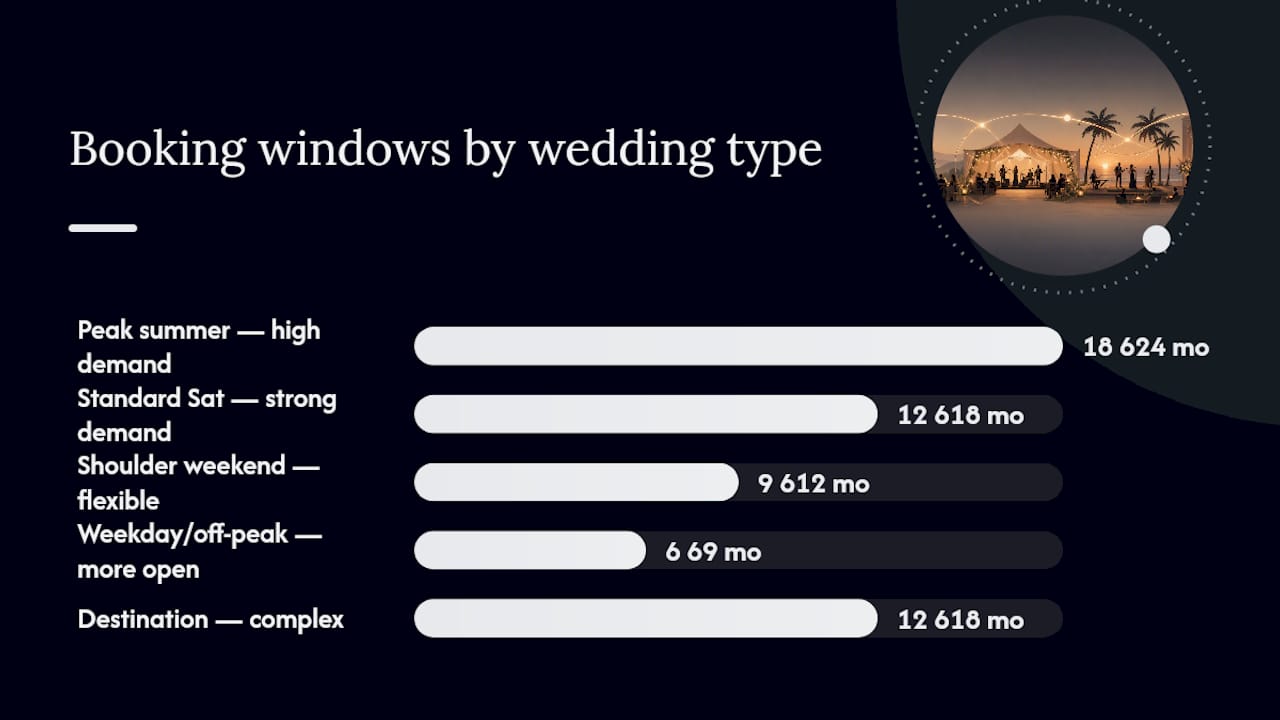
Peak summer Saturdays, bank holidays and New Year’s Eve carry the tightest booking windows. These are the dates every couple wants, which means bands with strong reputations are often locked in 18 to 24 months ahead for full-day coverage. If your wedding falls into this category and you have a specific act in mind, start reaching out as soon as your venue is confirmed. Don’t wait for the rest of your vendor list to fall into place first.
Most Saturday weddings, outside the absolute peak dates, sit comfortably in the 12 to 18 month window. This is the range that applies to the majority of couples reading this. It gives you time to audition a few bands, negotiate a package that suits your reception style, and still have room to adjust song requests later.
Shoulder season weekends (think early spring or late autumn) tend to have slightly more flexibility. Nine to twelve months is often a workable minimum, though popular acts on any Saturday can still book out earlier, according to uRequest Live.
Weekday and off-peak weddings are the most forgiving. Fridays and Sundays tend to open up more room than Saturdays, and a genuine weekday or winter wedding can often be booked with 6 to 9 months’ notice. Even here, earlier is better if you’re set on one particular band rather than “any good band available.”
Destination weddings and luxury multi-day celebrations deserve their own category, not because the booking window is necessarily longer, but because the logistics are more complex. Travel, accommodation, equipment transport and extended performance schedules across multiple days all need confirming well in advance. Treat these like peak-date bookings even if your actual wedding date falls in a quieter month.
| Wedding type | Recommended booking window | Why |
|---|---|---|
| Peak summer Saturday / bank holiday / NYE | 18 to 24 months | Highest demand dates, full-day packages sell out earliest |
| Standard Saturday wedding | 12 to 18 months | Strong demand but more available acts than peak dates |
| Shoulder season weekend | 9 to 12 months | Moderate demand, more flexibility on choice |
| Weekday / off-peak | 6 to 9 months | Lower demand, more last-minute availability |
| Destination / multi-day luxury | 12 to 18 months (book as early as logistics allow) | Travel, accommodation and equipment coordination add complexity |
A quick example: if you want an all-day package covering ceremony, cocktail hour, dinner and the evening reception, push your enquiry to the earlier end of whichever window applies to your date. Bands selling full-day coverage are managing fewer available slots per weekend than bands offering evening-only sets, so that choice narrows faster.
When does a band play during the wedding day, and what packages exist?
Most couples don’t need a band for every hour of the day, and understanding the package options helps you work out how urgent your booking timeline actually is.
- Ceremony-only covers your walk down the aisle and the signing of the register, typically a short, focused set. This suits couples who want live music at one specific emotional moment without committing to the whole day.
- Evening-only is the most common package: the band arrives in the afternoon, plays through cocktail hour or dinner background music, then delivers the main dance sets once the formalities are done.
- Cocktail plus evening extends coverage to include the drinks reception, giving guests live music from the moment they arrive after the ceremony through to the last dance.
- Full-day packages cover ceremony, cocktail hour, dinner, and evening reception as one continuous booking. Entertainment experts note that integrated all-day packages help maintain momentum across vendor transitions, rather than losing energy every time the music stops and starts.
Set structure matters here too. A typical live band arrangement runs 45-minute sets with 15 to 20 minute breaks, which affects how your runsheet gets built around speeches, cake cutting, and first dance timing.
Full-day packages generally fill first, purely because there are fewer of them available per weekend and they represent a bigger commitment for the band. If your reception style depends on live music carrying the whole evening without a DJ handoff, that’s a strong argument for booking earlier rather than later. Our guide on live band wedding reception benefits covers how coverage choice affects atmosphere in more detail.
Which package suits you depends largely on venue size and the atmosphere you want. Smaller, more intimate weddings often do well with evening-only coverage paired with recorded music earlier in the day. Larger receptions with a strong entertainment focus tend to benefit from full-day bookings, since the transition from cocktail hour to dinner to dancing feels seamless when the same musicians are carrying it throughout.
What if you need to hire a wedding band at short notice?
Sometimes the venue falls through, plans change, or you simply didn’t realise how far ahead bands book. If you’re now three or four months out with no band confirmed, you still have options, just fewer of them.
- Local acoustic duos or trios are often more available at short notice than full seven-piece bands, since they need less coordination and equipment.
- A DJ paired with a short live set (an hour of live music bookended by DJ coverage) can deliver a live element without needing a full band’s availability window.
- Agency rosters sometimes hold last-minute cancellation slots or bench musicians who can step in with less lead time than booking a band directly.
- Session musicians familiar with wedding repertoire can occasionally be assembled faster than a fixed band lineup, though rehearsal time will be limited.
If you’re booking urgently, work through a short checklist before you commit:
- Confirm the named musicians performing, not just the agency or band name.
- Ask about the load-in window and whether it fits your venue’s access hours.
- Check what equipment they bring versus what the venue needs to provide.
- Ask directly about overtime rates if your reception runs long. Hidden costs like vendor meals, equipment transport and overtime fees catch out couples booking in a hurry more than anyone else.
Manage your expectations on repertoire, too. A band with two weeks’ notice hasn’t had time to learn a bespoke first dance song or rehearse an unusual request list. Soundcheck time may also be compressed, so build in flexibility rather than expecting the polish of a booking made a year in advance.
What questions should you ask before booking a wedding band?
A verbal agreement and a good feeling aren’t a contract. Before you sign anything, work through these points with the band or agency:
- What’s the deposit amount, and when is the balance due?
- What happens if the wedding is postponed or cancelled? Get the cancellation terms in writing.
- Who is actually performing? Ask for named musicians, not a generic “band member” placeholder.
- Is there a substitute policy, and if so, what standard are replacements held to?
- What’s the load-in time, and does it fit your venue’s access window?
- How long is the soundcheck, and when does it need to happen?
- What are the stage size, power, and parking requirements?
- Is the venue’s music licensing sorted, and does the band carry appropriate insurance?
- Are vendor meals and breaks included or expected separately?
- What’s the overtime rate if the reception runs past the agreed finish time?
Contracts should name specific musicians or, at minimum, an approved list of quality substitutes. A vague clause promising an “equivalent” performer is one of the clearest warning signs in a wedding band contract, since it gives the band total discretion to swap out your chosen lineup at the last minute.
Watch for these red flags before you sign:
- Load-in times left blank or described as “to be confirmed” close to the wedding date.
- No written rider covering technical requirements like power, stage size, or backline.
- Vague substitute clauses with no quality standard attached.
- Reluctance to put deposit and cancellation terms in writing.
Our wedding band performance checklist walks through these logistics in more detail once you’ve confirmed your booking.
What happens between booking and the wedding day?
Signing the contract isn’t the end of the planning process. It’s the start of a coordination timeline that runs right up to the day itself.
| Milestone | Typical timing | What happens |
|---|---|---|
| Deposit and booking confirmation | At contract signing | Date locked, deposit paid, initial package agreed |
| Song requests and rough run-of-show | 3 to 6 months before | Must-play and do-not-play lists submitted, draft timeline shared |
| Final details call | Roughly 4 weeks before | Setlist finalised, cues confirmed, timing questions resolved |
| Final cue sheet / runsheet | 2 weeks before | Exact timings for entrances, speeches, first dance locked in |
| Load-in and soundcheck | Day of the wedding | Band arrives, sets up, tests sound ahead of guest arrival |
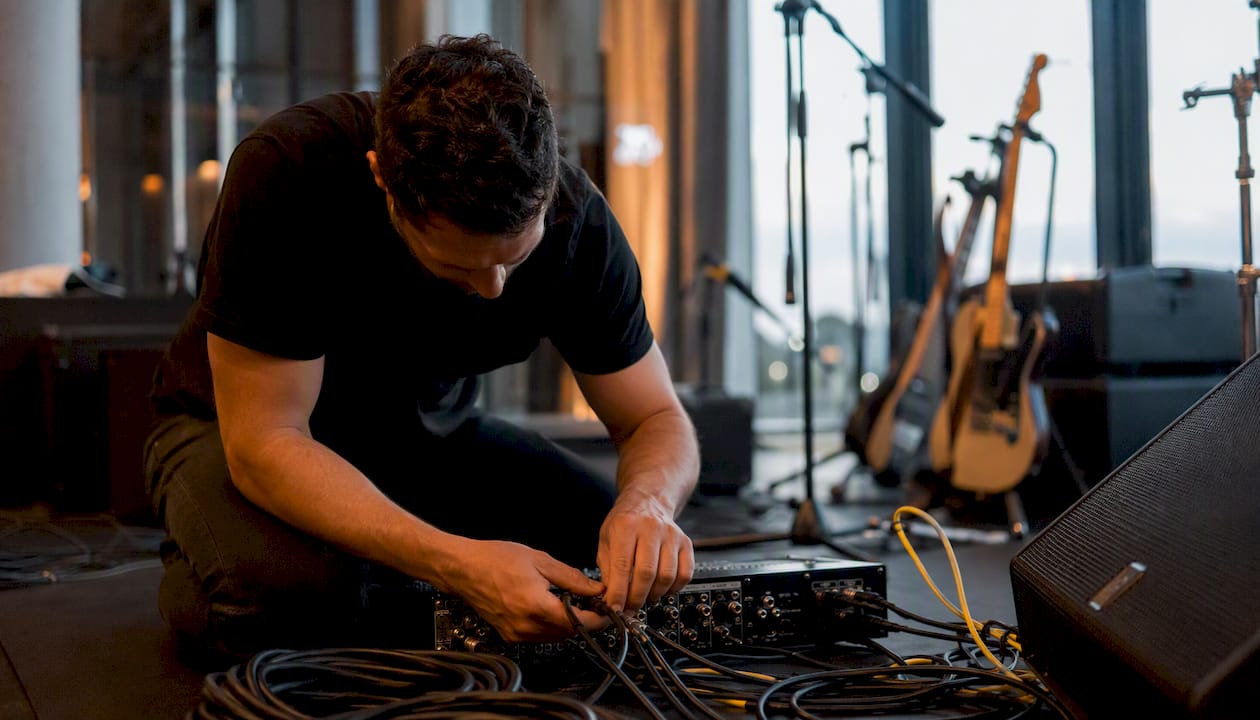
The final details call, typically scheduled around four weeks out, is where most of the practical decisions get locked in: start times, musical cues for key moments, and any last adjustments to the song list. A shared, editable runsheet that accounts for load-in and set breaks, distributed to the band and your coordinator four to six weeks ahead, prevents the kind of last-minute timing scramble that derails an otherwise well-planned reception.
If you want guidance on submitting your must-play list well ahead of that final call, our page on requesting songs for your wedding band covers timing and format. And for advice on managing guest requests without losing control of your set list, see our guest music requests guide.
Why do planners treat the band as an early priority?
Ask most experienced wedding planners which vendor to book second, right after the venue, and many will say the band. The reasoning is straightforward: the band shapes the entire energy of your reception, from the mood during dinner to whether the dancefloor actually fills up. Booking it early preserves your choice, particularly if you want something specific, like a genuine R&B and soul sound rather than a generic covers act.
Most experienced planners build the entire runsheet around the band’s technical requirements, scheduling 60 to 90 minutes for load-in and soundcheck rather than squeezing the band into whatever gap is left. It’s easier to fit venue access, catering timing, and photography around a confirmed soundcheck window than to force a band’s setup into a schedule already locked in for everyone else.
Pro Tip: Ask your venue coordinator for the earliest possible access time before you finalise your runsheet. A 60-minute load-in squeezed into a 30-minute window is the single most common cause of a delayed reception start.
Here’s a common scenario: a couple books a venue with a 3pm access time, then plans a 4pm ceremony immediately after. The band arrives at 3pm expecting a 90-minute load-in and soundcheck, only to discover florists and caterers are also using that hour. The fix is almost always the same: negotiate earlier venue access specifically for sound-sensitive vendors, or shift the ceremony start by 30 minutes. Either resolves the clash, but only if it’s caught during planning rather than discovered on the day. For more on how technical requirements shape venue logistics, see how wedding band performance works and this partner guide on what venue access time means for your wedding.
A note on getting the timing right
Every wedding I’ve watched come together well shares one trait: the band was booked early enough that it never became a source of stress. The couples who struggle are almost always the ones who treated the band as an afterthought, something to sort out once the cake and the flowers were settled.
That’s backwards. The band is often the loudest, most present vendor at your reception for hours at a stretch. It deserves the same early attention as your venue, not a rushed decision made three months out because every other box got ticked first.
Working with a professional band with genuine performance history removes most of the guesswork. Ask for named musicians, get everything in writing, and prioritise availability over price the moment you find a sound you love. The couples who do this rarely regret it.
Ready to check availability for your date?
If you’ve read this far and you’re picturing a reception built around genuine R&B and soul rather than a generic covers set, Brownsugarmusic offers something most local bands can’t: two decades of near-continuous live performance experience, including a residency held every Friday night at Marble Bar in the Hilton Sydney for over 20 years. That’s not a band learning your date on the fly. It’s a band that has performed at countless weddings, corporate functions, and private parties, and knows exactly how to read a room and hold a dancefloor.
Packages range from evening-only sets through to full-day coverage spanning ceremony, cocktail hour, dinner, and the evening reception, built around the same 45-minute set and 15 to 20 minute break structure most professional bands use. Rather than guessing whether a band will suit your reception style, you can explore what R&B and soul music brings to a wedding atmosphere and see how packages are structured before you commit.
The next step is simple: check availability for your date now, particularly if you’re eyeing a Saturday in peak season. Enquire about booking Brownsugarmusic for your reception and get a bespoke package built around your ceremony, venue, and guest count.
Sources
- Wedding bands | Australia’s Wedding Guide
- Hidden wedding costs | Easy Weddings
- Editable wedding timeline template for live bands | Cap City Band
- How far in advance to book a wedding band: the 2026 planning timeline | The Hitment Rio