

A live band is often the better choice for a first dance when your venue can handle the sound and your song translates well to a live arrangement. It brings something a speaker never will: a musician reading the room and adjusting to you, not the other way round.
Three things settle the decision fast:
- Emotional impact. Real vocals and instruments carry warmth and small imperfections that make the moment feel lived rather than played back.
- Flexibility. A band can adjust tempo, shorten a song to 60–90 seconds, or transpose the key so a shaky first line still lands.
- Planning essentials. Sound levels, a clear starting cue, and a smooth handover into the party all need agreeing before the day, not during it.
What follows is a full checklist for choosing and preparing a first dance live band, plus a shortlist of songs that work well live.
Key Takeaways
A live band gives couples control over tempo, length and emotional tone that a recorded track simply cannot match.
| Point | Details |
|---|---|
| Choose a song that works live | Pick for tempo and lyrics, not just popularity, and confirm the band can adapt or learn it. |
| Confirm length and arrangement early | Agree the 60 to 90 second edit, key and tempo weeks before the wedding, not days before. |
| Rehearse to the real tempo | Request a demo recording and practise steps against it, ideally in your wedding outfit. |
| Plan the transition into the party | Fix the exact end cue with the band and MC so the dance floor doesn’t sit empty afterwards. |
| Consider a specialist R&B/soul band | Brownsugarmusic builds bespoke arrangements with rehearsal recordings and soundcheck included for first dances. |
Table of Contents
- Why a live band elevates the first-dance moment
- When does the first dance happen, and how long should it last?
- How do you choose the right band for your first dance?
- Choosing and arranging your first-dance song
- How do you rehearse and coordinate the first dance with your band?
- How does a professional band actually prepare a first-dance performance?
- What do couples most often overlook when planning their first dance?
- Book a live R&B and soul band for your first dance
- Where to go for more song ideas and planning help
- Frequently asked questions
- Sources
Why a live band elevates the first-dance moment
The difference between a recording and a live performance comes down to what musicians call the human element. A singer holds a note a beat longer because the room feels right. A guitarist softens a chord because he can see your face. None of that exists on a track, however good the mastering.
That responsiveness has practical uses too. A band can slow a song down slightly so your steps don’t rush, nudge the key up or down if the singer’s range doesn’t match the original artist’s, and stretch or trim the arrangement to fit your timing exactly. Try asking a phone playlist to do any of that mid-song.
There’s also the guest experience to weigh. A band performing live gives photographers and videographers movement, light, and faces to work with, rather than a static speaker stack in the corner of the frame. Musicians create a small visual event around your dance, which shows up in the footage for years afterwards.
Compared with a recorded track, the trade-off is straightforward: a track is note-perfect and needs zero rehearsal, but it’s fixed. A band costs more coordination but adapts to you. For a first dance specifically, where the whole point is personal and unrepeatable, that adaptability tends to matter more than studio-perfect audio.
Pro Tip: Match the band size to the song’s intimacy. A stripped-back trio (vocals, keys, light percussion) often suits a slow ballad better than a full seven-piece, which can overpower a quiet moment. Save the full band’s horns and rhythm section for the transition into the party.
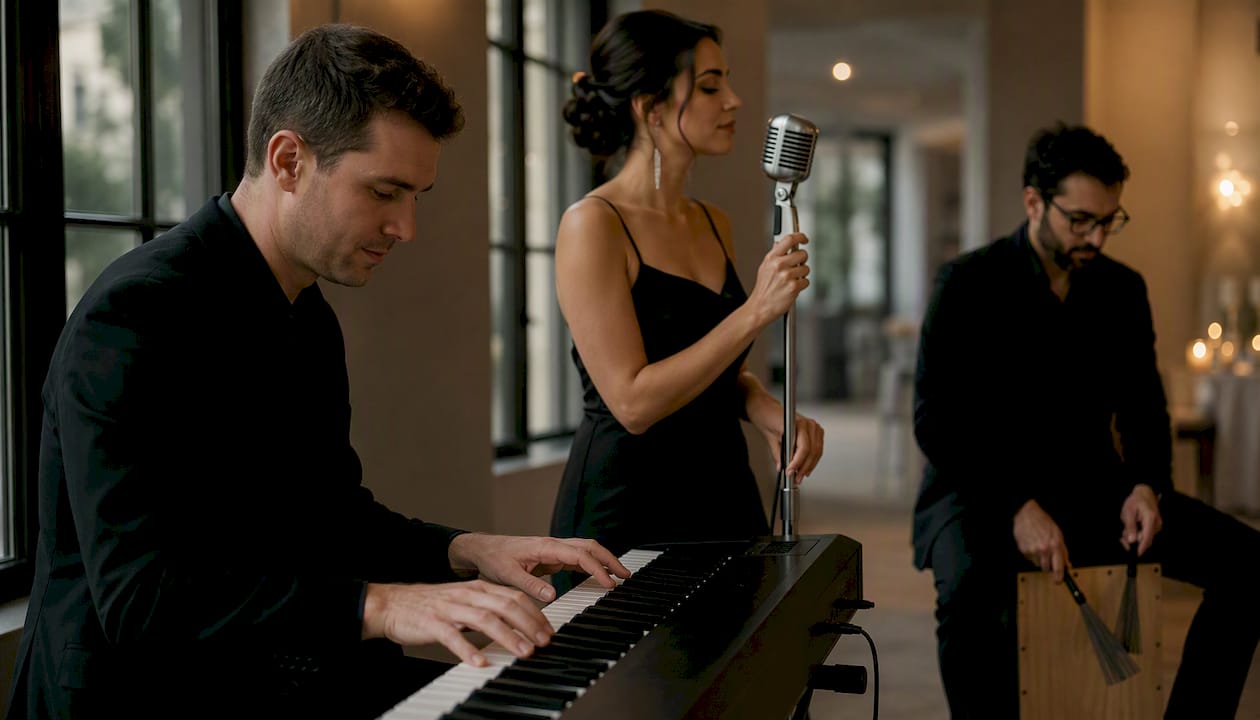
Bandleaders who specialise in live jazz and smaller ensemble arrangements point out that a scaled-down lineup gives more room to breathe and respond to the couple in the moment, rather than sticking rigidly to a chart.
When does the first dance happen, and how long should it last?
Most couples place the first dance right after the bridal party’s entrance, while energy is still high and everyone’s attention is on the room. Others prefer it after the meal, using it to open the dancing portion of the night and roll straight into the party. Both work. The entrance slot suits couples who want the moment captured while makeup and outfits are still pristine; the post-meal slot suits couples who want the first dance to double as the “let’s dance” signal for guests.
Duration matters more than most couples expect. The Knot recommends keeping a first dance to around 60 to 90 seconds, and this is exactly why bands routinely edit the full track down rather than play it in full. A four-minute ballad, danced in full, tends to drag, especially once the room is watching. A tight 75 seconds keeps the emotion high without letting attention wander.
Where it sits in the evening: Bridal entrance → welcome speech (optional) → first dance → parent dances (optional) → open floor / band’s first party set.
Before the day, confirm these cues with your band and MC:
- Who makes the announcement, and the exact wording they’ll use.
- Whether lighting changes for the dance (spotlight, dimmed room, or no change).
- The point at which guests are invited to join the floor.
- The band’s precise start cue and end cue, agreed in advance, not guessed on the night.
How do you choose the right band for your first dance?
Book on more than a demo video and a friendly phone call. A short, direct checklist saves you from surprises later.
Ask these questions before booking:
- Does the singer’s vocal range suit your chosen song, or will it need transposing?
- Will the band learn your exact version, or adapt their own arrangement of it?
- Can they send a short rehearsal or demo recording of the song before the wedding?
- What is the soundcheck window on the day, and who runs it?
- What happens if a musician is unwell, or equipment fails?
Greenlight Booking’s guidance is blunt about this: check the band’s specialism and vocal range, and always ask for a sample recording of them playing your song or something close to it, rather than trusting a generic showreel.
Beyond repertoire, check the contract itself. Confirm set times in writing, rehearsal or soundcheck inclusion, the cancellation policy, headcount limits for the venue, and any restrictions on amplification (some heritage venues cap decibel levels). If a stage is small or power points are limited, raise it early rather than on the day.
Watch for a few warning signs: no sample recordings offered, vague answers about whether they’ll adapt arrangements, or no written agreement at all. If choreography or dance lessons are part of your plan, lock in the tempo and key well before rehearsals start; changing either late forces you to relearn steps.
Choosing and arranging your first-dance song
Start with tempo and feel, not just the title. A slow ballad gives you room to sway and talk quietly; a mid-tempo song gives structure for simple steps; an upbeat number works if you want energy from the first note. Each maps to a different live treatment, and telling your band which effect you want lets them arrange accordingly.
Certain songs reappear on first-dance lists for good reason. Spotify data reported by Brides shows that “Can’t Help Falling in Love” and “At Last” were among 2024’s most chosen first-dance songs, alongside newer entries like “Perfect”. These work because they’re recognisable, sit in a comfortable tempo range, and translate easily to a live band without losing their character.
If you want more options, Brides’ broader round-up and Bark’s list of 160 first-dance songs span genres well beyond the obvious ballads, from soul classics to modern pop. There’s no single “correct” genre. Editors increasingly note that couples choose songs for personal meaning over chart popularity, which is exactly why a band that can learn or adapt a less obvious pick matters more than one that only plays the top ten.
| Arrangement style | What it sounds like | Best for | Trade-off |
|---|---|---|---|
| Original recorded track | Exactly as on the album | Couples wedded to a specific version | Zero flexibility on tempo or length |
| Full band cover | Full arrangement, band’s own interpretation | Couples wanting energy and stage presence | Needs rehearsal time to nail |
| Acoustic duo or trio | Stripped back, vocals and one or two instruments | Intimate, quiet ballads | Less impact if the room is large |
| Live segue into party song | First dance live, then band flows straight into an upbeat number | Couples who want a seamless mood shift | Requires tight coordination on timing |
Pro Tip: If the singer’s natural range sits a little low or high for the original recording, ask for a key transposition during the first rehearsal, not the week of the wedding. A comfortable key changes everything about how confident the performance sounds.
Some couples open with the recorded track for the first eight bars, then let the band pick up live from the first chorus. Others prefer the reverse: live from the first note, then a segue straight into an upbeat party opener once the dance ends. Both approaches work; the choice usually comes down to whether you want the recognisable studio sound at the very start or want the room to feel live from the first second.
How do you rehearse and coordinate the first dance with your band?
Preparation runs in a fairly predictable sequence, and skipping a step is usually where nerves creep in on the day.
- Book early and send your song choice as soon as you’ve decided, including a link to the exact version (a shared Spotify playlist works well for this).
- Confirm arrangement details four to six weeks out: length, key, tempo, and any specific lyrics or instrumental moments you want kept.
- Request a rehearsal recording so you can practise steps at home to the actual tempo the band will play, not the studio version.
- Finalise cues with your MC or planner roughly two weeks before: who announces the dance, and the band’s exact start signal.
- Soundcheck on the day, ideally before guests arrive, to balance vocal levels and confirm the room’s acoustics haven’t shifted anything.
A simple day-of template helps everyone stay aligned: MC announcement at, say, 7:15pm, couple on the floor by 7:16pm, dance runs to around 7:17.5pm, then a two-second pause before the band launches straight into the first party song. Small margins like that stop the moment feeling rushed or abrupt.
Contingencies are worth agreeing in advance too. If the lead singer loses their voice, does another band member cover, or does the group fall back to an instrumental version? If sound cuts out mid-song, does the band restart or continue acoustically? A stripped-back fallback arrangement, agreed beforehand, removes the panic if anything goes wrong.
None of this works if the band, MC, DJ and photographer aren’t reading from the same page. Share the final running order with all of them, not just the band, so everyone knows exactly where the first dance sits and who’s cueing what.
How does a professional band actually prepare a first-dance performance?
At Brownsugarmusic, preparation for a first dance follows a fairly consistent process, refined across two decades of playing R&B and soul at weddings, corporate events and, every Friday night for over 20 years, the Marble Bar residency at the Hilton Sydney.
The process starts with a briefing: what song, what version, what feeling the couple wants. From there, the band proposes an arrangement, often including where the vocal sits, how the rhythm section builds, and whether horns feature at all in something this intimate. A rehearsal or demo recording follows, so the couple can hear the arrangement before the wedding rather than trusting it blind. A final dress rehearsal or soundcheck on the day locks in mic balance and levels.
A typical 90-second arrangement of a popular ballad might run like this: vocal and keys carry the first verse alone, bass and light percussion enter on the chorus to build warmth, and if horns feature at all, they arrive only in the final eight bars as a soft punctuation before the song resolves. Nothing overplayed. The goal is restraint, not spectacle.
A first dance doesn’t need a big arrangement to feel big. The moment carries itself. The band’s job is to support it without stepping in front of it.
Soundcheck for a moment this small focuses on two things above all: getting the vocal sitting clearly above the mix, and keeping dynamic range tight enough that a quiet verse doesn’t disappear under room noise. Get those two right and the rest tends to sort itself out.
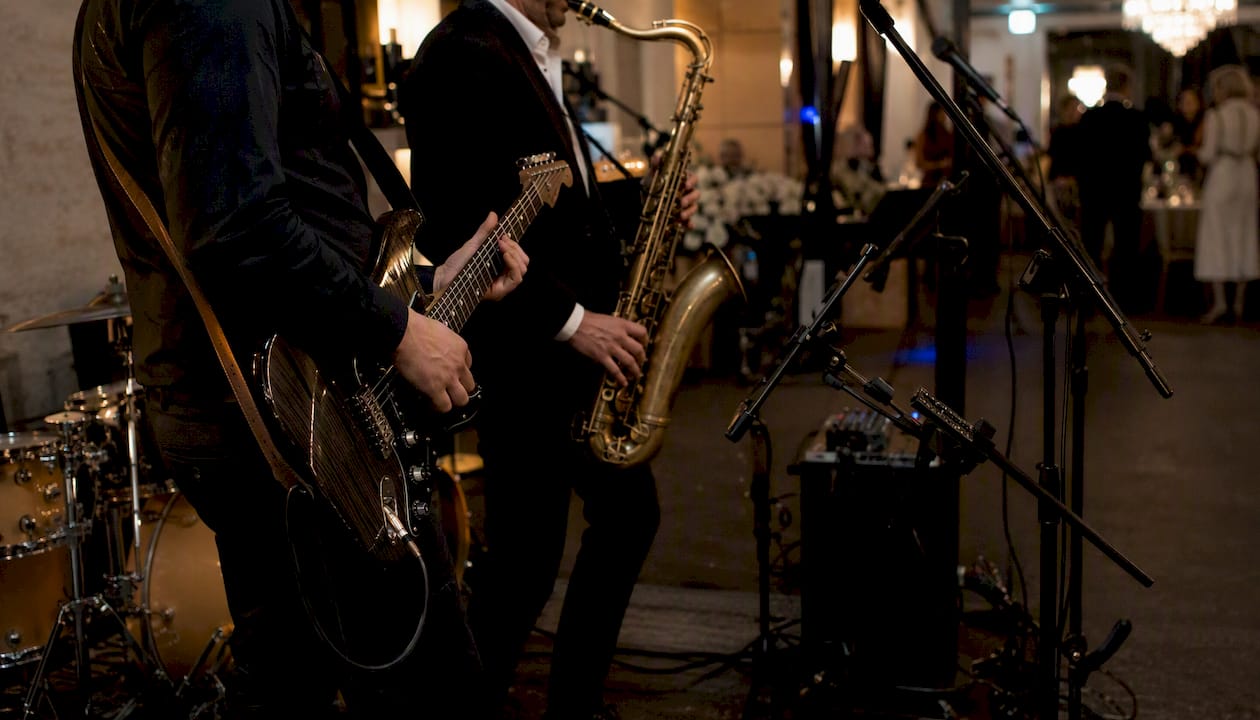
Transitions into the party matter just as much as the dance itself. A clear end cue and pre-agreed opening party song stop the dance floor sitting empty and awkward once the couple steps back. Brownsugarmusic coordinates this directly with DJs and MCs beforehand, so the handover from first dance into the reception’s first big song feels like one continuous moment rather than two separate events bolted together.
What do couples most often overlook when planning their first dance?
The most common mistake isn’t musical, it’s logistical. Couples pick a beautiful song, then leave the final arrangement details until the week of the wedding, when there’s no time left to fix a key that doesn’t suit the singer or a tempo that doesn’t match the steps they’ve been practising.
Second: almost nobody rehearses in their actual wedding outfit. A heavy dress or unfamiliar shoes changes how you move, and the first time most couples discover this is on the day itself, mid-dance, in front of everyone.
Third, and easy to forget entirely: agree exactly when guests are invited onto the floor, and who gives that signal. Without it, you get an awkward few seconds of guests glancing at each other, unsure whether it’s their moment yet.
A few practical habits fix most of this. Confirm PA and vocal levels during soundcheck, not by guessing. Check sightlines with your photographer so nobody’s shooting into a pillar. Agree the exact end cue with both the band and MC, in writing if you can, so there’s no confusion in the moment.
None of this should tip you into obsessing over a flawless routine. The first dance isn’t a performance for judges. It’s two minutes that belong to you, watched by people who love you, and a slightly wobbly turn or a missed lyric rarely registers with anyone but you. Plan the logistics tightly. Let the feeling stay loose.
Book a live R&B and soul band for your first dance
Brownsugarmusic gives you a done-for-you first-dance service rather than a DIY playlist and a set of hopeful instructions to a hired PA system. Every booking includes a bespoke arrangement built around your chosen song, a rehearsal or demo recording so you know exactly how it will sound before the wedding, day-of soundcheck to balance vocals and levels, and a rehearsed transition straight into your first party song.

The core lineup covers singer, keys and rhythm section, with horns available for couples who want a fuller sound for the segue into the reception. Because Brownsugarmusic has spent over 20 years building an R&B and soul repertoire across weddings, corporate events and its long-running Marble Bar residency, the band already knows how to adapt a wide range of songs into a tight, emotionally resonant 60 to 90 seconds without losing what made you choose the song in the first place.
If you’re ready to lock in a date, book an R&B band for your reception and start the conversation about your song, your timing, and your arrangement preferences.
Where to go for more song ideas and planning help
- Brides’ first-dance song round-up for a wide mix of classic and modern picks.
- The Knot’s guidance on classic first-dance songs for timing and duration advice.
- Bark’s list of 160 wedding first-dance songs for genre-spanning inspiration.
- Planning guidance for a live-band first dance covering version, tempo and lineup coordination.
- For a look at Brownsugarmusic’s own repertoire, see songs every wedding band plays, or enquire directly about booking for your date.
Frequently asked questions
Is a live band better than a DJ or recorded track for a first dance?
A live band brings adaptability, real-time tempo and key adjustments, and a stronger visual moment for photos, though a recorded track guarantees a note-perfect version with no rehearsal needed. For a first dance specifically, most couples prioritise the emotional presence a band offers.
How long should a first-dance song last with a live band?
Around 60 to 90 seconds, following The Knot’s guidance. Bands routinely edit a full track down to this length so the moment stays emotionally focused without dragging.
Can a band change the key or tempo of our chosen song?
Yes, and it’s worth requesting this at your first rehearsal rather than the week of the wedding. A comfortable key for the singer and a tempo matched to your steps both make a noticeable difference to how confident the performance feels.
What if we haven’t rehearsed and are worried about the live element?
Ask for a rehearsal or demo recording before the wedding so you can prepare at home, and confirm a soundcheck window on the day itself. A short, well-communicated arrangement matters more than lengthy rehearsal time.
How do we transition smoothly from the first dance into the party?
Agree an exact end cue with your band and MC, and settle on the first party song in advance. A clear handover plan stops the dance floor sitting empty once the couple steps back.
Sources
- Spotify Wrapped, Wedding Edition: These Were the Top 10 First Dance Songs of 2024, According to the Music Experts
- Classic first dance songs (The Knot)
- The 160 Best Wedding First Dance Songs