

When you hire a live R&B/soul band, the “band PA system” refers to the sound-reinforcement service the band brings to your event. That typically means front-of-house (FOH) speakers, a mixing console, microphones, DI boxes, and on-stage monitors. Most reputable bands travel with their own sound system and can cover crowds of roughly 200–300 people without additional hire. Brownsugarmusic operates as a self-contained act, meaning the band arrives with its own technical package. Three things to confirm immediately: whether the band is self-contained, who operates the FOH mix, and whether the venue requires a public liability insurance (PLI) certificate before load-in.
- Confirm self-contained status in writing before paying a deposit.
- Ask for the technical rider and PLI certificate upfront.
- Check whether the venue has noise restrictions or a sound curfew.
Key takeaways
A self-contained R&B/soul band brings its own PA, engineer, and backline — but confirming that in writing, securing PLI, and sharing a stage plot with the venue at least two weeks out removes the most common causes of day-of failure.
| Point | Details |
|---|---|
| Confirm self-contained status | Get it in the contract — backline plus full PA, lighting, and engineer included. |
| Secure PLI and licences | Request the certificate at least 14 days before the event, not on the day. |
| Plan for power correctly | A 6-piece band draws 30–50 amps; reserve dedicated circuits or a generator for larger rigs. |
| Share the stage plot early | Send the input list and stage plot to the venue AV team at least two weeks out. |
| Schedule soundcheck properly | Allow 45–60 minutes for a 4–6 piece band before guests arrive. |
Table of Contents
- What does a professional band’s PA system include?
- What stage space, power, and timing do you need to plan for?
- How much does a live R&B/soul band cost in the UK?
- What questions should you ask before you book?
- A copy-and-paste technical rider and input list template
- Red flags to watch for before you confirm a booking
- A one-page planning checklist for event organisers
- What bands want planners to know
- Sources
What does a professional band’s PA system include?
Never assume the venue has the equipment. Some bands provide a full PA and lighting rig; others expect the venue to supply it. A professional R&B/soul band typically brings:
- FOH speakers and a digital mixing console.
- Vocal microphones (commonly Shure SM58 or equivalent) and instrument microphones.
- DI boxes for bass guitar and keyboards.
- On-stage monitors or in-ear monitor systems.
- Core backline: drum kit (acoustic or electronic), amplifiers.
- Basic stage lighting in many cases.
What the band usually expects the venue to supply:
- Adequate power circuits with labelled breakers.
- Clear load-in access and nearby parking for a van or truck.
- A secure green room or break area.
- Permission to integrate with any house PA system, plus a named venue contact.
Pro Tip: Ask for the phrase “artist to be self-contained” in the contract. If it is there, confirm exactly what it covers — backline only, or backline plus full PA and lighting.
What stage space, power, and timing do you need to plan for?
A typical 4-piece band needs a moderate performance space sufficient for their setup and a named venue contact who understands live-music logistics. FOH speakers also need floor space or rigging points in front of the stage, so factor that into the room layout.
Power and timing action items for the venue:
- A standard 6-piece band with full PA typically draws a moderate amount of power; larger rigs with lighting or horns need dedicated circuits or a generator… Larger rigs with lighting or horns need dedicated circuits or a generator.
- Reserve at least two separate 13-amp or 16-amp circuits for audio and lighting independently.
- For marquees, confirm generator capacity before the band confirms the booking.
- Block soundcheck time in the venue schedule before guests arrive. See Brownsugarmusic’s band soundcheck guide for a step-by-step sequence.
- A DJ-to-band or band-to-DJ handover using a hot-swap system reduces dead air to under a minute.
How much does a live R&B/soul band cost in the UK?
Pricing for a live band in the UK varies by several factors. No single figure applies to every booking, but understanding the drivers helps planners budget accurately.
- Band size. A 3-piece costs less than a 6-piece with horns, partly because the larger act draws more power and requires more setup time, which can add technician costs.
- Performance length. A single 60-minute set differs from two 45-minute sets with a DJ fill between them.
- Day and season. Weekend and peak-season bookings (summer, December) carry a premium.
- Travel and accommodation. Bands travelling more than 60–90 miles typically add a travel fee; overnight stays add further cost.
- Technical package. A self-contained band that brings PA, lighting, and an engineer costs more upfront but removes the need to hire separate AV equipment. For venues without a house system, this is often the more cost-effective route overall.
- Extras. An MC service, DJ set after the band, or additional lighting all affect the final quote.
For events beyond 300 guests, a house PA or supplementary speaker hire may be needed regardless of what the band brings. That additional hire cost should sit in the venue’s budget, not the band’s fee.
What questions should you ask before you book?
Ask these before paying a deposit. They cover the points most likely to cause problems on the day.
Contractual and technical:
- Is the band fully self-contained (PA, lighting, engineer included)?
- Do you carry public liability insurance, and can you provide the certificate?
- Who operates the FOH mix — is a dedicated engineer included, or does a band member double up?
- Do you hold a public performance licence for cover material?
Logistics:
- What are the exact stage dimensions and power requirements?
- What is the load-in route, and how many parking spaces do you need?
- Are there sound-level or curfew restrictions the band has worked within before?
Extras:
- Can you provide an MC, DJ set, or lighting package?
- Will you supply a technical rider and stage plot before the deposit is paid?
Pro Tip: Request the technical rider and a sample stage plot as a condition of booking, not an afterthought. Experienced bands use DI setups, wireless mics, and hot-swap systems — a well-prepared rider reflects that level of professionalism.
A copy-and-paste technical rider and input list template
Use this template when briefing the venue or the band’s agent. Adapt channel numbers to match the actual act size.
Sample stage plot (4–6 piece R&B/soul band):
[STAGE — facing audience]

LEFT                    CENTRE                   RIGHT
FOH Speaker             Lead Vocal (mic stand)    FOH Speaker
                        Keys (DI L+R)
Guitar Amp              Drums (kit centre-rear)   Bass Amp (DI + cab)
BV Mic (L)                                        BV Mic (R)

[FOH MIX POSITION — rear of room or elevated platform]
Sample input list:
Venue checklist (send to the venue coordinator):
- Labelled power circuits with breaker locations confirmed.
- Nearest mains socket to stage identified and accessible.
- Load-in vehicle access confirmed (time window and route).
- Green room or holding area available from load-in time.
- Named day-of contact with a mobile number provided to the band.
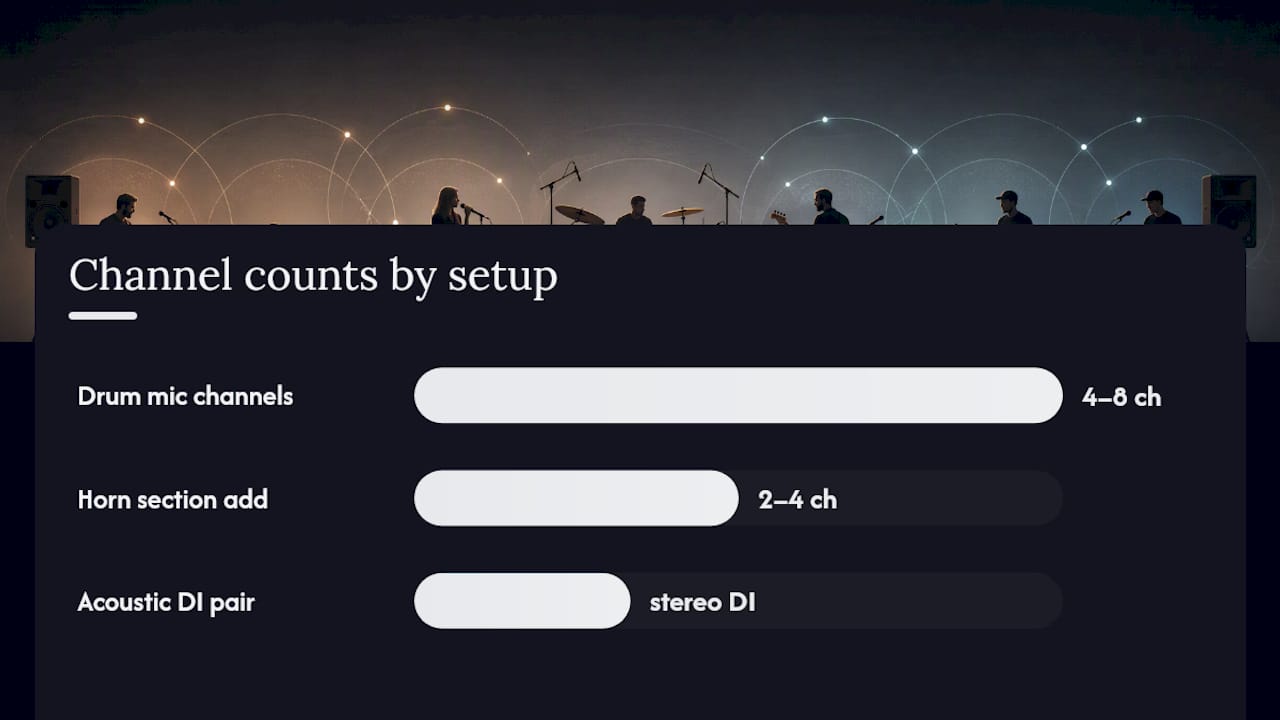
For a smaller acoustic set (2–3 piece), remove drum channels 4–8 and replace with a single stereo DI pair for a portable PA. For a larger act with a horn section, add two to four additional channels (tenor sax, alto sax, trumpet, trombone) and increase the amp draw estimate accordingly.
Red flags to watch for before you confirm a booking
Some issues are fixable; others are deal-breakers. Know the difference.
- No technical rider. A professional act always has one. A vague input list or verbal assurance is not a substitute.
- Band refuses to show PLI. No certificate means no cover if equipment damages the venue or injures a guest.
- Unclear FOH operation. If no one can confirm who runs the mix, sound quality on the night is unpredictable.
- Vague load-in times. A band that cannot confirm arrival and setup windows will disrupt catering, photography, and the venue schedule.
- No contingency plan. Ask what happens if a PA component fails or power drops. A professional band has a backup.
- Stage footprint too large for the room. If the band’s minimum stage size leaves no room for a dance floor, that is a structural problem, not a negotiation point.
- No live recordings or references. Demo tracks and references from comparable events are standard. Absence of both is a warning sign. Reviewing live performance videos before booking is a reliable way to assess real-world sound quality.
Include a clause in the contract requiring the band to supply a rider and PLI certificate at least 14 days before the event, with a remedy deadline.
A one-page planning checklist for event organisers
Share this with the venue coordinator and the band’s agent as soon as the booking is confirmed.
Before the event:
- Confirm self-contained status in the contract.
- Collect the technical rider and input list.
- Confirm PLI certificate and public performance licence.
- Reserve power circuits and confirm amp draw with the venue’s electrician.
- Block parking spaces for the band’s vehicle(s).
- Schedule soundcheck time before guest arrival.
- Confirm DJ handover plan (band to DJ or DJ to band).
- Share the stage plot and input list with the venue AV team.
On the day:
- Provide a single named contact with decision-making authority.
- Confirm green room access and hospitality (water, snacks).
- Walk the load-in route with the band’s crew on arrival.
- Confirm sound curfew time with the venue manager and relay it to the band.
Pro Tip: Add this checklist to the event run sheet and share it with the catering manager. Caterers and bands share the same service corridors — coordinating load-in avoids bottlenecks.
For corporate events, Brownsugarmusic’s staff party booking guide contains additional timeline templates suited to conference venues and hotel ballrooms.
What bands want planners to know
The details that matter most on the day are rarely the ones planners spend time on in advance.
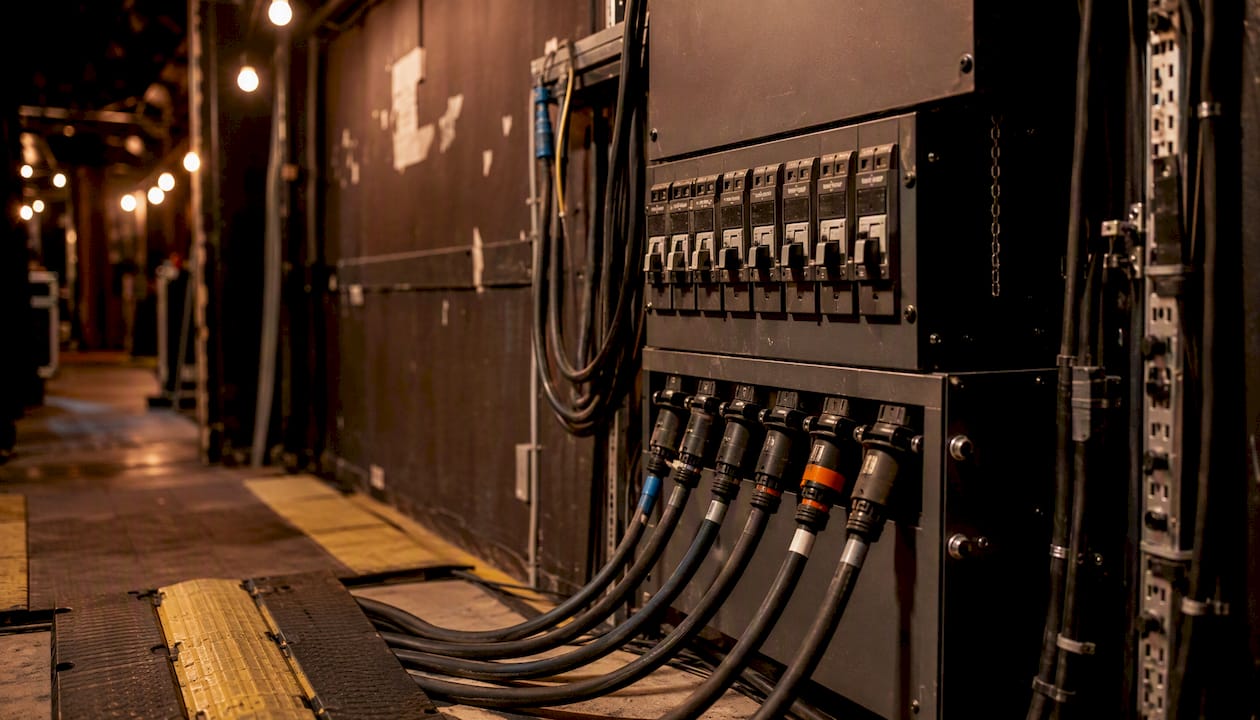
Consistent FOH sound depends on a stable mains supply. Voltage fluctuations from shared circuits cause audible drops and, in some cases, equipment shutdowns. A dedicated circuit is not a luxury request.
Clear stage space matters more than stage size. A band can adapt to a smaller footprint if the space is unobstructed. Chairs, cables, and décor items left on stage during soundcheck add time and create trip hazards.
A single day-of contact who can make decisions quickly is the most useful thing a planner can provide. Questions about curfew extensions, volume adjustments, or set-time changes need an answer in seconds, not minutes.
Hospitality is practical, not ceremonial. Water on stage and a quiet space to warm up before the set directly affect vocal performance. A band that arrives to a prepared green room performs better.
Sources
- Everything You Need to Ask a Wedding Band Before You Book: 2025-2026 Guide | OurVows Blog | OurVows
- Live Music & Your Venue: 13 Things You Need to Check | Function Central | Function Central
- Do Live Bands Bring Their Own Speakers?