

Your do-not-play list for your wedding should go to your DJ or band at least 30 days before the event. Copy the shortlist below, paste it into an email, and send it with your final music brief.
Hard ban shortlist — copy and send as-is:
- The Chicken Dance
- Macarena (Bayside Boys Mix)
- Single Ladies (Put a Ring on It) — Beyoncé
- Marry You — Bruno Mars
- A Thousand Years — Christina Perri
- Every Breath You Take — The Police
- Gangnam Style — PSY
- Who Let the Dogs Out — Baha Men
- Y.M.C.A. — Village People
- Uptown Funk — Mark Ronson ft. Bruno Mars
- Blurred Lines — Robin Thicke
These tracks are banned for different reasons: novelty and line-dance chaos, overplay to the point of parody, lyrics about stalking or infidelity, or explicit content that does not suit a mixed-age room. Most couples include a moderate number of songs on a final list.
Template line to paste into your vendor email:
Pro Tip: Send the list as a numbered document, not a paragraph in the body of an email. A numbered list is easier for a DJ or band to check against their set plan.
Key takeaways
A clear, tiered do-not-play list sent to your vendor at least 30 days before the wedding is the single most effective step couples can take to protect the atmosphere of their reception.
| Point | Details |
|---|---|
| Send the list 30 days out | Finalise and deliver your do-not-play list to your DJ or band at least 30 days before the wedding. |
| Use hard and soft bans | Hard bans are absolute; soft bans give your vendor room to read the crowd. |
| Cap the list at 10–30 songs | Most couples include a moderate number of songs on a final list; longer lists restrict vendors too heavily. |
| Screen lyrics, not just titles | Check for stalking, infidelity, death, and explicit themes — not just overplay. |
| Pair bans with must-plays | Send a must-play shortlist of 10–15 songs alongside the bans to give vendors a positive target. |
Table of Contents
- Your full do-not-play list, sorted by category
- How to build and deliver your list to a DJ or band
- What your DJ or band will and won’t do with the list
- Lyric themes that commonly spoil a wedding
- Replacement songs worth asking for instead
- Why the do-not-play list matters more than couples expect
- Sources
Your full do-not-play list, sorted by category
A short shortlist covers the obvious offenders. A categorised list covers everything else. Brides identifies 32 songs couples commonly avoid, and WeddingWire’s do-not-play guide stresses that many popular hits are inappropriate not because they are cheesy but because their lyrics deal with death, cheating, or desperation.
Novelty and line-dance tracks
These songs trigger choreographed group dances or comedy routines. Once started, they are hard to stop.
| Song | Reason to ban |
|---|---|
| The Chicken Dance | Novelty; clears the floor for non-participants |
| Macarena | Line dance; dated and divisive |
| Gangnam Style | Novelty; comedy effect wears off in seconds |
| Y.M.C.A. | Line dance; overplayed at many events |
| Who Let the Dogs Out | Novelty; no musical value at a reception |
| The Cha Cha Slide | Instructional; kills spontaneous dancing |
| Cotton Eye Joe | Line dance; genre mismatch for most receptions |
| YMCA (any remix) | Same issue as the original |
Overplayed pop and chart hits
These tracks have been played at so many weddings that guests groan before the chorus arrives. The Knot lists 26 songs couples commonly skip for exactly this reason.
| Song | Reason to ban |
|---|---|
| Marry You — Bruno Mars | Overplayed at UK weddings; now a cliché |
| A Thousand Years — Christina Perri | Overplayed ceremony track; loses impact |
| Uptown Funk — Mark Ronson ft. Bruno Mars | Overplayed; every DJ plays it by default |
| Can’t Stop the Feeling — Justin Timberlake | Overplayed; children’s film association |
| Happy — Pharrell Williams | Overplayed; feels like a corporate event |
| Shake It Off — Taylor Swift | Overplayed; divides older guests |
| Shape of You — Ed Sheeran | Overplayed; lyrics about a casual encounter |
| Perfect — Ed Sheeran | Overplayed first-dance track |
| Thinking Out Loud — Ed Sheeran | Overplayed; now associated with legal disputes |
| All of Me — John Legend | Overplayed first-dance track |
Songs with negative or inappropriate lyrics
The tune sounds fine. The words do not. Screening lyrics is the step most couples skip, and it is the one that causes the most awkward moments.
| Song | Reason to ban |
|---|---|
| Every Breath You Take — The Police | Lyrics describe stalking, not romance |
| Blurred Lines — Robin Thicke | Explicit sexual content; widely criticised |
| Single Ladies — Beyoncé | Lyrics about being unmarried; odd at a wedding |
| You Oughta Know — Alanis Morissette | Breakup rage; explicit content |
| Before He Cheats — Carrie Underwood | Infidelity and revenge theme |
| Gold Digger — Kanye West | Explicit; anti-relationship messaging |
| Love the Way You Lie — Eminem ft. Rihanna | Domestic conflict theme |
| Irreplaceable — Beyoncé | Breakup anthem |
| Since U Been Gone — Kelly Clarkson | Breakup anthem |
| Somebody That I Used to Know — Gotye | Post-breakup bitterness |
Depressing or ceremony-inappropriate tracks
These songs are musically strong but carry themes of loss, death, or endings that clash with a wedding atmosphere.
| Song | Reason to ban |
|---|---|
| My Heart Will Go On — Celine Dion | Associated with the Titanic; death and loss |
| Angels — Robbie Williams | Funeral association in the UK |
| Tears in Heaven — Eric Clapton | Written about the death of a child |
| The Sound of Silence — Simon & Garfunkel | Isolation and despair theme |
| Hurt — Johnny Cash | Death and regret |
| Mad World — Gary Jules | Nihilistic; funeral playlist staple |
| Fix You — Coldplay | Grief and failure theme |
| Chasing Cars — Snow Patrol | Passive resignation; often played at funerals |
How to build and deliver your list to a DJ or band
A clear, well-structured list saves time and prevents awkward conversations on the day. Denver DJ Service recommends tiering bans into hard and soft, keeping the list to 10–15 specific songs plus two or three genre notes, and finalising it at least 30 days before the wedding.
Step-by-step checklist
- Decide hard bans. Songs that must not play under any circumstances, including guest requests.
- Decide soft bans. Songs you would prefer to avoid but leave to the DJ’s judgement if the room demands it.
- Add genre notes. Two or three lines: “No country,” “No heavy metal,” “No explicit rap.”
- Add phase restrictions. Note which rules apply to cocktail hour, dinner, and dancing separately.
- Cap the list. Aim for 10–30 songs total. A list of 60 songs restricts the DJ too heavily.
- Send it 30 days out. Follow up one week before to confirm receipt.
- Set a last-requests window. Tell the DJ that no new bans will be added after 48 hours before the event.
Pro Tip: Ask your DJ or band to confirm in writing that they have received and reviewed the list. A brief reply email (“Confirmed, all noted”) is enough.
Sample vendor email
Handling family and guest requests
Guests will make requests. Some will conflict with your list. The cleanest approach: tell your DJ or band in advance that all requests go through them, not through you on the night. They can decline politely without involving you. If a family member is persistent, a brief, direct message before the wedding works well: “We’ve given the band a specific brief — please send any requests to them directly and they’ll do their best.”
For a full timeline of when to send music briefs and confirm details, the wedding entertainment timeline guide covers each checkpoint from booking to the day itself.
What your DJ or band will and won’t do with the list
The New York Times reports that handing DJs a do-not-play list is now a normal part of wedding planning, used to shape the vibe and avoid politically sensitive or personally awkward songs. Most professional vendors welcome a clear list. What they do with it depends on their setup.
What DJs typically do:
- Honour all hard bans without question.
- Flag soft bans and use judgement based on the room.
- Decline guest requests that conflict with the list.
- Confirm receipt and note any tracks they cannot source.
What live bands typically do:
- Honour hard bans for songs in their repertoire.
- Note that they cannot play songs outside their arranged set list.
- Offer alternative arrangements of similar tracks where possible.
- Decline to learn new songs after a set rehearsal deadline.
What neither will typically do:
- Guarantee they can source every obscure track a guest requests.
- Override a hard ban because a guest is persistent.
- Accept new bans added on the day of the event.
Questions to ask before you hire:
- How do you handle guest requests that conflict with our list?
- What is your deadline for receiving the final do-not-play list?
- Will you confirm receipt of the list in writing?
- Can you play songs outside your standard library if we request them in advance?
Pro Tip: A live band’s constraints differ from a DJ’s. A band can only play songs they have rehearsed. Send your list early enough that they can confirm which hard bans are already outside their repertoire — saving you both time.
For practical guidance on balancing guest engagement with a tight music brief, that page covers read-the-room strategies from a live-band perspective.
Lyric themes that commonly spoil a wedding
Most couples focus on song titles. The smarter screen is the lyric theme. Brides recommends looking beyond obvious cheese and checking for negative messages, including stalking, infidelity, and desperation.
Themes to screen for:
- Stalking or possession. “Every Breath You Take” is the most cited example. The lyrics describe surveillance, not devotion.
- Breakup or infidelity. Songs written from the perspective of a scorned or cheating partner. Common in country and pop.
- Death or grief. Tracks written as tributes or elegies. “Angels” and “Tears in Heaven” both fall here.
- Revenge. Songs where the narrator destroys property, threatens an ex, or celebrates a breakup.
- Overtly sexual content. Explicit lyrics that do not suit a mixed-age room with children and grandparents present.
- Anti-love or nihilistic messaging. Songs that frame commitment as a trap or relationships as doomed.
Quick lyric-screening checklist:
- Read the full lyrics, not just the chorus.
- Check the song’s original context (was it written for a film, a breakup, a tribute?).
- Play it to someone outside your relationship and ask for their honest reaction.
- Search “[song title] + wedding” — if the top results are “why to avoid,” trust them.
For a broader guide to wedding music curation, that page covers how to build a full playlist from ceremony to last dance.
Replacement songs worth asking for instead
A do-not-play list works best when it comes with a must-play list. Give your vendor both. These replacements cover the same moods as the banned tracks without the baggage.
Upbeat dance floor (replacing Uptown Funk, Y.M.C.A., Gangnam Style):
- September — Earth, Wind & Fire
- Get Lucky — Daft Punk ft. Pharrell Williams
- Superstition — Stevie Wonder
- Signed, Sealed, Delivered — Stevie Wonder
- Don’t Stop Me Now — Queen
Singalong crowd-pleasers (replacing Macarena, Chicken Dance):
- Mr Brightside — The Killers
- Livin’ on a Prayer — Bon Jovi
- Sweet Caroline — Neil Diamond
- Valerie — Amy Winehouse
- Twist and Shout — The Beatles
Romantic slow songs (replacing A Thousand Years, All of Me):
- At Last — Etta James
- Make You Feel My Love — Adele
- La Vie en Rose — Édith Piaf
- Unchained Melody — The Righteous Brothers
- Crazy in Love — Beyoncé (slower version)
Cocktail hour and dinner background (replacing overplayed pop):
- Isn’t She Lovely — Stevie Wonder
- The Way You Look Tonight — Frank Sinatra
- Put Your Records On — Corinne Bailey Rae
- Feeling Good — Nina Simone
- Higher Ground — Stevie Wonder
Pro Tip: Give your vendor a must-play shortlist of 10–15 songs alongside the do-not-play list. It gives them a clear target rather than a blank canvas, and it means the floor stays full without you having to intervene.
For timing guidance on which tracks suit cocktail hour versus late-night dancing, the wedding song shortlist guide maps replacements to each phase of the reception.
Why the do-not-play list matters more than couples expect
The do-not-play list is not a control mechanism. It is a communication tool. After years of performing at weddings and corporate events, the pattern is consistent: couples who send a clear, tiered list before the event spend the night dancing. Couples who skip it spend the night managing requests.
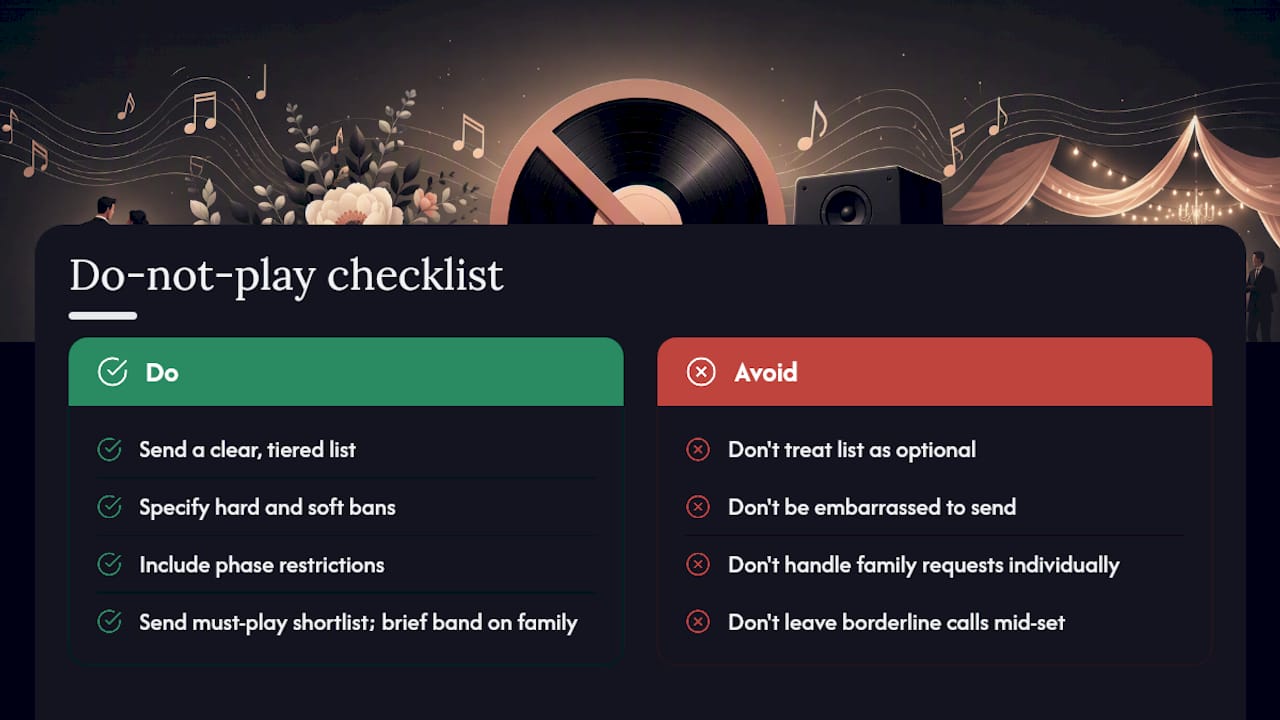
The most common mistake is treating the list as optional or embarrassing to send. Professional DJs and bands expect it. They prefer it. A specific list of hard bans and soft bans gives a live band the freedom to read the room within boundaries the couple have already approved. Without it, every borderline track becomes a judgement call made under pressure, mid-set.
Two lessons from live-band experience stand out. First, the couples who include phase restrictions — “nothing slow during cocktail hour,” “no novelty tracks before 9 PM” — get a noticeably more consistent atmosphere across the whole evening. Second, the couples who also send a must-play shortlist alongside the bans give the band a positive target, not just a list of things to avoid. The result is a set that feels curated rather than cautious.
One practical note on family requests: the most effective approach is to brief the band directly, not to manage family members individually. A band that knows the couple’s brief can decline a request graciously without creating a scene. That is a conversation worth having before the day, not during it.
Sources
- 32 Songs to Avoid Playing at Your Wedding
- The Ultimate Wedding Do-Not-Play List
- 26 Do Not Play Wedding Songs That Are a Hard Pass
- How to Create a “Do Not Play” List for Your Wedding
- For Perfect Wedding Day Music, Couples Give D.J.s ‘Do Not Play’ Lists – The New York Times
- Most Common Songs On a Wedding Do Not Play List | CC King Entertainment