

Map every moment first, then choose songs to fit each one. That single principle separates couples who hand their DJ a coherent brief from those who arrive with a random playlist and hope for the best. Wedding music curation starts with structure, not song titles.
Start here:
- List every musical moment from prelude to last song (use the timeline in the next section)
- Decide your must-play and do-not-play tracks before you book anyone
- Book your ceremony musician at least 6–8 months out; your DJ or band at 4–6 months
- Download or copy the music brief template in Section 7 and share it with every vendor
- Confirm your venue holds a PRS for Music licence and a PPL licence before signing the contract
Key takeaways
A full-day wedding music programme requires roughly 150–200 songs mapped to specific moments, a complete music brief delivered to your entertainer at least four weeks before the day, and a single shared timeline that every vendor works from.
| Point | Details |
|---|---|
| Map moments before songs | Assign a musical job to each moment first; song choices follow from that structure. |
| Book early, brief in writing | Ceremony musicians at 6–8 months out; finalise and deliver the music brief 4–6 weeks before. |
| Must-play and do-not-play lists | The do-not-play list is as important as the must-play list; be specific with song titles, not genres. |
| Check PRS and PPL licences | Confirm your venue holds both licences and that its premises licence covers live amplified music to your curfew time. |
| Brownsugarmusic for live R&B/soul | Brownsugarmusic brings live band flexibility, real-time room-reading and a structured briefing process to wedding receptions. |
Table of Contents
- How to plan your wedding music programme: the full timeline
- What music goes where in the ceremony?
- How to programme your reception music from cocktails to last song
- DJ, live band, soloist or hybrid: which suits your wedding?
- UK venue rules, PRS, PPL and sound logistics
- How to brief your DJ or band: template and checklist
- How to write your ceremony programme
- Sample song suggestions for every moment
- Final checks, rehearsal and day-of coordination
- How to include personal and cultural song choices
- How to synchronise music cues with your officiant and other vendors
- What to do when the music programme changes on the day
- What working performers know that most planning guides miss
- Live R&B and soul wedding music from Brownsugarmusic
- Sources
How to plan your wedding music programme: the full timeline
The most common mistake couples make is booking entertainment before mapping moments. Start with the moments-first framework: identify every musical slot in the day, assign a job to each one, then choose songs. That order matters.
Booking windows
- 9–12 months out: Research ceremony musicians, live bands and DJs. Attend showcases or watch live videos. Book your first-choice act as soon as you decide.
- 6–8 months out: Confirm ceremony musician. WeddingWire advises starting the search 8 months out because the best players fill their diaries early.
- 4–6 months out: Book DJ or reception band. Begin building must-play and do-not-play lists.
- 4–6 weeks out: Finalise all playlists. Send the completed music brief to your DJ or band. Confirm technical requirements with the venue.
- 1–2 weeks out: Final meeting with your entertainment provider. Walk through the timeline cue by cue. Collect signed contracts if not already done.
- 48–72 hours out: Confirm arrival times, load-in access and any last-minute changes.
How many songs do you actually need?
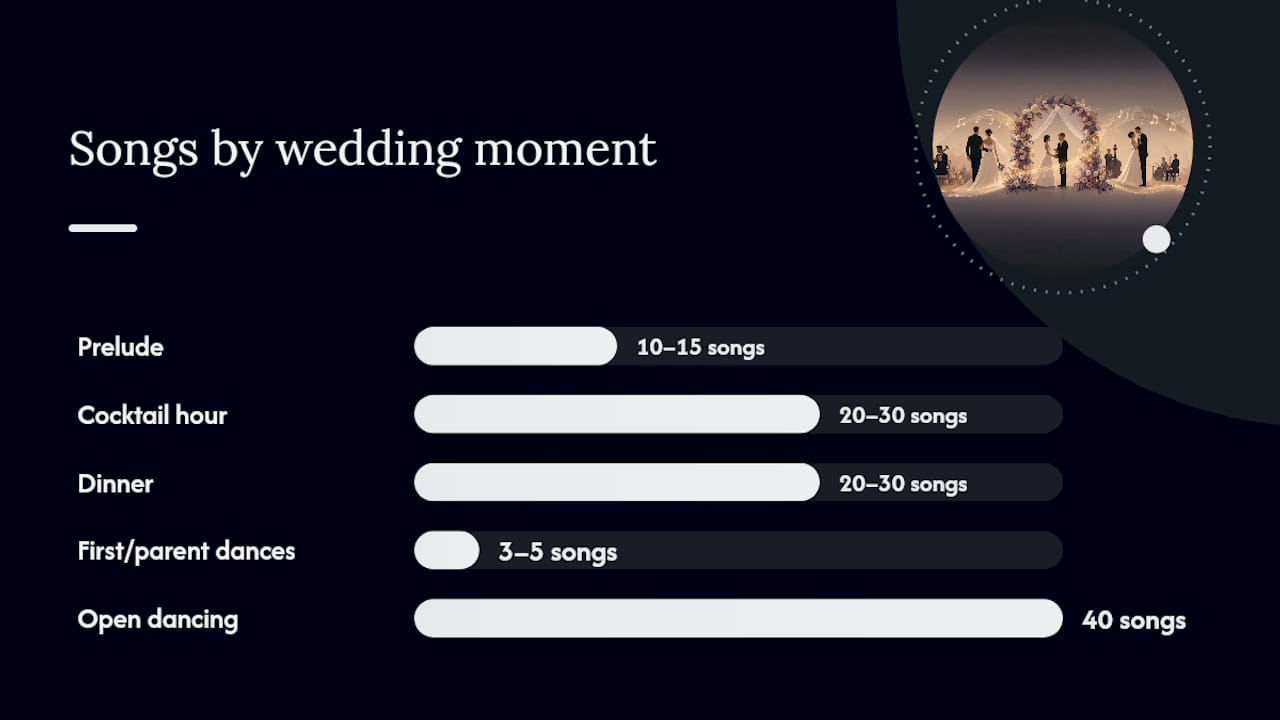
A full-day wedding typically needs roughly 150–200 songs to cover every moment from prelude to last dance. The table below breaks that down by moment.
| Moment | Typical duration | Suggested song count |
|---|---|---|
| Prelude | 20–30 min | 10–15 songs |
| Processional(s) | 3–10 min | 1–3 songs |
| Ceremony interludes / signing | 5–10 min | 1–2 songs |
| Recessional | 2–4 min | 1 song |
| Postlude | 10–15 min | 4–6 songs |
| Cocktail hour | 60–90 min | 20–30 songs |
| Dinner | 60–90 min | 20–30 songs |
| First dance / parent dances | 10–15 min | 3–5 songs |
| Open dancing | 90 min | 40 songs |
| Last song | 3–5 min | 1 song |
Pro Tip: Build each list with a few extra songs as cover. Moments run long, guests linger, and a DJ who runs out of dinner music is a problem you can avoid with five spare tracks.
What music goes where in the ceremony?
The ceremony has five distinct musical moments. Each one has a specific job, and choosing the wrong track for the wrong moment is one of the most common planning errors.
Prelude
Guests arrive 15–30 minutes before the ceremony starts. The prelude plays throughout. Its job is to set atmosphere and signal that something significant is about to happen. Choose tracks that are calm, warm and slightly below conversational volume so guests can still greet each other. Instrumental arrangements work well here.
Processional(s)
There are usually two: one for the wedding party and one for the couple’s entrance. The Knot notes that processional timing depends on the number of people walking and aisle length, typically lasting 3–10 minutes. Choose a tempo that matches a natural walking pace, roughly 60–80 beats per minute. Avoid tracks with sudden tempo changes.
Interludes and signing
If there are readings, a unity ceremony or a ring warming, music can play quietly underneath or pause entirely. The signing of the register is a natural moment for a single song, usually 3–4 minutes. Choose something meaningful but not so lyrically dense that it competes with the moment.
Recessional
One song. High energy. This is the moment the couple walks back up the aisle as married partners. It should feel celebratory and immediate. Guests often clap along, so a strong, recognisable beat helps.
Postlude
Plays while guests file out and move to the drinks reception. Four to six tracks at a slightly higher energy than the prelude. Instrumental or lightly vocal works well.
Live vs recorded for the ceremony. A live musician can adapt to walking pace in real time. A pre-set track cannot. If your processional involves multiple people walking at different speeds, or if timing is likely to shift, a live player gives you flexibility a playlist never can. For unamplified settings, prioritise instruments that carry acoustically: classical guitar, strings, or a solo vocalist with natural projection. Larger venues or outdoor ceremonies almost always need amplification.
Coordinating cues. Agree a clear signal with your officiant and musician before the day. A nod, a hand gesture, or a specific phrase from the officiant works. Rehearse it. If the processional runs long because someone walks slowly, the musician needs to know whether to loop, extend or hold.
Pro Tip: Ask your musician to prepare an instrumental arrangement of your chosen processional track rather than the original recording. Lyrics can pull guests’ attention away from the moment itself, and an arrangement gives the musician room to stretch or compress the timing naturally.
How to programme your reception music from cocktails to last song
The reception is not one continuous playlist. It is a sequence of distinct phases, each with a different musical job.
Cocktail hour
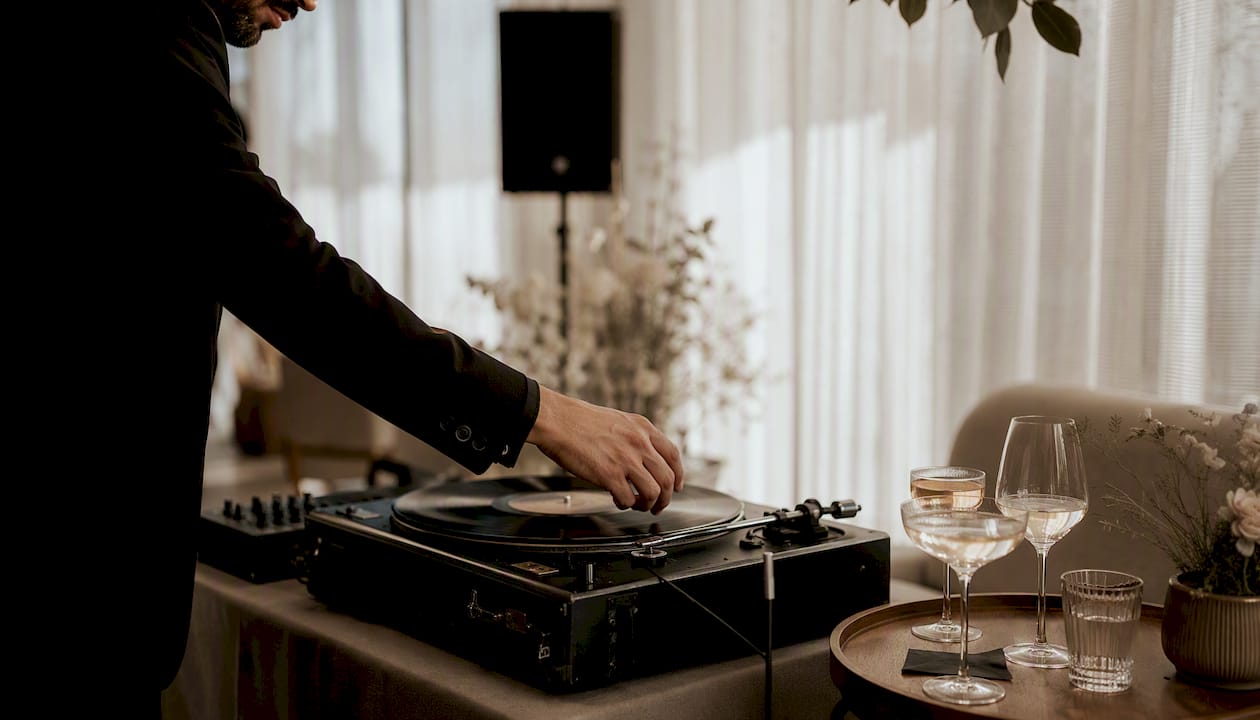
Background music. Guests are moving, talking and drinking. The music should be present but not dominant. Think warm, mid-tempo tracks: soul, jazz, acoustic pop, or light funk. Aim for 20–30 songs and avoid anything with a heavy drop or aggressive energy.
Entrance and first moments
When the couple enters the reception room, the energy shifts. One high-energy track, chosen by the couple, signals the transition from ceremony to party. It should be immediately recognisable and feel personal.
Dinner
Ambient but engaging. Building three separate playlists for cocktail, dinner and dancing is standard practice among professional entertainers, and bringing a pre-built dinner playlist to your vendor meeting communicates your vibe far more clearly than genre labels. Dinner music sits at a lower volume than dancing music. Avoid anything with a heavy bass line that competes with conversation.
First dance and parent dances
Spotlight moments. Each one is a single song, chosen specifically. The first dance is typically 3–4 minutes. If the full track is longer, ask your DJ or band to fade at the 3-minute mark. Parent dances follow the same logic. Confirm the exact edit or arrangement with your entertainer in advance.
Open dancing and the energy arc
This is where the evening either lifts or stalls. The dance floor energy curve should build gradually, peak roughly 60–90 minutes after dancing opens, and include mixed eras to keep different generations engaged. A practical structure:
- Opening 20 minutes: Familiar, mid-energy tracks to get people up. Avoid obscure choices here.
- Peak window (60–90 min in): Highest-energy anthems. This is when the floor should be full.
- Wind-down: Slow the tempo gradually. One or two slower tracks before the last song.
For multi-genre or cross-generational crowds, ask your DJ or band to sequence by era in short blocks rather than jumping randomly between decades. Three Motown tracks, then three current R&B tracks, then three 90s pop tracks holds the floor better than a random shuffle.
Must-play, play-if-possible and do-not-play lists
Organise your song requests into three tiers. The must-play list is the spine of the evening. The play-if-possible list gives your entertainer flexibility. The do-not-play list is the most important single deliverable you hand over: it defines what your event is not. Be specific on do-not-play. List song titles, not just genres. A vague “no cheesy songs” instruction is useless to a DJ at 10pm.
Pro Tip: Build a sample set of 6–8 songs you love and bring it to your band or DJ meeting. It communicates vibe and pacing far better than any genre label.
DJ, live band, soloist or hybrid: which suits your wedding?
The right choice depends on budget, venue size, vibe and how much variety you want. Each option has clear strengths and real limitations.
DJ
Wide song variety, lower cost, compact setup. A good DJ reads the room and transitions between tracks without gaps. The limitation is that there is no live performance energy: no visual spectacle, no spontaneous arrangement, no crowd interaction beyond the mic. Typical UK DJ fees for weddings range from around £500 for newer acts to £1,500 or more for experienced professionals with full PA rigs.
Live band
Visual impact, live energy and a sound that fills a room differently from a PA system. Bands typically cost more: a four-piece function band in the UK commonly ranges from £1,500 to £3,500 depending on experience and location; larger ensembles or specialist acts sit higher. The trade-off is a more limited song list compared to a DJ’s full digital library. A good band, however, brings something a playlist cannot: the ability to read the room, extend a groove when the floor is full, and shift energy in real time.
Soloist
Suited to ceremonies and intimate receptions. A solo guitarist, pianist or vocalist creates atmosphere without the volume or setup demands of a full band. Cost is lower, typically £300–£800 for a ceremony set. The limitation is range: a soloist cannot sustain a full evening of dancing.
Hybrid setups
A soloist or string duo for the ceremony, a DJ for the reception, or a live band for the peak dancing window with a DJ continuing into the late night. Hybrid approaches give couples the best of both formats. They also require more coordination: two separate contracts, two sets of technical requirements and two briefing conversations.
For a detailed comparison of live band and DJ options, the live band vs DJ guide covers the decision in full.
Technical checklist to confirm with every vendor:
- Stage or performance area dimensions (minimum floor space required)
- Power access: number of sockets, distance from performance area
- Load-in and load-out time windows
- PA system: provided by the vendor or the venue?
- Microphone requirements for speeches and announcements
- Noise curfew time and decibel limit (if applicable)
UK venue rules, PRS, PPL and sound logistics
UK venues that play recorded music in public need two separate licences. PRS for Music covers songwriters and composers; PPL covers the recording artists and record labels. Most established wedding venues hold both. Confirm this before signing your venue contract. If a venue does not hold the relevant licences, it is the venue’s legal responsibility to obtain them, not yours, but knowing the situation in advance avoids surprises.
Live music is covered differently. A venue hosting live performances needs a premises licence that includes live music under the Licensing Act 2003. Again, this is the venue’s responsibility, but couples should ask the question directly: “Does your premises licence cover live amplified music until [your curfew time]?”
Common venue restrictions to check
- Noise curfew: Most UK venues have a hard curfew, commonly 11pm or midnight. Confirm the exact time and whether it applies to amplified music only or all sound.
- Decibel limits: Some venues, particularly those near residential areas or with noise-sensitive neighbours, impose a decibel cap. Ask whether the venue has been tested and what the limit is.
- Stage dimensions: Confirm the exact floor area available for the band, including access for equipment load-in.
- Outdoor contingencies: If any part of the day is outdoors, confirm the weather contingency plan, where equipment moves to and whether power access changes.
- Load-in windows: Bands and DJs need time to set up and sound-check. A typical four-piece band needs 60–90 minutes. Confirm the venue allows this before guests arrive.
A site visit or AV walkthrough with your musician and venue coordinator, ideally 4–6 weeks before the wedding, resolves most technical issues before they become day-of problems.
Statistic note: A full-day wedding typically requires 150–200 songs across all moments. Planning to that scale, rather than building a single playlist, is what gives couples and their entertainers enough material to handle overruns, extended sets and last-minute requests without running dry.
How to brief your DJ or band: template and checklist
A music brief is the single document that tells your entertainer everything they need to deliver the day you have planned. A complete brief covers: must-play list, do-not-play list, crowd description, timeline with exact cue times, announcement wording, special requests and song dedications.
The wedding music brief guide from Brownsugarmusic covers what to include and why each element matters. For a step-by-step walkthrough of preparing the brief itself, the how to brief a wedding band guide is the practical companion.
Music brief template
Copy this template and fill in each section before your final vendor meeting.
| Brief section | What to include | When to provide |
|---|---|---|
| Must-play list | Song title, artist, moment (e.g. “first dance: Al Green, Let’s Stay Together”) | 4–6 weeks before |
| Do-not-play list | Specific song titles and artists, not just genres | 4–6 weeks before |
| Crowd description | Age range, musical tastes, energy level expected | At booking |
| Day timeline | Exact cue times: doors open, first dance, speeches, last song | 2 weeks before |
| Announcement script | Exact wording for each announcement (couple’s entrance, first dance, cake cut) | 2 weeks before |
| Song dedications | Song title, artist, who it is for and when to play it | 2 weeks before |
| Vibe words | Three to five words describing the feeling you want (e.g. “warm, soulful, celebratory”) | At booking |
Note for editorial: place the downloadable brief template file in the CMS and link it from this section.
Numbered checklist: sending and confirming the brief
- Complete all sections of the brief template above.
- Send the completed brief to your DJ or band at least 4 weeks before the wedding.
- Request written confirmation that they have received and reviewed it.
- Schedule a final meeting 1–2 weeks before the wedding to walk through the timeline.
- At the final meeting: confirm cue signals, announcement wording and any last-minute changes.
- Ask the band or DJ to play back the first dance track or processional so you can confirm the edit or arrangement.
- Confirm the emergency contact number for the day itself.
Collecting song requests ahead of time and using a structured must-play/do-not-play format keeps the evening coherent and prevents tracks being played that are personally painful or simply wrong for the moment.
How to write your ceremony programme
A printed ceremony programme helps guests follow the order of service, understand any rituals they may not be familiar with, and feel included. Ceremony programmes typically include the order of service, names of the wedding party, readings, brief ritual explanations and musician credits.
What to include
- Names of the couple, officiant, wedding party and readers
- Order of service with each element listed in sequence
- Titles of music pieces and the name of the musician or ensemble
- Brief explanations of any cultural or religious rituals
- Words to any hymns or songs guests are invited to join
Format options
Flat card: Simple, low cost, easy to print at home. Works for short ceremonies. Limited space.
Booklet (folded A5): Most common format. Enough space for full order of service, readings and music credits. Easy to hold during the ceremony.
Paddle fan: Popular for outdoor summer weddings. Practical as well as decorative. Higher cost per unit.
Tri-fold: More space than a flat card, less bulk than a booklet. Good for ceremonies with multiple elements.
Large signage: A single printed board or easel display instead of individual programmes. Lower print cost, no distribution needed. Works well for intimate ceremonies or couples who want to reduce paper waste.
Printing tips
Use a paper weight of at least 250gsm for a quality feel. Order at least 3 weeks before the wedding to allow for proofing and reprints. If pairing programmes with favours, confirm the assembly timeline with your stationer.
Wording templates
Traditional:
The Marriage of [Name] and [Name] / [Date] / [Venue] / Order of Service
Non-traditional:
[Name] & [Name] / [Date] / Welcome. We’re glad you’re here. / Here’s what’s happening.
Musician credits line: Music performed by [Name / Ensemble name] / [Instrument(s)]
For further wording examples and format guidance, the ceremony music types guide covers how to describe each musical moment for guests.
Sample song suggestions for every moment
These lists are starting points. Swap in tracks that mean something to you. The goal is a coherent arc, not a specific set of songs.
Prelude (calm, warm, instrumental)
- Norah Jones, Come Away With Me
- Ludovico Einaudi, Una Mattina
- Jack Johnson, Better Together (acoustic)
- Etta James, At Last (instrumental arrangement)
- Coldplay, The Scientist (piano version)
Processional: wedding party
- Canon in D (Pachelbel) — string quartet or solo piano
- Stevie Wonder, Isn’t She Lovely (instrumental)
- Ed Sheeran, Thinking Out Loud (acoustic)
Processional: couple’s entrance
- John Legend, All of Me
- Beyoncé, Halo
- Ben E. King, Stand By Me
- Fleetwood Mac, The Chain (for a more dramatic entrance)
Recessional
- Stevie Wonder, Signed, Sealed, Delivered
- Pharrell Williams, Happy
- The Beatles, Here Comes the Sun
- Earth, Wind & Fire, September
Cocktail hour (background soul and jazz)
- Amy Winehouse, Valerie
- Marvin Gaye, Let’s Get It On
- Bill Withers, Lovely Day
- Nina Simone, Feeling Good
- Al Green, Let’s Stay Together
Dinner (ambient, mid-tempo)
- Sam Cooke, Wonderful World
- Van Morrison, Brown Eyed Girl
- Alicia Keys, If I Ain’t Got You
- John Mayer, Gravity
- Sade, By Your Side
For a fuller list of songs suited to each reception moment, the songs every wedding band plays guide is a practical reference.
First dance picks
- Al Green, Let’s Stay Together
- Etta James, At Last
- John Legend, All of Me
- Bruno Mars, Marry You
- Whitney Houston, I Will Always Love You
Open dancing: floor-fillers and anthems
Opening (familiar, mid-energy):
- Justin Timberlake, Can’t Stop the Feeling
- Mark Ronson ft. Bruno Mars, Uptown Funk
- Pharrell Williams, Happy
Peak window:
- Earth, Wind & Fire, September
- Beyoncé, Crazy in Love
- Michael Jackson, Don’t Stop ‘Til You Get Enough
- Daft Punk, Get Lucky
Wind-down:
- Whitney Houston, I Wanna Dance with Somebody
- Lionel Richie, All Night Long
Last song
- The Beatles, Hey Jude (crowd singalong)
- Journey, Don’t Stop Believin’
- Bon Jovi, Livin’ on a Prayer
On instrumental arrangements: For ceremony use, ask your musician to prepare an instrumental cover rather than playing the original recording. This removes lyrics that might distract during a reading or vow exchange, and gives the musician control over timing. Most experienced players can extend or compress an arrangement by 30–60 seconds without it sounding forced.
On covers and remixes: Radio edits are typically 3–4 minutes and work well for most moments. For the first dance, if the original track runs over 4 minutes, ask your DJ or band to prepare a clean fade at the 3-minute mark. Bespoke arrangements for ceremony processionals are worth requesting in writing so both parties agree on the version being performed.
Final checks, rehearsal and day-of coordination
The week before the wedding is not the time to make new decisions. It is the time to confirm every decision already made.
Final-week checklist
- 4–6 weeks out: Deliver the completed music brief. Confirm technical requirements with the venue. Check PRS and PPL licence status.
- 1–2 weeks out: Final meeting with DJ or band. Walk through the timeline. Confirm announcement wording. Sign off on all edits and arrangements.
- 48–72 hours out: Confirm arrival and load-in times. Share the day-of contact number for the band or DJ with your planner or coordinator.
Rehearsal run-through
- Walk the processional at actual pace with the musician present if possible.
- Confirm the cue signal between officiant and musician.
- Time the signing interlude: does the chosen song fit the expected duration?
- Run the first dance once with the exact edit or arrangement the band or DJ will use.
- Confirm mic levels for speeches and announcements.
Day-of coordination roles
Assign one person (your planner, a trusted family member or your venue coordinator) as the single point of contact for the band or DJ on the day. That person handles:
- Confirming the band or DJ is set up and sound-checked before guests arrive
- Relaying any last-minute timeline changes
- Giving the signal for the couple’s entrance and first dance
- Managing announcement timing with the MC or officiant
Contingency strategies
Delays happen. A speech runs long, the meal service is slow, or a guest requests an unplanned song. Brief your entertainer in advance on how to handle each scenario:
- Speeches overrun: DJ or band holds dinner music until the signal is given to move to dancing.
- Processional timing shifts: Musician loops or extends the arrangement until the cue is given.
- Cue error: Agree a recovery signal (a second nod, a raised hand) so the musician knows to hold or restart.
- Last-minute song request: Confirm in the brief whether the DJ or band should accept requests from guests, and if so, from whom.
How to include personal and cultural song choices
Personal and cultural songs add meaning. They also require more planning than a standard track, because they may be unfamiliar to guests, require a specific arrangement or need careful placement so they land at the right moment.
The placement rule is straightforward: personal or cultural songs work best at moments where the focus is already on the couple, not on the crowd. The signing interlude, the first dance and the last song are all natural homes for a track that means something specific to the two of you but may not resonate with every guest.
For cultural music, brief your musician or DJ on the correct title, artist and version well in advance. Provide a recording if the track is not widely available. If the song requires a live arrangement, confirm the musician knows the piece and has rehearsed it. Do not assume familiarity.
If the cultural element involves a specific ritual (a particular song played at a precise moment in a ceremony, for example), write that cue into the music brief explicitly. Note the trigger, the duration and what happens next. Verbal briefings get forgotten; written cues do not.
For guests who may not recognise a cultural song, a brief note in the ceremony programme explaining its significance is a small gesture that makes a real difference to how the moment lands.
How to synchronise music cues with your officiant and other vendors
Music cues fail when vendors are working from different information. The fix is a single shared timeline document that every vendor receives.
The timeline should list every cue in chronological order: the exact moment, who triggers it, who executes it and what the contingency is if timing shifts. Share it with your officiant, planner, venue coordinator, photographer and entertainer at least two weeks before the wedding.
Specific coordination points:
- Officiant and processional: The officiant gives the signal to start the processional music. Agree the exact signal in advance and rehearse it at the ceremony run-through.
- Photographer and first dance: The photographer needs to know the first dance song and its duration to position correctly. Share the track and the edit length.
- Planner and reception transitions: Your planner or coordinator manages the flow between cocktail hour, dinner and dancing. They need to know the exact cue for each transition and who gives it.
- Venue coordinator and curfew: Confirm the hard stop time with the venue coordinator and make sure the DJ or band knows it. Build a 10-minute buffer before the curfew into the timeline.
A shared timeline also protects against the most common coordination failure: two vendors making independent decisions about the same moment. When everyone works from the same document, conflicts surface in the planning stage, not on the day.
What to do when the music programme changes on the day
No wedding day runs exactly to the timeline. The goal is not a perfect schedule. It is a plan flexible enough to absorb changes without the couple noticing.
Brief your entertainer on the most likely disruptions:
- A late start to the ceremony (guests still arriving, transport delays)
- A speech that runs significantly over time
- A meal service that is slower or faster than planned
- A guest who approaches the DJ or band with a request mid-set
For each scenario, the entertainer needs a clear instruction: hold, extend, skip ahead or take direction from the named day-of contact. That instruction should be in the music brief, not communicated verbally on the day.
Tempo flexibility is a live band’s strongest asset. A skilled musician can extend a groove, drop the energy briefly or shift tempo without the crowd noticing. This is one of the clearest practical advantages of live performance over a pre-set playlist. If your ceremony processional runs long because someone walks slowly, a live musician loops the arrangement. A DJ using a fixed track cuts off or loops awkwardly.
Designate a decision-maker. On the day, the couple should not be managing music cues. One named person, your planner or a trusted coordinator, holds that role. They have the timeline, the entertainer’s contact number and the authority to make small adjustments without interrupting the couple.
Keep a short reserve list. Ask your DJ or band to hold three to five tracks in reserve that fit the evening’s vibe but are not on the main playlist. If a moment runs long or a gap opens up, those tracks fill it without requiring a decision from anyone.
What working performers know that most planning guides miss
Most wedding music guides are written from the outside. They cover what to choose. They rarely cover what it feels like to be the musician in the room when things shift.
The single most underrated skill in live wedding performance is tempo flexibility. A couple rehearses their first dance to a specific recording at a specific speed. On the night, nerves, adrenaline and the weight of the moment mean they almost always move differently. A band that can read that in real time and adjust the groove accordingly is doing something a playlist cannot. That is not a minor detail. It is the difference between a first dance that feels natural and one that feels like the couple is chasing the music.
Signal plans matter more than most couples realise. The processional cue is the most technically demanding moment of the ceremony. The musician needs to know exactly when to start, who gives the signal and what to do if the signal is delayed. A vague “just watch for when she starts walking” instruction is not a plan. A clear nod from the officiant, rehearsed the day before, is.
Small technical details have outsized consequences. A stage that is not level makes it harder for musicians to maintain position and focus. A power socket that is 15 metres away from the performance area means a cable run across a guest walkway. An outdoor setup with no shade in July means musicians are managing heat fatigue by the second set. None of these are the couple’s fault, but all of them are preventable with a site visit and a direct conversation with the venue coordinator.
The best thing a couple can do for their live entertainment is give the band or DJ a complete, written brief and then trust them to execute it. Micromanaging cues from the dance floor, or sending last-minute changes via text at 7pm on the wedding day, creates exactly the kind of distraction that leads to errors. A thorough brief, a final meeting and a named day-of contact is the complete system. Everything else is noise.
Live R&B and soul wedding music from Brownsugarmusic
Brownsugarmusic brings over two decades of live performance experience to wedding receptions, with a repertoire spanning classic soul, R&B, funk and contemporary pop. The band has performed at weddings, corporate events and private parties across Sydney and internationally, and has been the resident act at Marble Bar in the Hilton Sydney every Friday night for more than 20 years. That depth of live experience translates directly into what couples need most: a band that reads the room, holds the floor and handles timing shifts without missing a beat.
For couples planning their reception music, Brownsugarmusic supports the briefing process directly. View examples of elegant wedding entertainment and the band’s wedding entertainment timeline planning resource to see how a structured approach to live music planning works in practice. To discuss your playlist, check availability or request a consultation, contact the band directly via the events and booking page.
Sources
The following resources are worth bookmarking for UK licensing checks, playlist ideas and ceremony wording.
Licensing and legal (check these before signing your venue contract):
- Wedding music playlist: complete guide for every moment (2026) – WithJoy
- Here’s how to pull off the perfect wedding ceremony music program – The Knot
- How to choose wedding music: a complete guide – The Evore
- How to build a wedding playlist – Elegant Music Group (EMG)
- How to pick the right wedding ceremony music – WeddingWire
Planning and playlist inspiration:
Ceremony programme wording and formats:
Briefing and checklists: