

Expect the band to arrive well before their first set, spend about an hour to an hour and a half on load-in and soundcheck, then play two or three live sets across the evening. The band handles load-in, soundcheck, MC duties during key moments, and pack-down after the final song. Understanding this structure lets you build a realistic day-of schedule without surprises.
Quick checklist before you read further:
- Confirm the venue’s sound limiter decibel setting with the venue manager
- Allow a clear 60–90 minutes for setup and soundcheck before guests arrive
- Provide parking close to the load-in entrance, a changing room, and a hot meal
- Agree set start times, first dance song, and final curfew in writing
Table of Contents
- What does a typical wedding band timeline look like?
- What does setup and soundcheck actually involve?
- What stage space and power does a wedding band need?
- How do venue sound limiters affect a live band?
- How do bands manage the first dance and MC duties?
- What happens between sets, and how do you keep music going?
- Questions to ask before you book: a couple’s checklist
- What does a wedding band cost in the UK?
- How to handle problems on the day
- How professional bands read a crowd and shape the night
- Key takeaways
- What experienced performers know that most guides skip
What does a typical wedding band timeline look like?
Most evening receptions run from early evening to around midnight, and the band’s day starts well before the first note. Venue logistics such as load-in distance and stair carries affect how early the band needs access, so build in a buffer.
Common performance structures include two or three sets spread across several hours of the evening. Acoustic or early-evening sets during the drinks reception are an option for couples who want music from the moment guests arrive, though they require the band to be on site even earlier.
Sample timeline for an early evening to midnight reception:
| Time | Activity |
|---|---|
| — | Band arrives, load-in begins |
| 3:30pm–4:30pm | Stage setup and full soundcheck |
| — | Band break, change, meal |
| — | Guests arrive; background/playlist music |
| — | First dance and Set 1 begins |
| — | Break (DJ or playlist covers) |
| — | Set 2 begins |
| — | Break |
| — | Set 3 / final set |
| — | Last song, curfew |
| —–midnight | Pack-down and load-out |
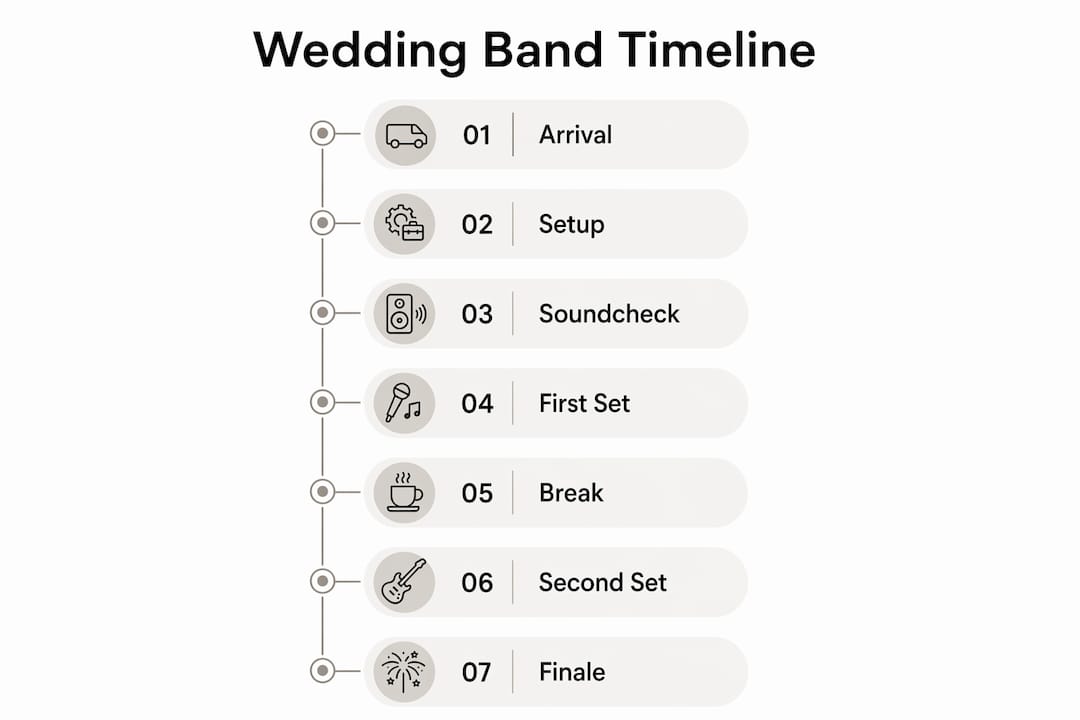
Buffer time matters. Speeches that run long, a delayed meal service, or a room turnaround between ceremony and reception all push the band’s start time back. Build at least 30 minutes of flex into the schedule between the end of dinner and the first dance.
What does setup and soundcheck actually involve?
Setup is not just plugging in cables. A full load-in and soundcheck covers several distinct steps, each of which takes time and cannot be skipped without consequences.
- Load-in: The band carries all equipment from the vehicle to the stage area. A distant loading bay or multiple flights of stairs adds time and physical effort.
- Stage placement: Positioning the PA speakers, monitors, drum riser, and backline so sightlines and sound projection work for the room.
- PA rigging: Connecting the front-of-house (FOH) speaker system, subwoofers, and monitor wedges or in-ear monitoring systems.
- Instrument setup: Drum kit assembly, amplifier placement, keyboard and music stand positions.
- Microphone and monitor checks: Each vocalist and instrument channel is tested individually for signal, gain, and feedback rejection.
- FOH balance: The sound engineer sets levels across all channels and adjusts EQ for the room’s acoustic properties.
- Full room soundcheck: The band plays together at performance volume so the engineer can hear how the mix translates across the full space.
A full load-in and soundcheck typically takes a significant amount of time. Rushing it risks feedback during the first song, uneven levels between instruments, and a mix that sounds fine at the stage but muddy at the back of the room.
If guests are already seated when the band arrives, a quieter line-check is possible. It confirms signal on each channel but cannot replicate a full balance through the audience area. Treat it as a last resort.
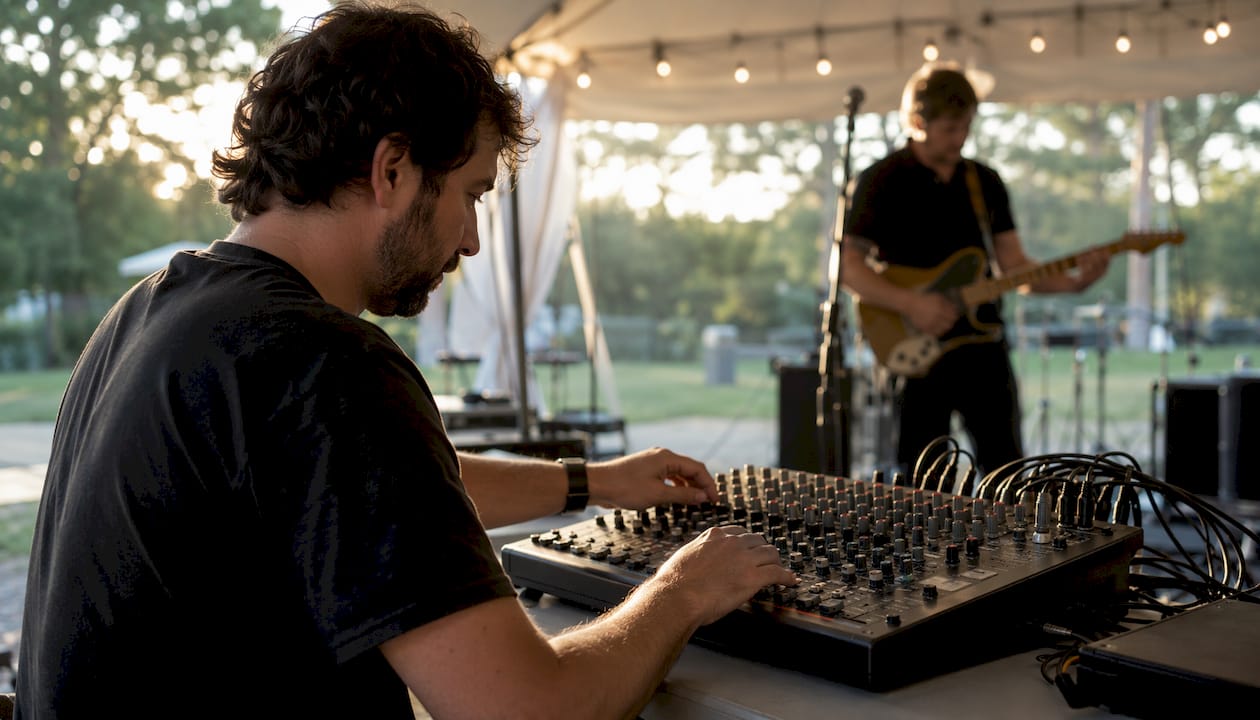
Pro Tip: Ask the venue to keep the performance space clear until at least 30 minutes after the band’s scheduled soundcheck start. This single step protects audio quality more than any other on the day.
What stage space and power does a wedding band need?
Stage footprint and power are the two areas where mismatches between band and venue cause the most avoidable problems. Confirm both before signing any contract.
Recommended stage footprints
| Band size | Minimum floor area | Notes |
|---|---|---|
| 4-piece | 4m × 4m | Drums, bass, guitar, vocals |
| 5–7 piece | 5m × 4m | Adds keys, horns, or extra vocals |
| minimum working area | 6m × 5m or larger | Full horn section, multiple vocalists |
These are minimum working areas. A larger space always helps. For a detailed breakdown of stage footprint requirements, confirm dimensions with the band and cross-reference with the venue’s floor plan.
Power requirements
Most professional bands need a minimum of 4–6 standard 13-amp sockets on a dedicated circuit, separate from the venue’s catering and lighting supply. For marquees or outdoor setups, confirming power capacity and whether a backup generator is available is a non-negotiable step. A single tripped breaker shared with the kitchen can cut the band mid-set.
PAT (Portable Appliance Testing) certificates and PLI (Public Liability Insurance) are standard requirements at most UK venues. Ask the band for copies before the event.
Additional logistics to confirm:
- Parking close to the load-in entrance (a van or minibus carrying a full PA system needs direct access)
- A private changing room or green room for the musicians
- A hot meal and soft drinks provided during the break between soundcheck and performance
- Secure storage for instrument cases and flight cases during the reception
Providing a hot meal and a private space keeps musicians energised through a long day and reduces the risk of a drop in performance quality during the final set.
How do venue sound limiters affect a live band?
Sound limiters are common in UK wedding venues, particularly converted barns, listed buildings, and urban hotels with residential neighbours. Understanding how they work before you book prevents a very unpleasant surprise on the night.
A sound limiter is a device connected to the venue’s power supply that monitors noise levels. Most operate on a traffic-light system: green means levels are safe, amber is a warning, and red triggers a power cut to the entertainment circuit. When the power cuts, music and lighting stop, and it typically takes 30–60 seconds to reset.
UK venue limiters often have thresholds that can be restrictive, sometimes requiring the band to use electric drums, in-ear monitors, and direct-input (DI) instruments rather than amplifiers.
Questions to ask the venue before booking:
- What is the exact limiter dB threshold, and is it a peak or sustained average measurement?
- Does the limiter cut power to the whole entertainment circuit, or just reduce it?
- What is the venue curfew for amplified music?
- Is the in-house PA system mandatory, or can the band bring their own?
- Has the limiter been tested recently, and is there a visible display?
Bands that prepare for limiter environments use electric drum kits, DI inputs for bass and guitar, and in-ear monitoring to stay within the dB ceiling while maintaining performance feel. For venues calibrated below approximately 90dB, skilled front-of-house mixing becomes the primary tool for maintaining perceived energy without triggering cuts.
Pro Tip: Ask the band to do a brief limiter test during soundcheck, before guests arrive. Run the loudest song in the set at full performance volume and watch the limiter display. This is the only reliable way to know whether the evening will stay in the green.
Experts advise couples not to rule out venues with sound limiters. Confirm the settings early and plan technical adaptations with the band. A limiter is a constraint to plan around, not a reason to change venue.
How do bands manage the first dance and MC duties?
The first dance is the most logistically sensitive moment of the evening. Getting the cue wrong, or having the band start before the couple is in position, is the kind of mistake guests remember.
Professional wedding bands commonly handle first-dance announcements, transitions between speeches, and real-time setlist adjustments to keep the event flow smooth. This informal MC role is one of the most practical reasons to choose live music over a DJ for a reception.
First dance options:
- Live intro, full song: The band plays the entire first dance song live. Requires the couple to confirm the key, tempo, and any arrangement changes in advance.
- Backing track support: The band plays over a pre-recorded track, useful for complex arrangements or songs outside the band’s usual repertoire.
- Fade-in for guests: The band begins quietly and builds volume as guests gather on the floor, creating a natural moment rather than an abrupt start.
Between sets, the band can signal when speeches are about to begin, gather guests for the first dance, and manage song requests. Designate one person on the day (a wedding planner, venue coordinator, or trusted family member) as the band’s single point of contact. This prevents conflicting instructions reaching the band from multiple directions.
Background music during speeches is handled either by a curated playlist routed through the PA or by a band member playing softly on keys or acoustic guitar. Confirm this arrangement in advance so the transition feels deliberate rather than accidental.
Pro Tip: If you want a surprise musical moment, such as a guest joining the band or an unexpected song reveal, rehearse the cue with the band’s bandleader at least two weeks before the wedding. A surprise that the band hasn’t prepared for rarely lands the way you imagine.
What happens between sets, and how do you keep music going?
Band breaks are unavoidable. Musicians need water, rest, and time to reset equipment. The question is not whether there will be a break, but how to fill it without losing the room’s energy.
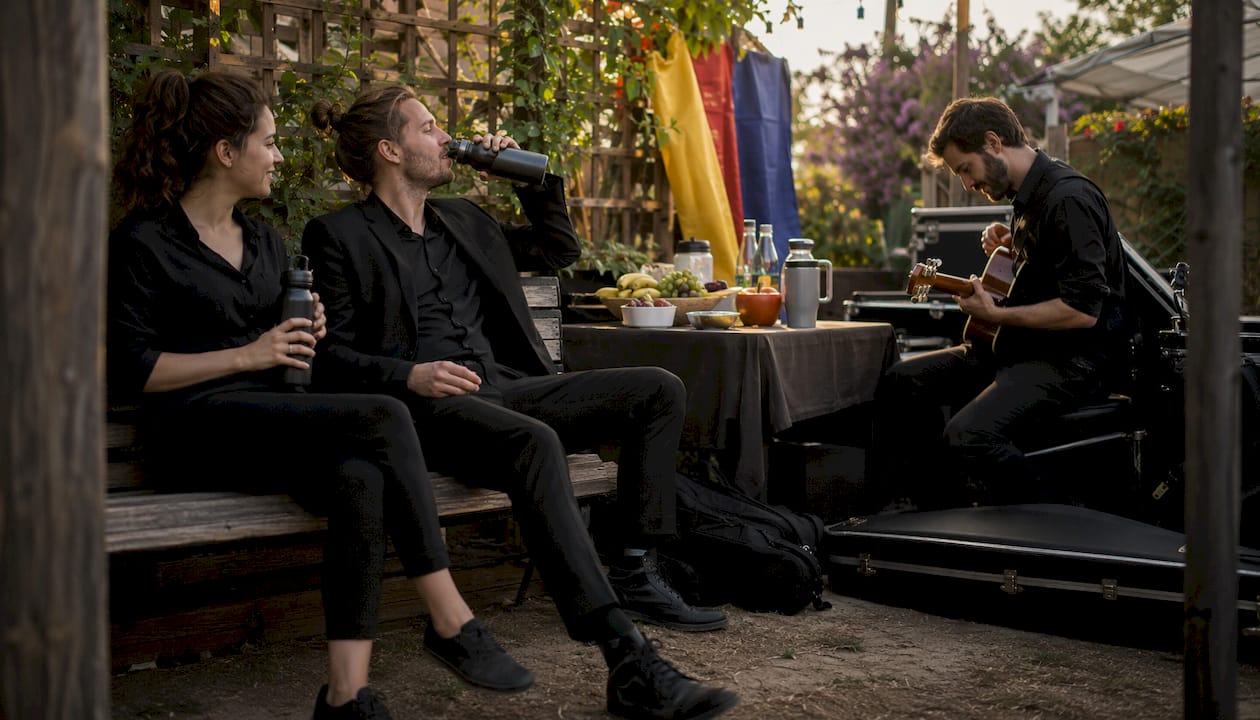
Typical breaks run 15–30 minutes. Longer pauses noticeably reduce dancefloor momentum, particularly after a strong set. Plan the break to coincide with a natural pause in the evening, such as the cake cutting or a scheduled toast, rather than leaving guests standing in silence.
| Option | Pros | Cons |
|---|---|---|
| Venue DJ | Professional, seamless handover | Additional cost; requires coordination |
| Band-provided DJ service | Single point of contact; consistent sound | Not all bands offer this |
| Curated playlist via PA | Low cost; couple controls the music | Requires someone to manage the system |
| Acoustic mini-set | Keeps live music flowing | Tiring for musicians; limits full-band rest |
For the handover to work cleanly, confirm in advance who controls the PA during the break, who has the playlist queued, and at what volume the background music should run. A playlist that is too loud makes conversation difficult; too quiet and the room feels empty.
The band’s sound engineer usually manages the PA transition. Brief them directly, not through a third party, on the break music plan.
Questions to ask before you book: a couple’s checklist
Misunderstandings between couples, bands, and venues almost always trace back to one thing: a question that was never asked. Use this checklist to close those gaps.
Four weeks before the wedding, confirm with the band:
- Agreed arrival time and load-in start
- Final setlist, first dance song, and any must-play or do-not-play tracks
- Whether the band provides a DJ service or playlist during breaks
- PAT certificates and PLI documentation
- Balance payment date and method
- Emergency contact number for the bandleader on the day
One week before, confirm with the venue:
- Load-in route and parking arrangements
- Sound limiter dB setting and behaviour (power cut or volume reduction)
- Number and location of dedicated power sockets
- Changing room availability and catering for musicians
- Curfew for amplified music and any noise restrictions
On the day:
- Introduce the band’s bandleader to the venue manager or coordinator
- Walk the load-in route together before unloading begins
- Confirm the first dance cue and who gives the signal
- Check the limiter display is visible to the sound engineer
For a broader set of questions to ask a wedding band before signing a contract, review the full guide covering technical riders, cancellation terms, and setlist agreements.
What does a wedding band cost in the UK?
Pricing varies considerably depending on band size, travel distance, equipment requirements, and whether limiter-friendly kit is needed. The figures below are broad indicative ranges for the UK market; always request a formal quote.
| Band type | Typical price range | Key variables |
|---|---|---|
| 3–4 piece | — | Travel, PA hire, set length |
| 5–7 piece | — | Horn section, extra vocalists |
| minimum working area | — | Full production, lighting rig |
These ranges shift upward for London and the South East, peak-season Saturdays, and bands that supply their own full PA and lighting rig. Limiter-friendly equipment (electric drum kits, DI rigs) may carry a hire surcharge if the band does not carry this kit as standard.
Deposit and payment terms:
Most UK bands require a deposit on booking, with the balance due several weeks before the event. Overtime rates for extended sets or late finishes are usually charged per time block; confirm the rate in the contract before signing.
Contract points to check:
- Cancellation policy for both parties, including force majeure provisions
- Replacement musician clause (what happens if a band member is ill)
- PAT and PLI requirements as specified by the venue
- Power and access obligations on the couple’s side
- Overtime rate and the process for requesting additional set time on the night
For sound system setup at marquee or outdoor receptions where the band supplies the full PA, confirm whether generator hire is included in the quote or charged separately.
How to handle problems on the day
Technical issues happen. The goal is to respond quickly and calmly, not to prevent every possible problem.
Common issues and fast fixes:
- Feedback: The sound engineer adjusts monitor levels or repositions microphones. Do not move speakers yourself.
- Tripped sound limiter: The band’s engineer reduces overall levels and resets the circuit. Allow the 30–60 second reset period before assuming the problem is serious.
- Failing microphone: The band should carry a spare. Signal the bandleader directly rather than interrupting the set.
- Late start: Compress the gap between sets rather than shortening individual set lengths. A shorter break is less noticeable than a truncated performance.
Build these contingencies into the schedule:
- Add a 20-minute buffer after speeches before the first dance cue.
- Keep a standby playlist ready on a phone connected to the PA for any unexpected gap.
- Confirm the venue manager’s direct mobile number the morning of the event.
Emergency contact template:
| Role | Name | Contact |
|---|---|---|
| Venue manager | [Name] | [Mobile] |
| Band representative | [Name] | [Mobile] |
| Sound engineer | [Name] | [Mobile] |
| Wedding planner | [Name] | [Mobile] |
Fill this in during the final week and share it with everyone on the list. A clear chain of contact means decisions get made in seconds, not minutes.
How professional bands read a crowd and shape the night
The mechanics of a wedding band performance extend well beyond playing the right songs. Professional bands act as de-facto masters of ceremony, reading crowd dynamics in real time to avoid dead air and sustain momentum across a long evening.
A band that notices the dancefloor thinning mid-set will typically pull forward a guaranteed floor-filler rather than sticking rigidly to a pre-agreed running order. This kind of real-time adjustment is what separates a good performance from a great one, and it is something no playlist can replicate. The benefits of live music for guest engagement come precisely from this responsiveness.
Tell the band the moments you value most before the day. If cross-generational singalongs matter, say so. If you want a specific energy shift after the first dance, brief the bandleader directly. Bands work best when they understand the couple’s priorities, not just the setlist.
Pro Tip: Give the band a one-page brief covering three things: the two or three songs that must happen, the two or three that must not, and the general energy arc you want across the evening. That brief takes ten minutes to write and saves hours of uncertainty on the night.
Key takeaways
A wedding band performance runs smoothly when setup time, venue constraints, and day-of communication are confirmed in advance, not on the night.
| Point | Details |
|---|---|
| Allow 60–90 minutes for setup | Book the band’s arrival 2–3 hours before the first set to allow full load-in and soundcheck. |
| Confirm the limiter setting early | Ask the venue for the exact dB threshold and whether it cuts power before finalising the band’s technical rider. |
| Provide a changing room and meal | A private space and hot meal during the break keeps musicians performing at full energy through the final set. |
| Nominate a single day-of contact | One person coordinates between the band, venue, and planner to prevent conflicting instructions on the night. |
| Settle the balance on time | Most UK bands require payment 2–4 weeks before the event; late payment can affect contract standing. |
What experienced performers know that most guides skip
The standard advice on wedding band logistics is sound but incomplete. Timings, checklists, and limiter guidance all matter. What most planning articles understate is how much the band’s performance quality depends on decisions made weeks before the day, not hours.
The single scheduling choice that prevents the most problems is straightforward: protect the soundcheck window. Not just on paper, but in practice. Venues that run ceremony and reception in the same space often need a room turnaround that eats directly into the band’s setup time. When that happens, the soundcheck gets compressed into a line-check, the mix is never properly balanced for the room, and the first set suffers for it. The couple rarely knows why the sound felt slightly off. The band does.
From a performer’s perspective, what musicians need most on the day is not complicated. Clear access to the stage, a private room to change and decompress between soundcheck and performance, and a hot meal. These are not luxury requests. A band that has been loading heavy equipment since mid-afternoon and has not eaten will not perform the same way in the final set as one that has been properly looked after. The difference is audible.
Brownsugarmusic has performed at weddings, corporate events, and residencies across two decades, including a long-running Friday night residency at Marble Bar in the Hilton Sydney. The pattern holds regardless of venue size or budget: the events that run best are the ones where the couple or planner treated the band’s logistics with the same care as the catering and the flowers.