

What is a wedding music deposit?
A wedding music deposit is an upfront partial payment made to secure a musician or band’s availability for your wedding date. It confirms the booking and removes that date from the vendor’s calendar. Without it, the musician has no obligation to hold the date, and you have no guarantee they will be available.
Deposits are often a partial upfront payment of the total fee, with the remaining balance due closer to the event. For example, a live band might require a deposit that counts toward the total cost to secure the booking. The deposit is not a separate charge. It counts toward the total cost.
Most deposits are non-refundable. This protects the musician against last-minute cancellations that would leave them unable to fill the date with another booking.
Table of Contents
- Understanding wedding music payment terms and contracts
- How much is a music deposit? UK norms explained
- How to avoid disputes over wedding music deposits
- Typical UK wedding music costs: deposits and balances
- Brownsugarmusic: live R&B and soul for your wedding
- Key takeaways
Understanding wedding music payment terms and contracts
A contract is the document that gives a deposit its legal weight. Paying a deposit without a signed contract leaves both parties exposed. The musician has no written protection if you cancel, and you have no recourse if they fail to show.

A well-written contract covers the total fee, the deposit amount, the balance payment deadline, cancellation penalties, and the scope of the performance. These terms protect both sides and prevent the kind of disputes that arise from verbal agreements or informal invoices.
Key elements every wedding music contract should include:
- Total fee and deposit amount stated clearly in pounds
- Balance payment deadline, typically 7–15 days before the event
- Cancellation policy with specific refund or penalty terms
- Performance details: start time, duration, number of sets
- Accepted payment methods
Payment methods commonly accepted by professional musicians include bank transfer, cash, credit or debit card, and cheque. Bank transfer is the most common for deposits in the UK, as it creates a clear paper trail.
Pro Tip: Sign the contract before transferring any money. There is only one correct order: contract first, deposit second. Reversing this leaves you with no written protection if anything goes wrong.
How much is a music deposit? UK norms explained
For wedding bands in the UK, deposits are commonly a substantial part of the total fee. Solo musicians and DJs may request a smaller upfront payment reflecting their lower overall costs.

UK wedding bands usually charge fees for standard live acts, with solo musicians and DJs generally at lower price points. A typical deposit represents a portion of the total fee and is paid at signing, with the balance settled before the wedding.
Timing matters too. Most musicians ask for the deposit at the point of signing the contract, not weeks later. Delaying payment after signing can result in the vendor releasing the date. For wedding entertainment timeline planning, booking music 12 months in advance is common for popular dates, which means deposits are often paid well over a year before the event.
Deposit amounts can sometimes be negotiated, particularly for off-peak dates or longer bookings. Ask the vendor directly. Many are open to discussion, especially for weekday or winter weddings.
How to avoid disputes over wedding music deposits
Disputes over deposits almost always trace back to one of two problems: no contract, or a contract that was vague about cancellation terms. Both are avoidable.
Steps to protect yourself before paying:
- Read the cancellation policy carefully before signing. Know exactly what you lose if plans change.
- Confirm whether the deposit is fully non-refundable or partially refundable under certain conditions.
- Keep copies of all signed documents, payment receipts, and written communications.
- Clarify what happens if the musician cancels. A good contract addresses this scenario too.
Cancellation terms vary widely. A common structure is: deposit non-refundable at any point; 50% of the total fee owed if cancellation occurs between 30 and 90 days out; 100% of the total fee owed if cancellation is within 30 days. Understanding these thresholds before signing is the only way to budget for the risk.
Legal advisors recommend that payment schedules and cancellation terms are stated explicitly in the agreement, not left to verbal understanding. If a term is not in writing, it is difficult to enforce.
Pro Tip: If a dispute does arise, go back to the contract first. Courts and mediators treat written terms as the starting point. A clear contract is your strongest tool for resolving disagreements without legal action.
For couples who want to know the right questions to ask before hiring, reviewing cancellation and deposit terms should be on that list from the first conversation.
Typical UK wedding music costs: deposits and balances
Deposits make more sense when you see them alongside total costs. The table below covers typical price ranges for common wedding music options in the UK, with indicative deposit amounts based on customary partial payment rates.
| Music type | Typical total cost | Indicative deposit (30–50%) | Balance due |
|---|---|---|---|
| Live band | £1,000–£2,000 | £300–£1,200 | 7–15 days before event |
| Wedding DJ | £300–£1,200 | £90–£500 | 7–15 days before event |
| Solo musician | £300–£800 | £90–£400 | 7–15 days before event |
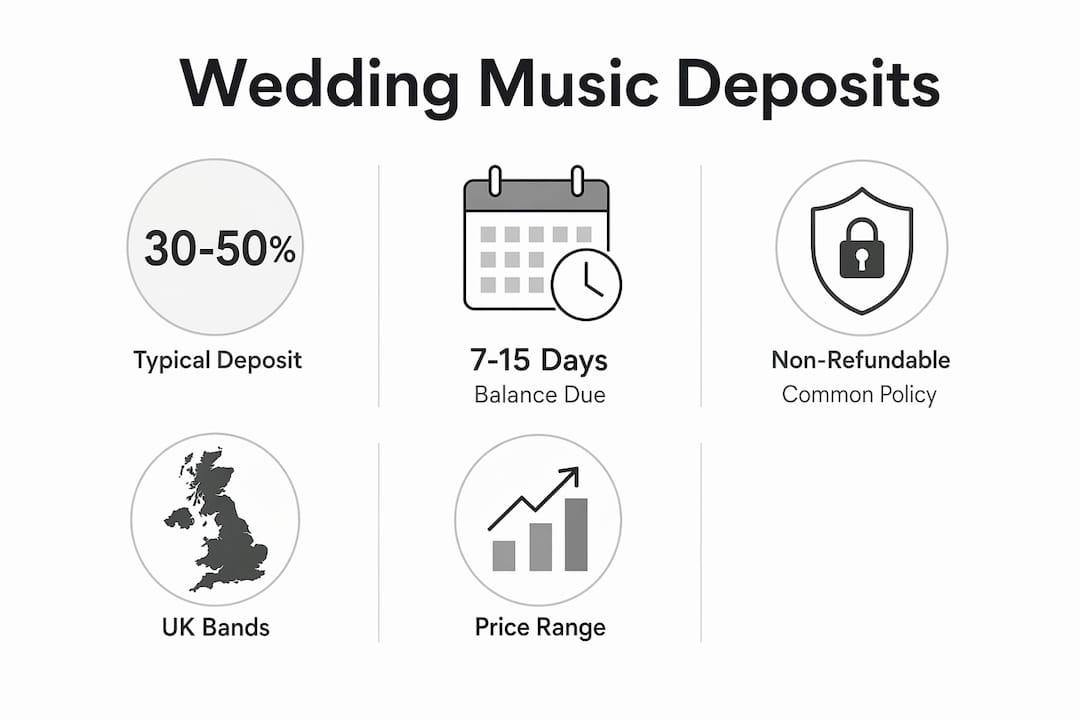
UK professional musicians typically require the final balance to clear 7–15 days before the wedding, not on the day itself. This avoids payment delays at the event and gives both parties confidence going in.
Additional costs to factor into your budget include travel fees for musicians coming from outside your area, fees for extra musicians added to the line-up, and rehearsal charges if you require the band to attend your ceremony run-through. These are usually listed separately in the contract and do not form part of the deposit calculation.
For broader event entertainment budgeting, music typically represents one of the larger line items in a wedding budget, so understanding the deposit structure early helps avoid cash flow surprises closer to the date.
Brownsugarmusic: live R&B and soul for your wedding
Couples who want a live band with a proven track record have a clear option in Brownsugarmusic. Established in 2003 and based in Sydney, Brownsugarmusic has performed at weddings, corporate functions, and private events across Australia and internationally. The band has held a residency at Marble Bar in the Hilton Sydney every Friday night for over 20 years, which reflects a consistency that matters when you are trusting a band with your wedding day.
For couples planning a wedding with R&B and soul at its centre, Brownsugarmusic brings a repertoire and stage presence built over two decades of live performance. The R&B soul wedding atmosphere guide covers what to expect from this style of music and how it shapes the feel of a reception. Booking enquiries, including deposit and contract details, are handled directly. Check availability and get in touch via brownsugarmusic.com.au.
Key takeaways
A wedding music deposit is a non-refundable upfront payment, typically 20–50% of the total fee, that legally secures your chosen musician or band for your wedding date.
| Point | Details |
|---|---|
| Deposit range | Deposits usually represent 20–50% of the total music fee, commonly agreed upon as a partial payment to secure the booking. |
| Contract first | Always sign the contract before paying any deposit to protect both parties. |
| Balance timing | The remaining balance is usually due 7–15 days before the wedding date. |
| Cancellation risk | Deposits are often non-refundable; cancellations within 30 days may incur the full fee. |
| Brownsugarmusic | An established Sydney R&B and soul band available for wedding bookings with clear contract terms. |