

A wedding music brief is defined as a written document that communicates a couple’s musical preferences, key moments, logistical requirements, and desired atmosphere to their performers. Getting this right is the single most important step in wedding music planning. Musicians who adapt to the room can boost guest engagement by up to 40% compared to a fixed, pre-scripted playlist. That figure tells you everything about why a brief built around flexibility outperforms a rigid song list every time. Brownsugarmusic, Sydney’s resident R&B and soul band at the Hilton’s Marble Bar since 2003, has worked with hundreds of couples and seen firsthand how a well-crafted brief transforms a good wedding into a great one.
What is a wedding music brief and why does it matter?
A wedding music brief is the primary communication tool between a couple and their performers. It covers musical taste, atmosphere goals, key moments in the day, and practical logistics. Think of it as a creative and operational handshake. Without one, performers guess. With one, they deliver.
The brief also functions as a logistical roadmap that coordinates MC announcements, speeches, and technical requirements across the day. Couples who skip this step often find themselves managing last-minute gaps between vendors. A clear brief prevents exactly that.

The industry term for this document varies. Some planners call it a wedding entertainment brief or a wedding entertainment package brief. All refer to the same core tool: a structured guide that tells performers what you want, when you want it, and how you want it to feel.
What key elements should a wedding music brief contain?
A strong brief covers six core areas. Each one gives your performers something concrete to work with.
- Must-play songs. Limit these to 10–20 tracks, with only 2–3 true non-negotiables. Overloading this list reduces a performer’s ability to read the room.
- Do-not-play list. Be specific. “No heavy metal” is vague. “No Ed Sheeran” is clear. Specific exclusions protect the atmosphere you want.
- Key moments and timing. List the processional, first dance, cake cutting, speeches, and recessional. Note the approximate time and duration for each.
- Vibe list. Name specific artists, eras, and energy levels. “Think Stevie Wonder meets late-night soul bar” gives a performer far more than “upbeat and fun.”
- Logistical details. Include sound limiter restrictions, load-in access, power availability, and stage dimensions. Technical realities determine what is feasible on the day.
- Requests policy. Decide in advance whether guests can make requests, and communicate that clearly to your performers.
Pro Tip: Write your brief in two parts: a creative section covering taste and atmosphere, and a logistics section covering venue constraints and timing. Keeping them separate makes it easier for performers to reference each one quickly on the day.
How does a wedding music brief differ for live musicians versus DJs?
The brief serves the same purpose for both, but the emphasis shifts depending on who you are briefing.
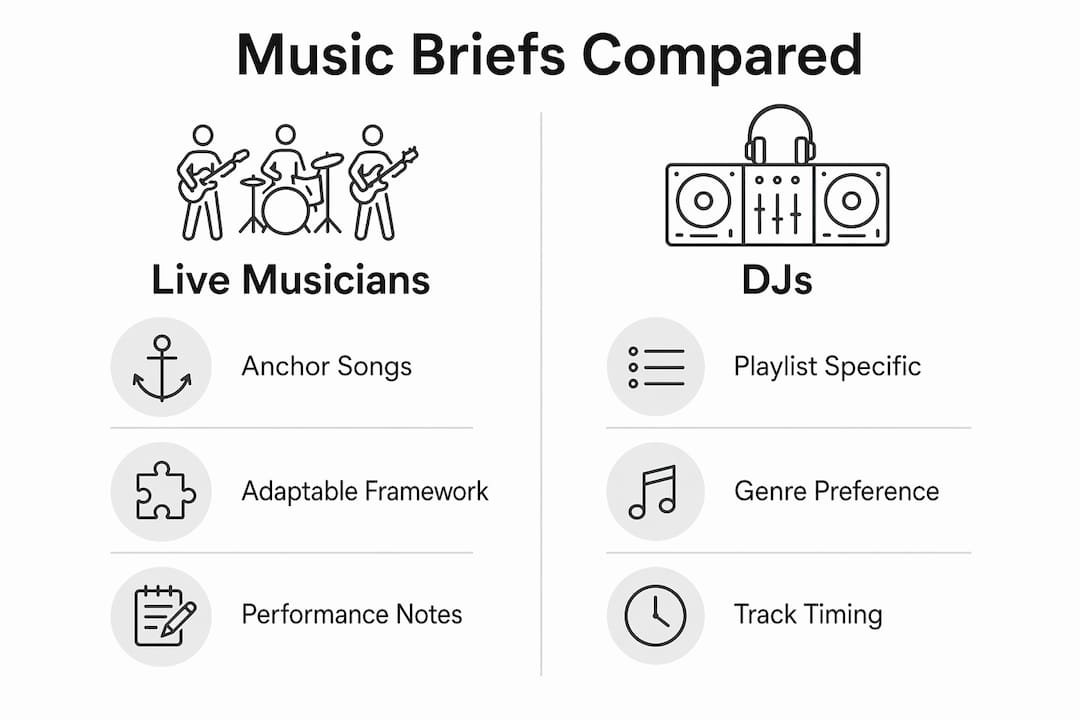
| Area | Live musicians | DJs |
|---|---|---|
| Must-play list | 5–10 anchor songs that suit the band’s repertoire | 10–20 tracks with 2–3 firm non-negotiables |
| Vibe list | Artists and eras that define the emotional tone | Specific genres, BPM ranges, and energy arcs |
| Do-not-play list | Styles or songs outside the band’s range | Specific tracks or genres to avoid entirely |
| Flexibility | High. Live musicians adapt to audience energy in real time | High, but within a more structured set framework |
| Logistics | Stage size, power, PA requirements, load-in time | Equipment setup, DJ booth space, power needs |
Live musicians benefit most from an adaptable framework built around anchors and boundaries rather than a minute-by-minute script. Trusting performers to read the room produces a higher quality experience than locking them into a rigid plan. DJs, by contrast, work well with a focused must-play list and a generous vibe list that gives them room to move.
The biggest mistake couples make is treating a live band brief like a DJ playlist. A band like Brownsugarmusic brings improvisation, crowd reading, and live energy to every set. The brief should give them direction, not a script.
What practical tips help couples create an effective music brief?
Creating a brief that performers actually use requires structure and specificity. Generic documents get ignored. Concrete ones get results.
- Start with moments, not genres. List every musical moment in the day chronologically. Ceremony entrance, signing of the register, drinks reception, first dance, dinner, evening party. Assign a mood or energy level to each one.
- Use named artists as reference points. Instead of writing “romantic,” write “think Norah Jones for the ceremony and D’Angelo for the evening.” Specific references remove ambiguity.
- Keep must-plays tight. Limiting must-play songs to a focused list preserves the performer’s ability to adapt. More than 20 tracks becomes a constraint, not a guide.
- Include venue-specific logistics. Note the load-in location, sound restrictions, and any curfew. Performers who arrive prepared avoid day-of surprises.
- Confirm understanding before the day. Send the brief at least four weeks out and ask your performers to confirm they have read it. A brief that sits unread in an inbox helps no one.
Pro Tip: Build your brief around what you want guests to feel at each stage of the day, not just what songs you like. Performers respond better to emotional cues than to exhaustive track lists.
Couples who plan music by moments rather than genre preference create a more intentional and coherent experience. The brief becomes a narrative guide, not just a checklist.
Why should wedding music run as a continuous thread through the day?
Music is not a series of isolated moments. It is the emotional backbone of the entire day. Ceremony music sets the tone instantly, drinks reception music adds atmosphere without overwhelming conversation, and evening music builds momentum for dancing. Each phase requires a different approach.
Couples who treat each segment separately often end up with a disjointed experience. Guests notice when the energy drops between the ceremony and the reception, or when the evening party starts too quietly. Planning music as a continuous arc prevents those gaps.
The emotional shifts across a wedding day should drive the music choices, not the other way around. A good brief maps the mood of each segment and gives performers the context to match it.
- Ceremony. Quiet anticipation before the entrance. Emotional peak at the processional. Joyful release at the recessional.
- Drinks reception. Warm, social, and conversational. Music should be present but not dominant.
- Dinner. Relaxed and ambient. Background music that supports conversation without competing with it.
- Evening party. Progressive energy build from the first dance through to the last song of the night.
Positive briefs that focus on what couples want at each stage, rather than only listing what they dislike, give musicians the confidence to perform with personality. The result is a day that feels cohesive rather than assembled from separate parts. For couples exploring how to create that R&B soul atmosphere across the full day, thinking in phases is the most effective starting point.
Entertainment briefs that coordinate across the full day also benefit from professional entertainment coordination, which shows how the same brief principles apply across different entertainment formats and cultural contexts.
Key takeaways
A wedding music brief is the most effective tool couples have for ensuring performers deliver the right music at the right moment throughout the day.
| Point | Details |
|---|---|
| Define the brief clearly | A wedding music brief covers preferences, key moments, logistics, and atmosphere in one document. |
| Keep must-plays focused | Limit must-play tracks to 10–20 songs with only 2–3 firm non-negotiables to preserve performer flexibility. |
| Use specific references | Name artists, eras, and energy levels instead of vague adjectives to give performers clear direction. |
| Include logistics | Sound limits, load-in access, and stage dimensions must appear in the brief to avoid day-of problems. |
| Plan music by moments | Map the mood of each wedding phase so music flows as a continuous arc rather than isolated choices. |
Deni’s take: what couples get wrong about music briefs
Most couples spend hours on song lists and almost no time on logistics. That imbalance causes more problems on the day than any playlist decision ever could. A band that cannot find the load-in entrance, or a venue with a sound limiter nobody mentioned, will derail the evening faster than a wrong song choice.
The briefs that work best are the ones that trust the performers. I have seen couples hand over a 60-track must-play list and wonder why the night felt mechanical. The brief should set the direction and then get out of the way. Give your band the anchors and the boundaries, then let them read the room.
The other thing couples overlook is the emotional arc. They pick songs they love without asking whether those songs fit the moment. A beautiful ballad is perfect for the first dance. The same song at the start of the evening party kills the energy. Thinking in phases, not just favourites, is what separates a good brief from a great one.
If you are working with a live band, brief your wedding band with the same care you would give a venue coordinator. The performers who receive a clear, well-structured brief consistently deliver better results. That is not opinion. That is two decades of watching it play out.
— Deni
How Brownsugarmusic supports your wedding music planning
Brownsugarmusic has performed at weddings across Sydney and beyond since 2003. The band brings over two decades of live R&B and soul experience to every event, with a deep understanding of how music shapes a wedding day from ceremony to last dance.

Couples who book Brownsugarmusic receive direct guidance on building a music brief that works for their venue, their guests, and their vision. The band’s experience at venues across Sydney means they understand sound restrictions, stage logistics, and timing pressures that couples often do not anticipate. For couples ready to explore what a live band wedding reception can offer, Brownsugarmusic provides a starting point that goes well beyond a standard entertainment package. Get in touch to discuss your wedding music brief and find out how the band can bring your vision to life.
FAQ
What is a wedding music brief?
A wedding music brief is a written document that outlines a couple’s musical preferences, key moments, logistical requirements, and desired atmosphere for their wedding day. It serves as the primary communication tool between the couple and their performers.
How long should a wedding music brief be?
A brief works best when it is concise and structured. One to two pages covering must-plays, do-not-plays, a vibe list, key moments, and logistics is sufficient for most performers.
What is the difference between a must-play list and a vibe list?
A must-play list contains specific songs the couple requires at named moments. A vibe list contains artists, eras, and energy descriptors that guide the performer’s broader choices throughout the event.
When should couples send their music brief to performers?
Send the brief at least four weeks before the wedding and ask performers to confirm receipt and understanding. Earlier is better for live bands with larger repertoires to prepare.
Does a wedding music brief work differently for live bands and DJs?
Yes. Live bands benefit from an adaptable framework with anchor songs and clear boundaries. DJs work well with a focused must-play list and a generous vibe list that gives them room to read the crowd.