

A wedding music vision board is a structured planning document that organises your personalised wedding music into moment-specific playlists, locked must-play songs, and clear guidance for your DJ or band. Unlike a simple song list, it acts as a map of emotional rhythm across your entire day, from the ceremony prelude through to the last dance. When you build a wedding music vision board properly, you give your music vendor everything they need to deliver exactly the atmosphere you want. Tools like Spotify, Canva, and Pinterest all support the process. The result is a wedding soundtrack that feels intentional, not accidental.
How to build a wedding music vision board by moment
The most effective way to start your wedding music inspiration board is to split the day into distinct musical moments. Each moment has a different emotional purpose, and that purpose should drive every song choice within it.
The standard wedding day breaks into seven core segments: ceremony prelude, processional, recessional, cocktail hour, dinner, dance floor, and last dance. Each segment needs its own curated playlist because the mood shifts significantly between them. A dinner playlist that bleeds into dance floor energy too early will unsettle guests before they are ready to move.
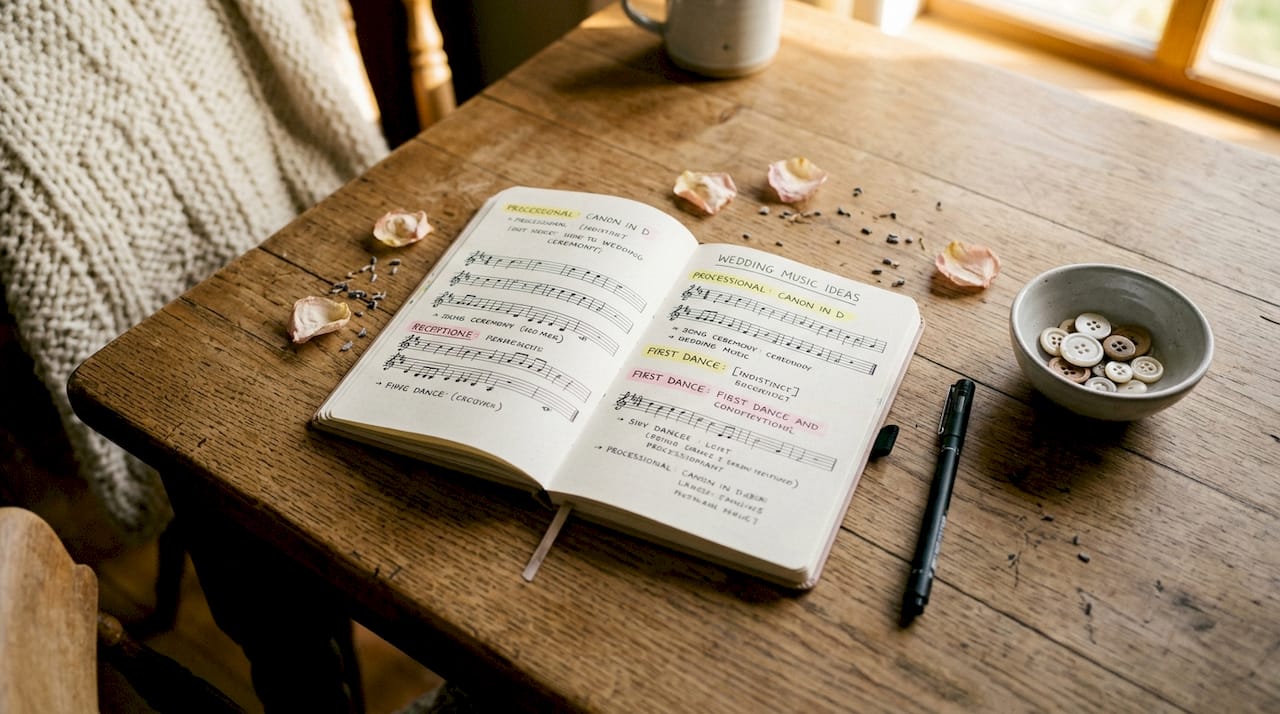
Recommended song counts for each segment give you a clear target to work towards:
| Segment | Duration | Recommended Song Count |
|---|---|---|
| Ceremony prelude | 20–30 mins | 8–12 songs |
| Processional | 3–5 mins | 2–3 songs |
| Recessional | 2–3 mins | 1 song |
| Cocktail hour | 60–75 mins | 15–20 songs |
| Dinner | 90–120 mins | 20–25 songs |
| Dance floor | 90–120 mins | 30–40 songs |
| Last dance | 3–5 mins | 1 song |
These counts are practical targets, not rigid rules. They help you avoid under-planning a segment and leaving your DJ with nothing to work from.
Pro Tip: Use tempo as your guide for each segment. Ceremony music works best below 80 BPM, cocktail hour sits comfortably at 80–100 BPM, and the dance floor calls for 120–140 BPM. Share these targets with your DJ so they can pace the energy correctly.
What songs should you lock in first?
The most reliable approach is a two-tier system. Lock 6–8 emotionally defining songs for your key moments first, then delegate the remaining fill music to your DJ with clear style and era guidance. This prevents late-stage changes and gives your DJ creative room to read the room.
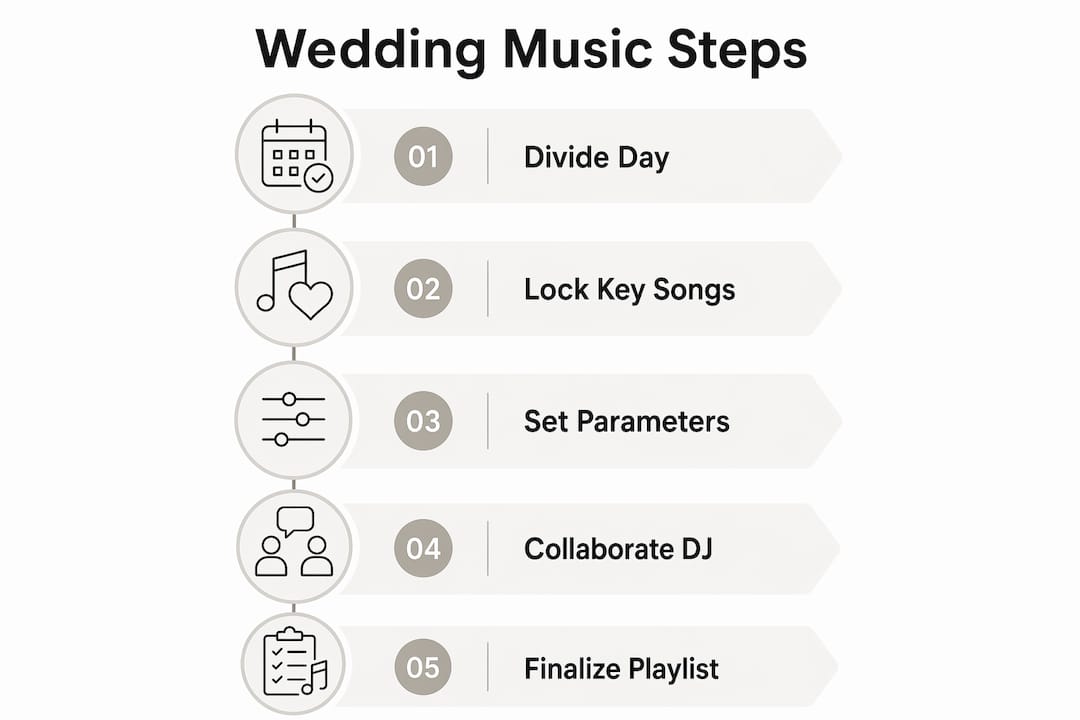
Your locked songs should cover the highest-stakes moments: the processional, your first dance, the parent dances, and the last dance. These are the moments guests remember and photograph. Every other segment can be guided by genre, era, and energy preferences rather than specific tracks.
Once your must-plays are confirmed, compile your do-not-play list with equal care. This list should include songs with personal negative associations, genres that clash with your guest demographic, and any tracks that would feel jarring in a formal setting. Moment-labelled playlists with clear vibe keywords and do-not-play lists reduce misunderstandings and last-minute revisions with your vendor.
- List your must-play songs in priority order, not alphabetically
- Note the specific moment each song belongs to (e.g. “first dance,” “father-daughter dance”)
- Include genre and era preferences for each segment (e.g. “cocktail hour: classic soul and Motown, 1960s–1980s”)
- Write your do-not-play list as a separate section, not buried in notes
- Specify any songs that are acceptable only in certain segments
Pro Tip: Always include version notes next to each song. Specify radio edit vs album version, clean vs explicit, and whether a cover is acceptable. A wrong version can completely change the mood of a moment.
How do you use spotify to create a music vision board?
Spotify is the most practical tool for building and sharing a digital wedding song playlist. The key is to organise playlists by wedding moment rather than by genre. A single playlist labelled “Wedding Music” tells your DJ almost nothing. Seven playlists, each labelled by segment and annotated with vibe notes, tells them everything.
Separating must-plays from inspirational songs is the most important structural decision you will make in Spotify. Must-plays are non-negotiable. Inspirational songs show your DJ the direction without restricting their choices. Mixing the two in one playlist creates confusion about what is locked and what is flexible.
Follow these steps when building your Spotify-based vision board:
- Create one playlist per wedding segment, named clearly (e.g. “Ceremony Prelude,” “Cocktail Hour,” “Dance Floor”)
- Add a playlist description with 3–5 vibe keywords (e.g. “warm, intimate, acoustic, low energy”)
- Create a separate “Must-Play” playlist containing only your 6–8 locked songs with moment notes in the track title field
- Create a “Do Not Play” playlist so your DJ can reference it directly
- Confirm exact song versions before sharing, checking that Spotify has the correct edit
- Share all playlist links at least four weeks before the wedding
Canva and Pinterest work well alongside Spotify for the visual side of your music inspiration board. A Canva board with artist images, lyric snippets, and mood photography helps vendors understand the emotional tone you are after, even before they press play.
How do you collaborate with your DJ using the vision board?
Giving your DJ a well-structured vision board is only half the process. The other half is explaining how to use it. A prioritised must-play list of 40–50 songs combined with a do-not-play list and moment-by-moment notes gives your DJ the clearest possible brief.
Follow this sequence when handing over your vision board:
- Submit your full vision board document in writing at least four weeks before the wedding
- Include a one-page summary sheet with your top 6–8 must-plays, key do-not-plays, and overall style notes
- Book a 30-minute phone or video call to walk through the document together
- Provide timing logic for each segment so your DJ knows the planned duration and can avoid awkward gaps or rushed transitions
- Assign a trusted guest or wedding party member as a day-of music manager to relay any real-time requests or timing changes
Style and era preferences are as useful to a DJ as specific song titles. Telling your DJ “we want 90s R&B and early 2000s soul for the dance floor” gives them the flexibility to read the room while staying within your vision. Rigid song-by-song playlists for the dance floor often backfire because they cannot adapt to the energy in the room.
Verbal follow-up after written submission matters more than most couples realise. A phone call confirms your DJ has read the document, understood the priorities, and flagged any songs they cannot source. Written documents alone leave too much room for assumptions.
Key takeaways
A wedding music vision board works best when it combines locked must-play songs, moment-specific playlists, and clear DJ parameters into a single structured document.
| Point | Details |
|---|---|
| Segment the day first | Divide your wedding into seven moments before selecting any songs. |
| Lock 6–8 must-plays | Secure your highest-stakes songs first, then delegate fill music to your DJ. |
| Separate must-plays from inspiration | Keep locked songs and reference songs in different Spotify playlists to avoid confusion. |
| Include version notes | Specify radio edit, clean version, or album cut to prevent atmosphere mismatches. |
| Submit four weeks ahead | Share your full vision board with vendors at least four weeks before the wedding. |
What i have learned from watching couples plan their wedding music
After more than two decades performing at weddings across Sydney and around the world, I have seen the same pattern repeat itself. Couples who arrive with a structured vision board get a better result every time. Not because the music is more controlled, but because the communication is clearer.
The two-tier approach, locking key songs and then setting parameters for the rest, is the single most practical framework I have seen work consistently. Couples who try to script every song for the dance floor almost always end up frustrated. The room has its own energy, and a good musician or DJ needs room to respond to it.
The most common mistake is not overplanning. It is failing to assign songs to specific moments. A list of 60 favourite songs with no moment labels is not a vision board. It is a playlist. The moment labels are what turn a playlist into a brief your band or DJ can actually use.
Start earlier than you think you need to. Four weeks feels like plenty of time until it is not. The couples who share their vision boards two months out have far less stress in the final weeks. Trust your vendor’s expertise within the parameters you set. That balance is where the best wedding soundtracks come from.
— Deni
How Brownsugarmusic can bring your vision to life
Brownsugarmusic has been performing at Sydney weddings since 2003, with a residency at Marble Bar in the Hilton Sydney that has run for over 20 years. That depth of experience means the band understands exactly how to work with a well-prepared music vision board.
When you book Brownsugarmusic for your wedding, you are working with musicians who have navigated every kind of wedding atmosphere, from intimate ceremonies to full reception dance floors. The band’s R&B and soul wedding guide walks couples through how to structure their music for each moment of the day. For couples who want to see the band in action before booking, reviewing the band’s videos is the recommended first step.
FAQ
What is a wedding music vision board?
A wedding music vision board is a structured planning document that organises your wedding songs into moment-specific playlists, locked must-play tracks, and style guidance for your DJ or band. It differs from a simple playlist by assigning each song or group of songs to a specific point in the day.
How many songs should a wedding playlist have?
A full wedding day playlist typically requires 75–100 songs across all segments. The dance floor alone needs 30–40 songs, while the ceremony requires far fewer, around 13–16 songs across prelude, processional, and recessional.
When should you share your vision board with your DJ or band?
Share your completed vision board at least four weeks before the wedding. Follow up with a phone or video call to confirm your DJ or band has reviewed it and can source all required songs and versions.
How do you choose wedding songs for each moment?
Start by locking 6–8 emotionally significant songs for your key moments, then use genre, era, and tempo preferences to guide the remaining segments. Matching tempo to each segment keeps the emotional energy consistent throughout the day.
Do you need a do-not-play list?
A do-not-play list is as important as your must-play list. It prevents songs with negative associations or clashing genres from appearing, and it gives your DJ clear boundaries without restricting their ability to read the room.