

Managing song requests for a live wedding band is the process of collecting, filtering, and coordinating music choices from guests and the couple to create a personalised and smoothly executed reception. Done well, it keeps the dance floor full and the atmosphere exactly as you imagined. Done poorly, it hands control of your wedding soundtrack to whoever shouts loudest. This guide covers the full process, from gathering requests before the day to handling live requests during the reception, using practical tools and clear boundaries to protect your musical vision.
How to request songs for your wedding band
The most effective way to manage a wedding band song request process starts well before the reception. Collecting requests in advance gives your band time to prepare, reduces on-the-night chaos, and ensures the playlist reflects what you actually want rather than what guests demand in the moment.
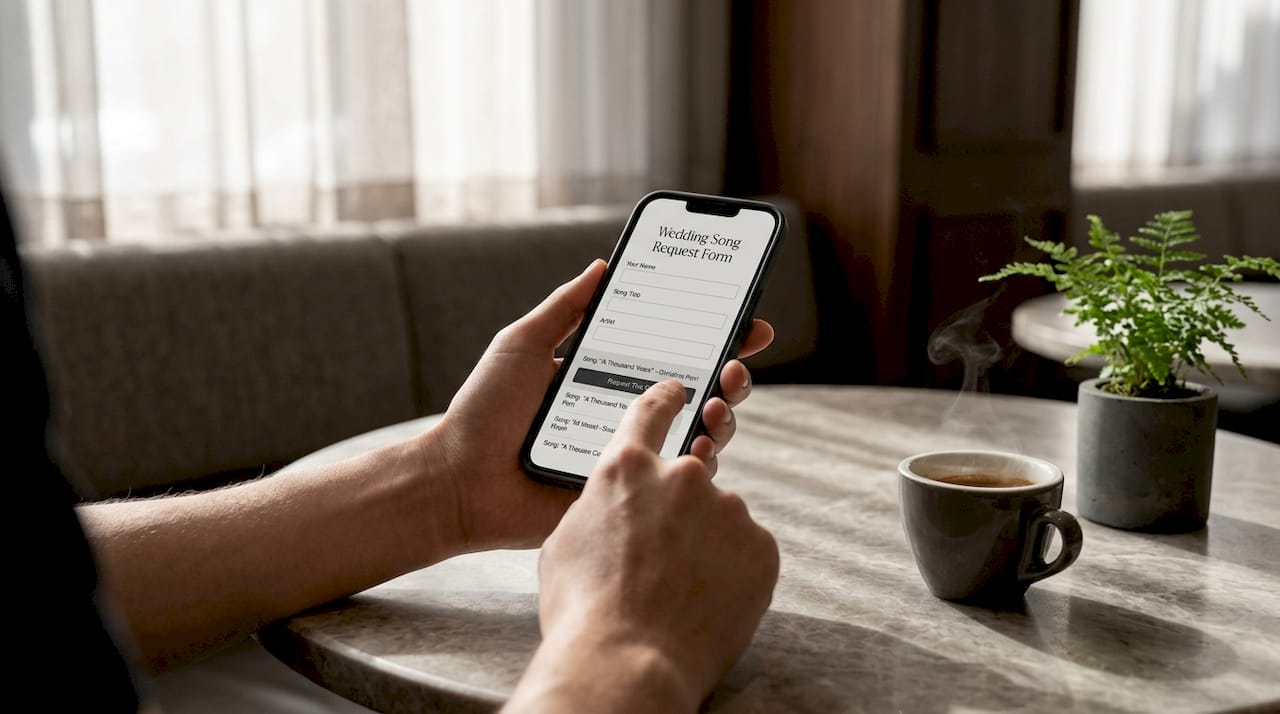
The three most common collection methods are RSVP cards with a dedicated song request field, wedding websites with built-in forms, and QR codes linked to a Google Form or spreadsheet. Platforms like The Knot and Wix integrate song requests directly into RSVP flows, making it easy for guests to submit suggestions alongside their meal choices. This structured approach increases guest engagement and delivers requests to you in an organised format rather than a flood of text messages.
Setting clear guidelines matters as much as the collection method itself. Tell guests upfront how many songs they can request, what genres fit the evening, and whether requests are guaranteed or treated as suggestions. This manages expectations before they become problems.
- Add a song request field to your RSVP card or online form
- Use a QR code at your venue or on invitations linking to a shared request form
- Set a submission deadline at least three weeks before the wedding
- Specify the genre or era to guide guests toward suitable choices
- State clearly that requests are suggestions, not guarantees
Pro Tip: Limit each guest to one or two requests. Open-ended requests produce lists of 80 songs that no band can realistically prepare, and filtering them becomes its own project.
Collecting requests ahead of the event allows your entertainment provider to prepare properly and reduces ad-hoc disruptions at the venue. The band arrives knowing what the crowd wants, which means better transitions and a more confident performance.
How do you filter guest requests to suit your setlist?
Collecting requests is straightforward. Curating them is where couples often struggle. A tiered approach works best: sort every request into must-plays, approved requests, and a “not tonight” category. This gives you control without dismissing guests entirely.
Here is a practical process for filtering your list:
- Start with your must-plays. These are the songs that matter to you as a couple. First dance, parent dances, and any tracks with personal significance go here. The band treats these as non-negotiable.
- Build your approved pool. Review guest requests and move those that fit your vibe into a second tier. These are songs the band can draw from if the moment is right, but they are not guaranteed.
- Create your do-not-play list. This is an absolute boundary. Include explicit tracks, songs with painful associations, or anything that clashes with the atmosphere you want. Explicit songs and line dances are common additions to keep the evening family-friendly.
- Filter for band compatibility. Not every song suits a live R&B or soul band. Check with your band which requests they can perform authentically. A song that works on a recording may not translate well to a live arrangement.
- Discard the rest without guilt. Guest requests are suggestions, not demands. You and the band hold veto power. Filtering a large list protects the event’s energy and keeps the playlist manageable.
Pro Tip: When sending your final list to the band, provide your do-not-play entries with specific categories and notes, such as “no line dances” or “nothing with explicit lyrics.” The more specific you are, the more confidently the band can enforce your boundaries without awkward moments.
Avoid sending an unfiltered list of 60 guest requests to your band and expecting them to sort it out. Categorising into must-plays and a curated pool helps with set planning and rehearsals, and it shows respect for the musicians’ preparation time.
When should you send your final song list to the band?
Timing is one of the most overlooked parts of wedding band setlist planning. The general rule is straightforward: send your final playlist at least two weeks before the wedding. This gives the band time to prepare tracks, arrange any special requests, and run through the material before the soundcheck.
The table below outlines a practical timeline for managing your music submissions.
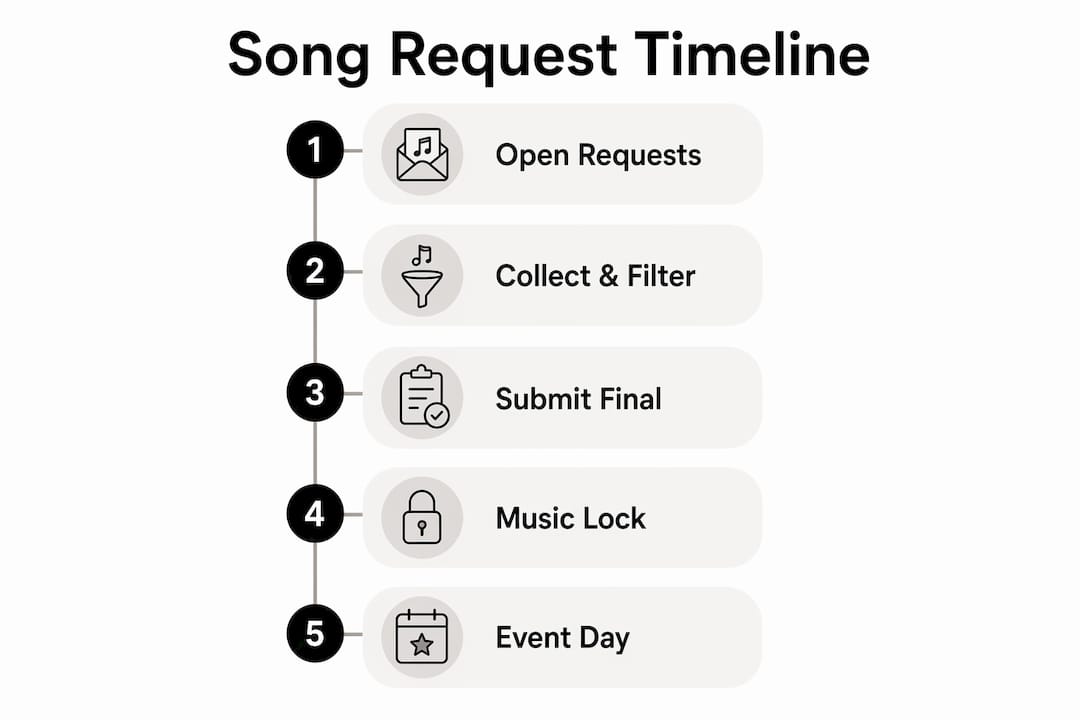
| Stage | Recommended timing | What to do |
|---|---|---|
| Open guest requests | 8 to 12 weeks before | Add request field to RSVP or wedding website |
| Close guest submissions | 3 weeks before | Set a firm deadline and stop accepting new requests |
| Submit curated list to band | 2 weeks before | Send must-plays, approved pool, and do-not-play list |
| Music lock period | 1 week before | No further changes to the playlist |
| Day-of coordination | Wedding day | Confirm running order with band at soundcheck |
A “music lock” period in the final week before the wedding reduces last-minute changes and planning stress significantly. Once the list is locked, you stop fielding requests from well-meaning relatives and the band can focus on performance rather than administration.
Live bands typically play 45 to 50 minute sets with 10 to 15 minute breaks. Treat those breaks as fixed blocks in your event timeline. Requests that arrive mid-set may not be playable until the next set, so coordinating the sequence in advance prevents disappointment. Aligning your must-plays with specific sets, such as placing high-energy tracks in the second set when the dance floor is warm, produces a better result than leaving the order entirely to chance.
How to handle guest song requests during the reception
Even with thorough pre-event planning, guests will still approach the band during the reception. How you handle this depends on the flexibility level you communicate to your band beforehand.
- Tell your band clearly whether you want a strict playlist or whether they have room to accommodate live requests at their discretion
- Brief the band on which family members or guests are likely to make persistent requests, so they are not caught off guard
- Use a QR code at the reception linked to a live request form, giving guests a structured channel rather than approaching the stage directly
- Ask the band to acknowledge requests warmly but honestly. A polite “we will see what we can do later in the evening” deflects pressure without creating conflict
- Trust the band to read the crowd and sequence requests at the right moment. Inserting a slow ballad when the floor is packed is a momentum killer regardless of who requested it
Bands experienced in weddings are trained to handle guest requests politely and protect the couple’s preferences without creating awkward moments. They will deflect or delay unsuitable requests gracefully, keeping the atmosphere intact. Your job is to give them clear permission to do so.
The most common source of on-the-night friction is a family member who feels their request carries special weight. The best solution is to address this before the wedding. Let close family know that the playlist is set and the band is following your instructions. It removes the band from an uncomfortable position and keeps the evening running smoothly.
Key takeaways
Successful wedding band song request management requires a curated list, a firm submission deadline, and clear communication with your band at least two weeks before the event.
| Point | Details |
|---|---|
| Collect requests early | Use RSVP cards, wedding websites, or QR-coded forms to gather requests at least three weeks before the wedding. |
| Use a tiered list | Sort all requests into must-plays, approved suggestions, and a do-not-play list with specific notes for the band. |
| Submit two weeks out | Send the final curated playlist to your band at least 14 days before the wedding to allow proper preparation. |
| Lock the music early | Implement a music lock in the final week to prevent last-minute changes and reduce planning stress. |
| Brief the band on live requests | Tell your band your flexibility level and give them clear authority to decline unsuitable on-the-night requests. |
What I have learned from years of wedding nights
From Deni’s perspective, the couples who enjoy their wedding music the most are the ones who make decisions early and trust the band to execute. The ones who struggle are usually those who leave the playlist open too long, hoping to please everyone.
Here is the uncomfortable truth about guest song requests: most guests forget what they requested by the time the reception starts. They are caught up in the moment, the food, and the company. The couple, on the other hand, will remember every song that played during their first dance, their parent dance, and the moment the floor finally filled. Those are the songs worth protecting.
The do-not-play list is underused and undervalued. Couples often feel awkward about it, as though banning a song is rude. It is not. It is the clearest form of communication you can give a band. A specific, well-written do-not-play list lets the musicians focus on performance rather than second-guessing your preferences mid-set.
Digital tools have made request collection genuinely easier. A QR code on the invitation or table card, linked to a simple Google Form, collects structured data that is easy to sort. It also signals to guests that there is a process, which reduces the number of people who approach the band directly on the night.
One more thing. If your band has a residency or a long track record of live performance, lean on their experience. They have read more crowds than you have attended weddings. Give them your boundaries, your must-plays, and your vibe, then let them do their job.
— Deni
Plan your wedding music with Brownsugarmusic
Brownsugarmusic has been performing at weddings, corporate events, and private functions since 2003, with a 20-year residency at Marble Bar in the Hilton Sydney. They bring the same preparation and professionalism to every wedding setlist that they bring to a packed Friday night venue.
Brownsugarmusic works with couples to handle must-plays, approved song pools, and do-not-play lists as part of their standard booking process. They are experienced in managing live requests on the night while keeping the dance floor moving and your preferences intact. If you are looking for a band that treats your wedding music as seriously as you do, Brownsugarmusic is worth a conversation. Contact them directly to discuss your setlist, availability, and what they can bring to your reception.
FAQ
How many songs should I request for my wedding band?
Submit 15 to 20 songs across your must-plays and approved pool. This gives the band enough material to work with across multiple sets without overwhelming their preparation.
When should I send my song list to the wedding band?
Send your final curated list at least two weeks before the wedding. This allows time for rehearsal, arrangement of special requests, and soundcheck preparation.
Can guests make song requests on the night?
Yes, but set clear boundaries with your band beforehand. Tell them whether to accept live requests at their discretion or follow the pre-approved list strictly, and give them authority to decline unsuitable requests politely.
What should go on a do-not-play list?
Include explicit songs, tracks with personal negative associations, specific genres that clash with your vibe, and any line dances or novelty songs you want to avoid. Specific categories and notes help the band enforce your boundaries confidently.
How do wedding bands handle requests they cannot play?
Experienced bands acknowledge requests warmly and either incorporate them if suitable or politely defer them. They are trained to protect the couple’s preferences without creating uncomfortable moments on the dance floor.